

Match Your Fitness to Phuket Kayak Routes, Tides and Tour Type
Most guided sea-kayak tours in Phuket are beginner-friendly and manageable for anyone with moderate fitness. The main exceptions are pregnant travellers, anyone with a serious heart, back, or neck condition, and paddlers who feel uneasy in tight spaces, since some caves require lying flat to pass through. Beyond that, how “hard” a trip feels depends mostly on tidal timing and whether you’re paddling yourself or being paddled.
TL;DR:
- Most kayak tours are beginner-friendly, but cave passages and low-ceiling tunnels require lying flat and may be challenging for claustrophobic or mobility-limited paddlers.
- Tidal timing and weather conditions largely determine access to caves and lagoons, with calm dry-season seas offering the best chances for smooth, safe trips.
- Guided trips vary in physical effort depending on the type of kayak and control level, with self-paddle tours involving more active paddling, especially on open-sea sections.
- Even easy tours typically involve at least one to two hours of active paddling, with longer trips exceeding two hours of paddling time across multiple activities.
- Proper preparation, including suitable clothing, sun protection, hydration, and understanding of safety procedures, is essential for comfort and safety on Phuket kayak tours.
Table of Contents
- What affects kayak tour difficulty in Phuket?
- Which Phuket kayak routes are hardest, and why?
- Who should avoid or take extra care on a Phuket kayak tour?
- How to choose the right kayak tour for your fitness level
- How should you prepare and what should you pack?
- What safety procedures should you expect on the water?
- How does Qbic Travel approach kayak difficulty and safety?
- Balancing adventure and comfort on Phuket kayaks
- Ready for a kayak day tailored to your comfort level?
- Where to check tides, itineraries and official guidance
- Sources
What affects kayak tour difficulty in Phuket?
Difficulty on a Phuket kayak trip rarely comes down to fitness alone. Four variables decide how demanding your day will feel, and understanding them helps you match a tour to your comfort level rather than guessing.
Tides govern access to the hongs, the hidden lagoons inside Phang Nga Bay’s limestone islands. Guides to time cave entries to the tide window, since a cave opening that’s a comfortable paddle-through at low tide can be sealed shut or require ducking at high water. Weather adds a second layer: the dry season from November to April brings calmer seas and more predictable access, while the monsoon months can push swell and wind high enough to cancel cave visits entirely.
Tour format changes the physical load more than anything else. Here’s how the main options compare:
- Guide-paddled inflatable canoes — a guide does most or all of the paddling while you sit back and enjoy the scenery, ideal for a passive, low-effort day.
- Guided self-paddle sit-in kayaks — you paddle under instruction, which raises the workout but keeps supervision close.
- Private self-paddle trips — you control the pace and route, often with more flexible tidal access than a fixed group departure, according to Paddle Asia’s private kayaking tours.
Equipment matters too. Sit-inside touring kayaks demand more core engagement but offer better protection when squeezing through low cave mouths, while sit-on-top craft are easier to climb back onto if you tip over.
Statistic callout: Reviews of established Phang Nga Bay operators show that even trips billed as “easy” typically involve one to two hours of active paddling, based on feedback gathered on John Gray’s Sea Canoe reviews. That’s worth knowing before you commit to a “gentle sightseeing” itinerary.
Which Phuket kayak routes are hardest, and why?
Phuket’s most popular kayak routes sit inside Phang Nga Bay, and the practical difficulty varies a surprising amount within a single day’s itinerary.
Phang Nga Bay and the hong islands offer generally sheltered water, protected from open-sea swell by the surrounding limestone towers. The catch is the entry points. Some hongs are reached through low-ceiling tunnels where you’ll need to duck, kneel, or lie flat in the kayak while a guide steers from outside.
Sea caves are where difficulty spikes briefly. Trip reports describe short squeezes where paddlers must remove their paddle and lie flat to clear the rock ceiling, with guides often stabilising the kayak by hand or holding onto the escort boat, according to a first-hand account of cave kayaking in Phuket. It’s a normal technique, but it can feel disorientating the first time you try it.

Open-coast legs between islands are the wildcard. On a calm morning they’re an easy cruise; add wind or afternoon swell and the same stretch turns into genuine work for the arms and shoulders.
In practice, effort accumulates across the day rather than in one long stretch:
- A half-day sheltered hong tour might total 45 to 90 minutes of actual paddling.
- A full-day multi-stop itinerary combining bay paddling, cave visits, and a coastal leg can push total paddling time well past two hours.
Our beginner’s guide to Phang Nga Bay kayaking covers route specifics in more depth if you’re weighing up a half-day versus full-day trip.
Who should avoid or take extra care on a Phuket kayak tour?
Certain conditions are widely used as exclusion criteria by operators, and it’s worth being honest with yourself before you book.
- Pregnancy and serious heart, back, or neck conditions are the most commonly flagged reasons to sit this one out; check with a doctor first if you’re unsure.
- Limited mobility matters because tours often require ducking into low caves and stepping between a moving kayak and an escort boat.
- Claustrophobia deserves a second thought, since some cave passages mean lying flat in low light for a short stretch.
Tell the operator about any of these when you book, and mention it again to your guide on the day. A good crew can often adjust the route or skip a tight squeeze if they know in advance.
How to choose the right kayak tour for your fitness level
Matching a tour to your fitness isn’t guesswork if you ask the right questions upfront. Here’s a simple checklist before you hand over your deposit:
- Ask how many minutes of active paddling the itinerary involves and how many cave entries are planned.
- Decide whether you want a self-paddle trip (more active, more control) or a guide-paddled inflatable (more passive, better for a relaxed day), and say so when booking.
- Confirm there’s escort-boat support, ask about the staff-to-guest ratio, and check that guides hold first-aid and CPR training.
- Look for operators who schedule around tides rather than a fixed clock time, and read their cancellation or refund policy for bad weather.
Pro Tip: If you’re travelling with a mixed-ability group, book a private trip rather than a shared group departure. Guides can then split effort levels within the same outing, letting confident paddlers self-paddle while others sit back in a guide-paddled kayak.
Some long-running operators maintain close to a 1:1 staff-to-guest ratio on select trip types, a detail worth confirming directly with Sea Canoe’s Phang Nga Bay day trip if a smaller group feels important to you.
How should you prepare and what should you pack?
A little preparation goes a long way toward avoiding sore shoulders and sunburn regret.
In the fortnight before your trip, some gentle core and shoulder work at home, planks, light rows, a few stretches, makes a genuine difference to comfort on longer paddles. You don’t need to train like an athlete; you just need shoulders that aren’t starting cold.
On the day, pack:
- Quick-dry clothing and a spare set for after the water
- Reef-safe sunscreen, reapplied more often than you’d think
- A refillable water bottle and any regular medication
- A hat with a retention cord, since a floating sun hat is a lost sun hat
- A dry bag for your phone, wallet, and anything else that hates seawater
Skip the flip-flops. They slip on wet kayak hulls and slide straight off mid-clamber, which makes getting in and out of the boat needlessly awkward. Closed-heel water shoes or sports sandals with a strap grip far better on grippy wet surfaces. Full-day trips in the heat also call for steady snacking and water breaks rather than one big lunch, especially since long stretches on a bright, hot escort boat between paddling legs can be as tiring as the paddling itself.
Our jet ski tour checklist for Phuket covers similar sun and hydration basics if you’re combining water activities during your stay.
What safety procedures should you expect on the water?
Every reputable operator starts the day with a safety briefing covering paddle technique, capsize procedure, and what to do if you’re separated from the group. Life jackets are standard practice and non-negotiable on Phuket kayak tours, a point echoed across Andaman Sea Kayak’s Phang Nga Bay itinerary, which also notes that guides carry first-aid and CPR training. Our own life jackets and jet ski safety guide covers why buoyancy aids matter across Phuket’s water activities generally.
Escort boats shadow the kayaks through open-water sections and stand by near cave entries, ready to intervene if tides shift or a paddler needs a tow. Most operators build in flexibility for cancelling or rescheduling around bad weather or unsafe tides, so it’s worth asking about refund or transfer terms before you pay.
Statistic callout: Trip reports consistently flag that even short cave passages can catch out unprepared paddlers, reinforcing why guides insist on the safety briefing regardless of how calm the bay looks that morning.
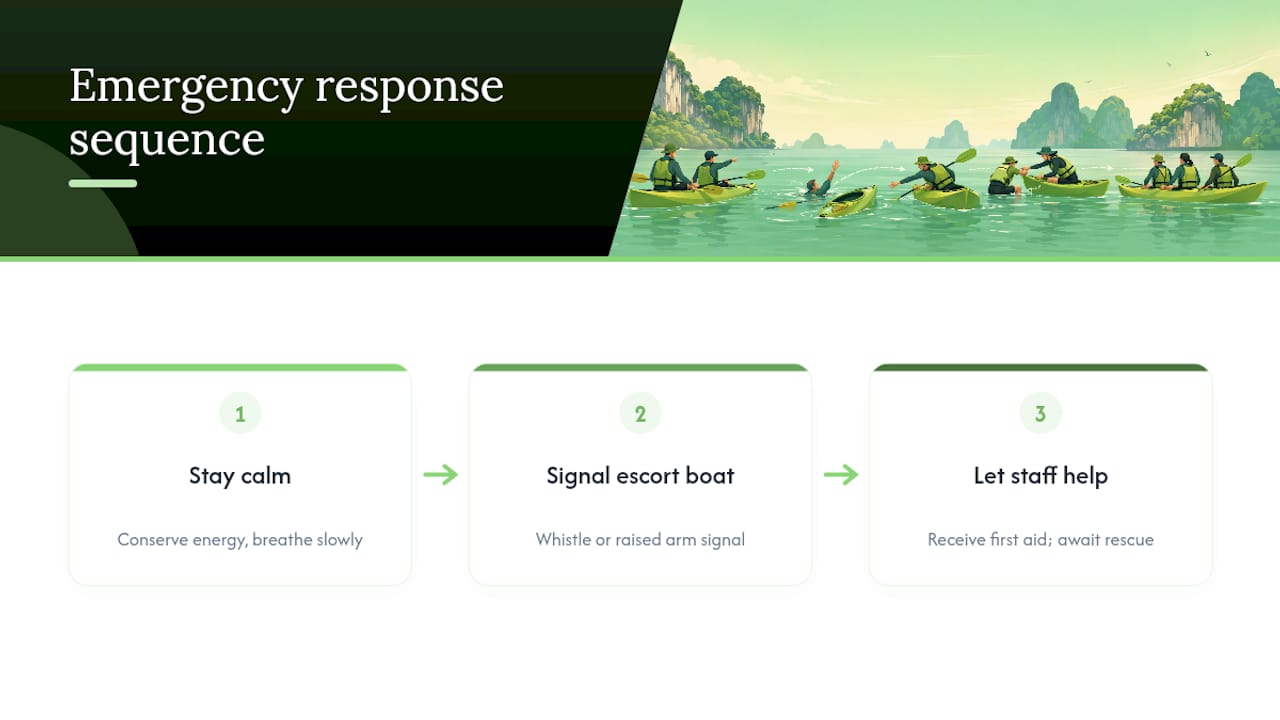
If something does go wrong, the basics apply: stay calm to conserve energy, signal the nearest escort boat rather than trying to self-rescue in open water, and let trained staff administer first aid while help arrives.
How does Qbic Travel approach kayak difficulty and safety?
Qbic Travel builds adventure experiences around what each guest actually wants from the day, rather than pushing everyone through one fixed itinerary. If you’d rather paddle yourself than sit back in a guide-paddled kayak, or you want a private group instead of a shared departure, that’s the kind of request worth raising directly when you book.
Qbic Travel reports a 4.5 rating from 237 reviews and highlights 99% issue-free service, verified by Trustindex, figures that reflect a track record of guests getting the trip they actually asked for. That focus on tailoring effort level, rather than treating kayaking as one-size-fits-all, is what separates a genuinely enjoyable outing from one that leaves you either bored or exhausted.
Balancing adventure and comfort on Phuket kayaks
Cave kayaking rewards travellers who don’t mind a bit of physical unpredictability, ducking low, paddling in dim light, trusting a guide’s hands on your hull for a few seconds. If that sounds unpleasant rather than thrilling, a guide-paddled inflatable trip gets you the same scenery without the squeeze.
Private self-paddle only earns its extra cost if you actually want the workout and the flexibility to dodge crowds at the hongs. Otherwise, save the money.
One seasonal note worth repeating: dry season, November to April, gives you the calmest water and the most reliable cave access. Monsoon swell has a habit of closing the best hongs just when you’d hoped to see them.
— Carl
Ready for a kayak day tailored to your comfort level?
This provider offers personalized tour options allowing guests to choose between an active self-paddle day or a relaxed, guide-paddled route, shaping trips around individual preferences rather than fixed departures.

With a 4.5 rating from 237 reviews and 99% issue-free service verified by Trustindex, Qbic Travel has a solid record of matching guests to the right pace of adventure. If cave kayaking sounds like too tight a squeeze but you still want time on Phuket’s water, browse our wider tour options and mention your preferred effort level when you enquire, gentle or active, we’ll tailor the day around it.
Where to check tides, itineraries and official guidance
For planning beyond this guide, the Tourism Authority of Thailand offers official safety and destination advisories. Operator pages like Andaman Sea Kayak show typical tide-aware itineraries, while first-hand cave kayaking trip reports set realistic expectations for the tight spots.
Sources
- Paddle Asia — Phuket Phang Nga private kayaking
- Phuket – Phang Nga Day Trip by Sea Canoe (Thailand) Co., Ltd.
- Thrilling cave kayaking in Phuket — BlondieAbroad
- John Gray’s Sea Canoe — TripAdvisor reviews


