
Avoid 10,000 Baht Fines: Phuket Jet Ski Distance Limits for Tourists
Tourists can legally jet-ski in Phuket, but only at five designated beaches, and only within set distance limits from shore. Common guidance suggests staying within 500 metres of shore, though Patong municipality applies specific zoning with swimming areas, approach buffers, and an outer limit for jet-skis defined by municipal buoys. Rental customers are usually exempt from Thailand’s licensing rules, but operators must still give a safety briefing, fit lifejackets, and confirm the craft is registered before you launch.
TL;DR:
- Most Phuket beaches restrict jet-skiing to designated zones marked by buoys, floats, and vendor flags, with local notices needing regular checking.
- The legal distance limits include a maximum of 1 nautical mile offshore and a minimum of 300 metres from shore unless actively landing or launching.
- Tourists renting from operators generally do not need a licence, but the vessel must be registered, insured, and operated by licensed vendors to avoid legal risks.
- Proper safety precautions such as safety briefings, fitted lifejackets, and adherence to buoy markers are mandatory for a safe ride.
- Guided jet-ski tours offer route planning that respects municipal limits, avoiding fines and reducing liability risks during the ride.
Table of Contents
- Which Phuket beaches allow jet-skiing?
- What are the exact distance limits from shore?
- Do you need a licence to jet-ski in Phuket?
- What safety rules should you expect from operators?
- How does Phuket enforce jet-ski rules on tourists?
- Your pre-ride and on-water checklist
- Carl’s take: why route planning beats winging it
- Book a jet-ski tour that already respects the limits
- Sources
- FAQ
Which Phuket beaches allow jet-skiing?
Jet-skiing in Phuket is not a free-for-all. It’s confined to a handful of beaches where local authorities have set up zoning, buoys, and vendor areas specifically for water sports. Five beaches commonly cited as approved spots are Patong, Karon, Kata, Kamala, and Bangtao, according to local travel guidance.
That said, rules on the ground can shift with the season or a local crackdown, so it’s always worth glancing at posted beach notices before you book. A sign that read one thing last dry season might read differently this year.
What actually marks the “designated area” on any given beach:
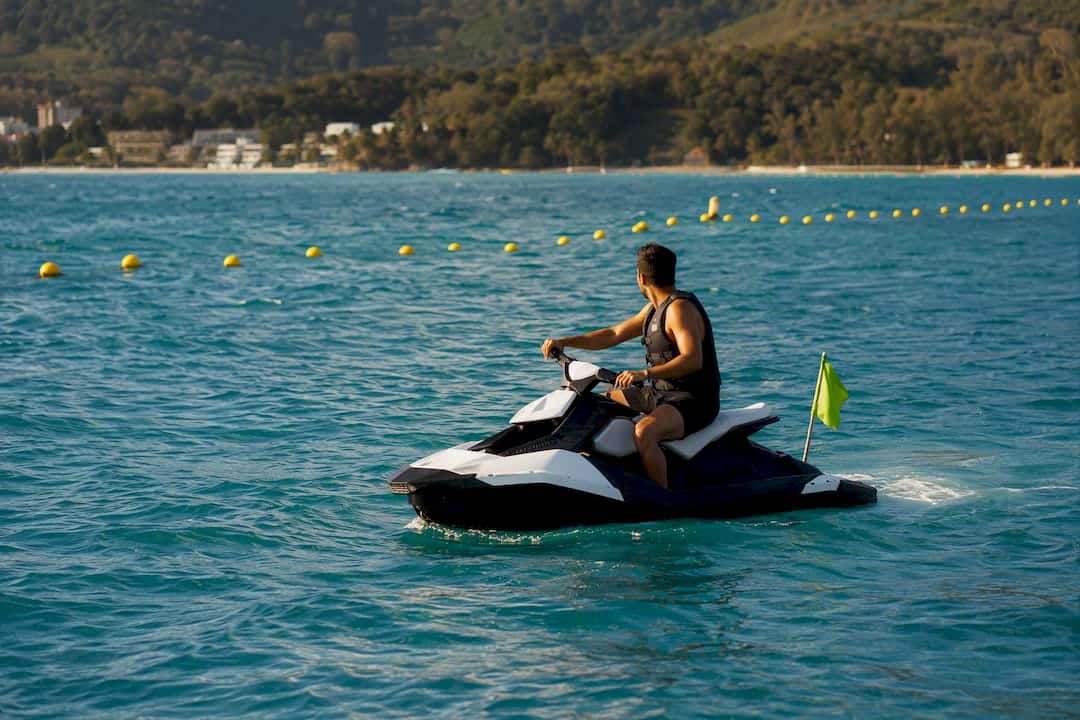
- Buoys and ropes set by the municipality or beach authority, separating swim zones from jet-ski lanes
- Floats marking the outer edge of swimming areas, which you must steer well clear of
- Vendor stalls and flags showing where jet-ski operators are licensed to launch from
Before you even climb on, ask your operator to physically point out the swim area, the jet-ski lane, and any buoys marking the offshore limit. A five-minute walk-through on the sand saves you from an awkward conversation with a marine police boat later.
What are the exact distance limits from shore?
The 500-metre guideline gets repeated across most Phuket travel advice, and it’s a sound rule of thumb for staying clear of marked swimming areas. But if you want the precise legal picture, Patong municipality’s rules are far more specific, and they’re the clearest benchmark for the whole island.
Pro Tip: Don’t treat “500 metres” as a single number that applies everywhere. It’s a general guideline, not a citywide statute. Municipal buoys on the day you ride are the actual law, and they can be tighter than 500 metres in places.
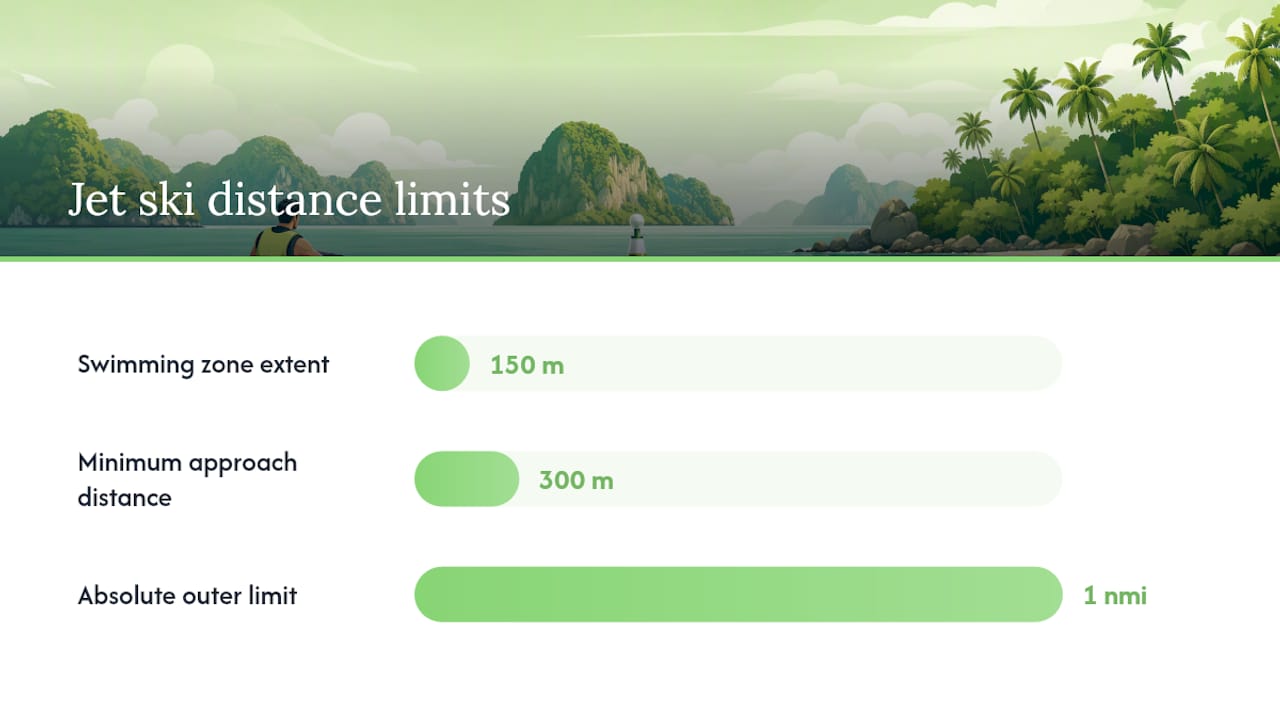
Patong set up three swimming zones, each 500 metres wide and extending 150 metres out from the beach, according to rules described by the governor and reported locally. Jet-skis that aren’t actively approaching or leaving the shore have to stay at least 300 metres out, and no jet-ski is permitted more than 1 nautical mile offshore.
Key numbers to remember: 150 m swimming zone extent, 300 m minimum approach distance for craft not landing or launching, 1 nautical mile absolute outer limit.
In practice, that means:
- Close to the beach, you’re either inside the 150-metre swim zone (off-limits to jet-skis) or crossing it briefly to launch and return
- Once you’re past the swim zone, you should hold at least 300 metres from shore unless you’re actively landing
- Red buoys typically mark the outer boundary, and treating that 1 nautical mile line as a hard stop, not a suggestion, is the safest approach
Currents shift with the monsoon season, and buoy positions can move slightly after storms, so a quick visual check against the shoreline each time you ride beats relying on memory from your last trip.
Do you need a licence to jet-ski in Phuket?
If you’re renting from a beach operator as a tourist, you generally don’t need a licence. Marine police have said tourists renting jet-skis are normally exempt from the Helmsman Class II licence requirement that applies to private owners and long-term operators.
That exemption doesn’t mean nobody’s accountable. The operator supplying the craft still needs the right paperwork, and riding with an unlicensed, unregistered vendor puts the legal risk back on you if something goes wrong.
Penalties for operating without a Helmsman Class II licence run up to 10,000 baht or six months’ imprisonment under Thai law, and that liability sits with whoever is legally responsible for the craft, which is usually the operator rather than a renting tourist. Still, worth confirming before you hand over cash:
- Visible vessel registration number on the jet-ski itself
- A licence or permit the operator can show you on request
- Some form of insurance confirmation covering the ride
If an operator gets vague or defensive about any of these, that’s your cue to walk to the next stall.
What safety rules should you expect from operators?
A proper jet-ski rental in Phuket comes with more than just keys and a life jacket thrown at you. Reputable operators run through a few things before you’re anywhere near the water.
- A safety briefing covering the controls, how to cut the engine in an emergency, and where the swim zones and buoys sit relative to your route
- Lifejackets fitted properly, not just handed over, and worn by every passenger for the whole ride, not just at launch
- Insurance confirmation, since resort towns like Pattaya have already moved toward mandatory group insurance for rental fleets, and Phuket operators are edging the same way
Pro Tip: Ask to see the lifejacket fitted correctly before you get on the craft, not after. A jacket that’s too loose is close to useless if you come off at speed.
Once you’re on the water, the same commonsense rules apply everywhere: keep your speed down near swimmers and other craft, never cut across a marked swim zone even to save time, and read the sea before you commit to a route. Choppy afternoon swells off Kamala or Bangtao during shoulder season aren’t the moment to test how far you can push the 300-metre buffer.
How does Phuket enforce jet-ski rules on tourists?
Enforcement isn’t theoretical. A 2026 crackdown saw officials fine 23 rental jet-ski operators 10,000 baht each for operating without the required licence, one of the clearest recent signals that Phuket’s marine police are actively checking paperwork, not just responding to complaints.
10,000 baht per operator was the fine handed down in that single 2026 sweep, applied to each of the 23 unlicensed operators caught.
Typical inspector actions in these sweeps include on-the-spot fines, temporary seizure of registration documents, and, in repeat cases, suspension of a vendor’s right to operate on that beach.
What this means for you as a renter:
- If your operator gets shut down mid-season, expect refund or rebooking hassle, not compensation as standard
- If an accident happens while riding with an unlicensed operator, your own liability position gets murkier, since insurance cover may not apply
- Sticking with a visibly registered, licensed operator isn’t just about avoiding a fine, it’s about who actually stands behind you if something goes wrong on the water
Your pre-ride and on-water checklist
A few minutes of checking before you ride saves a lot of hassle later, and most of it costs you nothing but time.
Before you get on the water:
- Ask to see the operator’s licence and the jet-ski’s registration number
- Take photos of the craft’s existing scratches or damage, timestamped on your phone
- Confirm insurance cover and get liability terms in writing, even a WhatsApp message counts
- Never hand over your original passport as a deposit; a photocopy or a cash deposit is standard practice elsewhere
Pro Tip: Precautions worth taking before any rental include photographing the craft and clarifying liability terms up front, exactly the two steps most tourists skip when they’re excited to get on the water.
While you’re riding:
- Follow the operator’s briefing to the letter, particularly on swim zone boundaries
- Keep your lifejacket on for the entire ride, not just the first five minutes
- Stay inside the marked zone and respect buoy positions, even if other riders are cutting corners
- Slow right down near swimmers, other craft, and the shoreline itself
If something does go wrong, document everything: photos, the other party’s contact details, and a request for a police or harbourmaster report before you agree to any on-the-spot cash settlement. Settling quietly on the beach rarely favours the tourist.
Carl’s take: why route planning beats winging it
Having watched enough riders bounce between beaches guessing where the swim zone ends, the pattern is consistent: the tourists who get fined or into trouble are almost never malicious, they’re just uninformed about where the invisible legal lines actually sit.
Guided routes solve this by design. A properly planned jet-ski route in Phuket is built around the municipal buoys, not despite them, so you’re never guessing whether you’ve drifted past the 300-metre mark. Guides also coordinate directly with beach markers rather than relying on memory from last month’s ride.
For anyone new to jet-skis, or planning a longer offshore stretch, that structure isn’t a limitation. It’s the difference between enjoying the ride and spending half of it worrying about a red buoy on the horizon.
— Carl
Book a jet-ski tour that already respects the limits
A guided tour service is a practical alternative to guessing your way through Phuket’s zoning rules on a solo rental. Every jet-ski tour ideally includes a full safety briefing, properly fitted lifejackets, and a route planned to stay inside local distance limits, so you’re not the one working out where a swim zone buoy sits relative to your position.

That planning matters most on longer routes, where drifting past a 300-metre buffer without noticing is easy if you’re navigating alone. Qbic Travel’s guides handle that navigation for you, whether you’re after a shorter coastal run or a full 8-island jet-ski tour that covers more ground in a single trip. First-timers particularly benefit from the structure; there’s a reason safety tips for first-time riders come up so often in Phuket travel forums.
If you’d rather ride knowing the legal groundwork is already sorted, check available dates on the jet-ski tours page or look at the Seadoo GTX 8-point jet-ski tour for a specific booking option.
Sources
For the latest details, see The Thaiger on Patong’s zoning and The Phuket News on 2026 enforcement. Always check beach notices on the day, too.
- Phuket jet-skis get green light | The Thaiger
- Phuket jet-ski crackdown nets 23 offenders, each fined B10,000 | The Phuket News
- Jet Skis on Phuket Thailand | Discovery Thailand
- Precautions when renting a jet ski in Phuket | Phuket Insider
FAQ
How far can you travel on a jet ski in Phuket?
Most guidance points to staying within 500 metres of shore, though Patong’s own rules set a 1 nautical mile outer limit with a 300-metre minimum distance for craft not actively landing or launching.
Can you jet-ski in Phuket?
Yes, but only at designated beaches, currently Patong, Karon, Kata, Kamala, and Bangtao, and only within marked swim zones and municipal distance limits.
Do you need a licence to drive a jet-ski in Thailand?
Private owners need a Helmsman Class II licence, but tourists renting from a beach operator are normally exempt, according to Phuket marine police statements.
How far offshore can you legally go on a jet ski in Phuket?
Patong’s rules cap jet-skis at 1 nautical mile offshore, with a 300-metre minimum distance from shore outside of launching and landing.
What happens if you’re caught breaking jet-ski distance limits?
Operators risk fines up to 10,000 baht or six months’ imprisonment for licensing breaches, and enforcement sweeps have already fined 23 unlicensed operators in a single 2026 crackdown.


