
Phuket Tides for Tours: How to Plan Your Trip Around the Water
Tides matter in Phuket, but not as much as most visitors fear. They decide when a reef is easy to swim over and when a sea cave opens for kayaks. Wind, waves and season decide whether a trip runs at all. The simple approach is to book a tour where the route is planned around the water for you. Our team at Qbic Travel Phuket builds island, jet ski and boat days with hotel pick-up and flexible last-minute booking, so you can pick a day on the forecast rather than guess weeks ahead.
TL;DR
- Phuket has two high and two low tides a day. The gap between high and low can reach about 2.5 to 2.6 metres around new and full moon, according to Window on Phuket.
- For snorkelling, mid to high tide is usually more comfortable, and mornings are calmer, as Phuket 101 explains.
- Tide tables are predictions. Wind and air pressure can shift the real water level, so check the sea on the day.
- November to April is the calmest season. May to October brings monsoon swell to the west coast.
- Check the marine forecast the night before and the morning of your tour.
Table of Contents
- What tides actually do on a Phuket tour
- How to read a Phuket tide table
- Snorkelling and tides: when to get in the water
- Tides and the different tour types
- Season beats tide: the bigger picture
- A simple checklist for the day before and the morning of
- What to check before you book
- Ready to pick your day?
- FAQ
- Sources
What tides actually do on a Phuket tour
Phuket has a regular tide cycle called semidiurnal: two high waters and two low waters in each lunar day. The Royal Thai Navy Hydrographic Department publishes the official predictions in its 2026 Tide Tables, using Ko Taphao Noi in Phuket as the reference station.
For a visitor, that means three practical things:
- Depth over reefs and sandbars. At low water, shallow reef flats and beach entries get awkward. At higher water you have more room to float.
- Access to caves and lagoons. Some of the kayak routes in Phang Nga Bay are only passable at certain heights. We cover this in our guide to Phang Nga Bay kayaking and the tides.
- Boat handling at piers and beaches. Low water can change where a boat can safely come in, so operators adjust the stop order.
Spring tides (around new and full moon) give the biggest range. Quarter moons give smaller neap tides. If your trip falls on a spring tide, expect the water to move more and the timing of caves, sandbars and shallow reefs to matter more.
How to read a Phuket tide table
A tide table lists the time and height of each high and low water. Heights are measured in metres above chart datum, the lowest level used as the zero line on charts. The Navy’s tables give heights at the start of each Thailand Standard Time hour.
A typical Thai tide-table example from ThaiAngler lists four events in one day: a high of 2.7 m in the early morning, a low of 0.3 m mid-morning, a second high of 2.5 m in the afternoon and a low of 0.5 m at night. That is the standard rhythm: roughly six hours between a high and the next low.
A worked example for reading one day, using Tide-Forecast’s Phuket table for Saturday 21 November 2026:
| Time | Event | Height |
|---|---|---|
| 2:19 am | Low | 0.48 m |
| 8:15 am | High | 1.29 m |
| 2:25 pm | Low | 0.25 m |
| 8:57 pm | High | 1.52 m |
That day’s range is only about 1 metre, a gentle neap-style day, and the next spring high of 1.84 m was listed for Thursday 26 November. Different tables use different reference points and heights, so compare times and range rather than treating one number as universal. A morning tour that day would meet rising water from about 2:30 am until the 8:15 am high, with the next low in the afternoon.
Why the table is a prediction, not a promise
The Navy itself notes that predicted times and heights are not forecasts of current conditions. Onshore wind or low pressure usually pushes water levels above prediction, while offshore wind or high pressure lowers them. In narrow channels, the delay between high or low water and the moment the current turns can be considerable, so tide time is not the same as slack current.
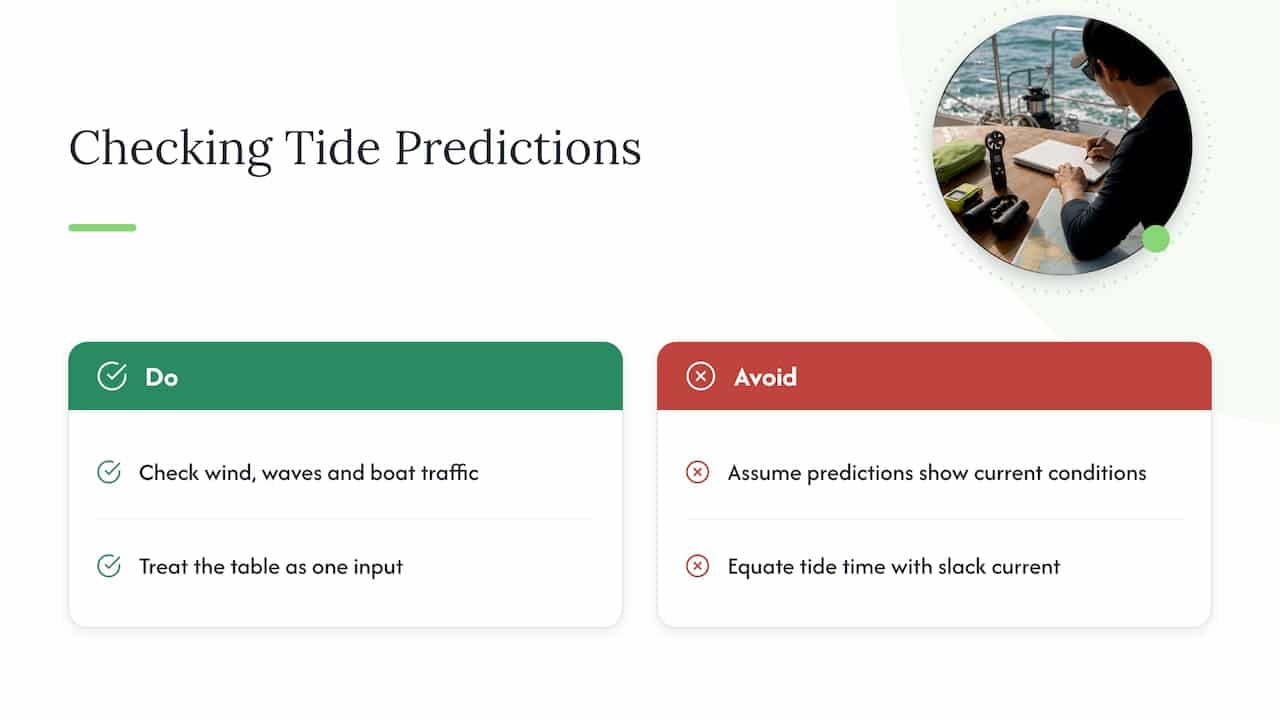
In practice, treat the table as one input next to wind, waves and boat traffic. That is exactly what a good skipper does before choosing a route.
Snorkelling and tides: when to get in the water
For shore snorkelling, Phuket 101 recommends mid to high tide, when water covers the reef and you are less likely to stand on coral or urchins. It also advises going in the morning, since afternoon wind can make west-coast water choppy.
A few more points that families especially appreciate:
- High tide is not automatically best. Beach shape and sea state matter, so a calm half-tide can beat a rough high tide.
- Visibility follows the season. November to April gives the calmest months and visibility often of 10 m or more.
- Monsoon months change the map. From May to October most west-coast snorkelling is unsafe. Paradise Beach, which faces north-east, is the year-round exception.
- Red flags mean no swimming, and that includes snorkelling.
For a month-by-month view, see our guide to Phuket snorkelling conditions from December to March.
Reef rules to know
Under Thai rules in force from 22 April 2025, snorkellers must wear life jackets near coral reefs unless they hold a valid freediving certification, and snorkelling is allowed only where at least 2 m of water covers the coral, according to this travel guide. That 2 m rule is another reason tide height matters: on a very low tide, a shallow reef stop may be skipped or swapped. Wear reef-safe sunscreen and bring your life jacket habit with you. Our packing list and reef rules covers the rest.
Tides and the different tour types
Island tours: Phi Phi, James Bond Island, Raya and Coral
Speedboat day trips are planned around sea state first and tide second. Stops such as beaches and lagoons are timed so you arrive when landing and swimming are comfortable. Our island tours in Phuket run with hotel pick-up, and our private options let you set the pace, which helps when you want a longer swim at a good-tide stop. See private boat tours in Phuket.
Kayaking and sea caves
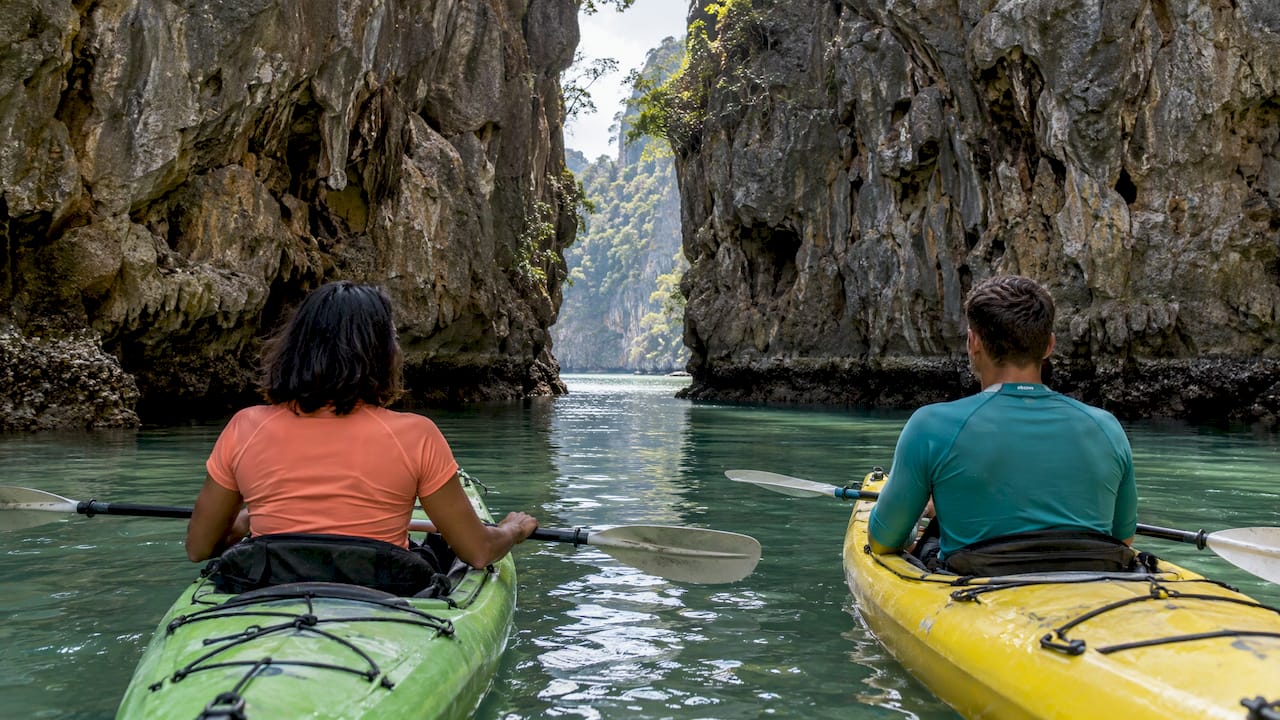
Kayak routes are the most tide-sensitive. Caves and hongs (hidden lagoons inside limestone islands) can be open at one height and closed at another, and currents turn later than the tide itself. Match your fitness to the route using our guide to kayak routes, tides and tour type.
Jet ski tours
Jet skis need enough water to leave and return to the beach safely, and they are more affected by wind chop than by tide height. A calm morning is usually the most comfortable slot. Before you ride, read our jet ski tour checklist, and see our jet ski tours.
ATV and off-road
ATV adventures run inland, so tides do not affect them. They are a handy backup for a day when the sea is not at its best. See ATV tours in Phuket.
Season beats tide: the bigger picture
If you only check one thing, check the season. November to April is the calm window on the west coast. May to October brings monsoon waves, and operators may change routes, delay departures or move to sheltered sides of the islands. The sea matters more than the sky: clear weather onshore does not guarantee calm water offshore.
We explain how to read the forecast in Phuket weather for boat trips, and what happens when weather hits in our boat rain plan. A rescheduled tour beats an unsafe one, so ask about postponement and refund terms before you pay.
It also helps to stay online at sea level before departure. A data eSIM makes checking forecasts easy, as in this guide to staying online in Thailand.
A simple checklist for the day before and the morning of
- Check the Thai Meteorological Department marine forecast the night before and again that morning.
- Look at the tide table for your date and note the high and low times.
- Pick the morning where you can, for calmer water.
- Confirm your pick-up time and what the plan is if the sea is rough.
- Make sure your insurance covers boat trips and snorkelling.
- Save 1669 for medical emergencies and 1155 for the Tourist Police.
If you are travelling while pregnant, read our guide to a pregnancy boat tour in Phuket and speak to your doctor before booking.
What to check before you book
Tide knowledge helps, but a well-run itinerary does the heavy lifting. Look at what the price includes, such as transfers, life jackets, snorkel gear and lunch. Our list of boat tour inclusions to check shows what to compare.
Our view on tides and tours
We plan Qbic Travel Phuket days around the sea, not just the calendar. Our focus is adventure and cultural tours: jet skis, ATVs, island boat trips, snorkelling, kayaking and sunset or bioluminescent outings. The best days are the ones where timing, weather and route all line up.
That is why we offer hotel pick-up and flexible last-minute booking. You can look at the forecast two or three days out, choose the calmest slot and book it, instead of locking in a date weeks before and hoping.
Our site shows a 99% issue-free service rate verified by Trustindex and a 4.5 rating from 237 reviews. Guests tell us what they value most: clear plans, helpful staff and a day that fits the conditions.
Carl
Ready to pick your day?
We run island tours, private and group boat excursions, jet ski and ATV adventures, snorkelling and diving packages from Phuket, with online or WhatsApp booking. Browse island tours in Phuket or see everything on our tours page. Published prices include a Jet Ski Transfer Service at 1,500 THB, a Tour Guide at 3,000 THB and an MV Phuket Champagne cruise from 3,500 to 4,800 THB, all on our services page.

FAQ
What is the best tide for snorkelling in Phuket?
Mid to high tide is usually the most comfortable, because water covers the reef and you are less likely to touch coral. High tide is not always best, though, since beach shape and sea state also count. Morning is generally calmer on the west coast.
How big are the tides in Phuket?
The difference between high and low water can reach about 2.5 to 2.6 metres around new and full moon. On quarter-moon days the range is smaller. The Navy’s tables use Ko Taphao Noi as the Phuket reference.
Do tides cancel tours in Phuket?
Rarely on their own. Weather, wind and swell are the usual reasons for changing a route or rescheduling. Tides more often change the order of stops or the timing of kayak caves.
When is the calmest time of year for island tours?
November to April is the calmest period, with the best visibility. May to October brings monsoon swell, so routes may shift to more sheltered spots.
Sources
- Royal Thai Navy Hydrographic Department, Tide Tables 2026
- Phuket Tide Times and Tide Tables 2026, Window on Phuket
- Reading Thai Tide Tables, ThaiAngler
- Tide Times and Tide Chart for Phuket
- Best Snorkelling Beaches in Phuket 2026, Phuket 101
- Taking Island Tours in Thailand? What Tourists Must Know
- Staying online in Thailand, winter sun escapes


