
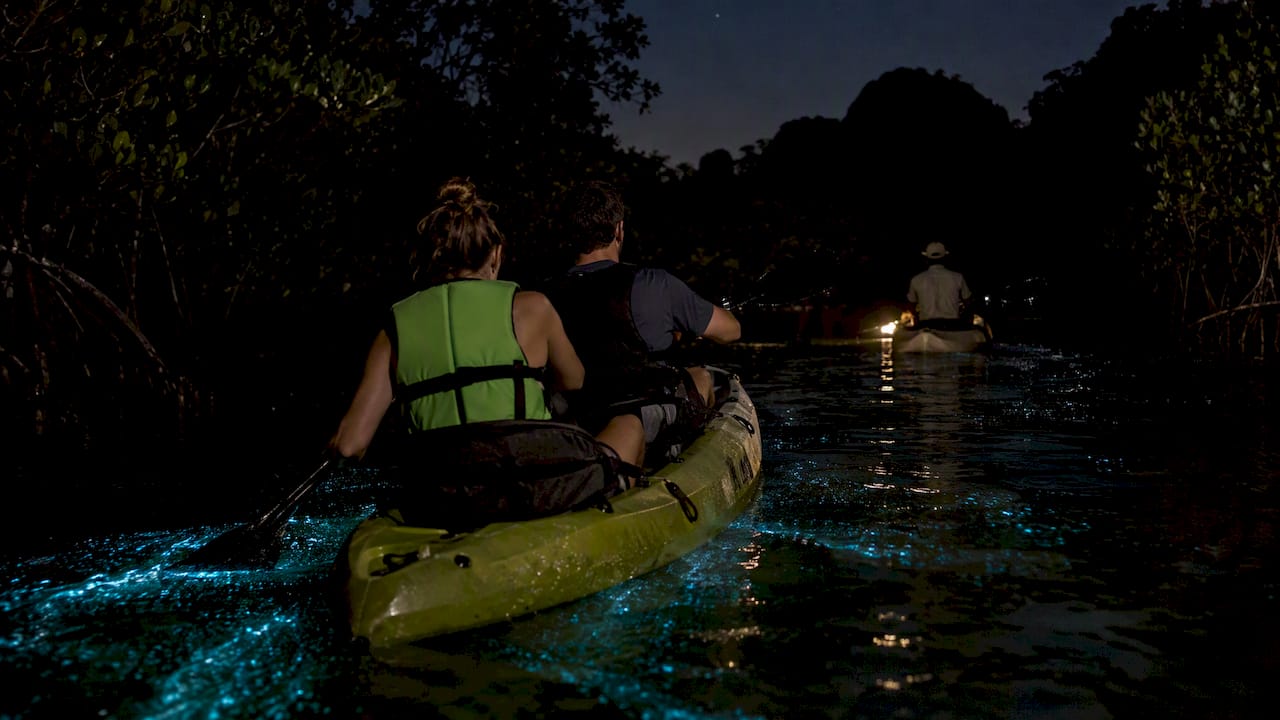
New Moon Nights (±3 Days): Best Moon Phase for Bioluminescence Tours
For the best unaided view of bioluminescence, pick new moon nights, typically new moon plus or minus three days, when the sky is darkest and faint blue flashes stand out clearly. Full moons do not stop the glow, they just wash out your perception of it. Before you lock in a date, always check moonrise and moonset for your actual tour hours, because a moon sitting below the horizon has no effect at all, whatever the phase.
TL;DR:
- Bioluminescence is most visible during new moon nights, especially within three days of the new moon, when sky darkness provides optimal contrast.
- The actual visibility depends heavily on moonrise and moonset times during your tour, not just the moon phase, making local timing crucial.
- Calm, sheltered waters with low wind and recent bloom activity offer the best conditions, regardless of moon phase or weather, for a strong bioluminescent display.
- Bioluminescent organisms can naturally vary in brightness due to circadian clocks and environmental factors such as salinity and temperature.
- Guided tours that check real-time conditions and prioritize sheltered locations consistently outperform self-planned trips relying solely on calendar dates.
Table of Contents
- How moon phases change what our eyes see
- Picking dates with a new-moon calendar and illumination percentages
- Why moonrise and moonset timing can beat phase alone
- Weather, tides and bloom dynamics that outweigh the calendar
- Your night-of checklist for a safe, low-impact trip
- On-the-water lessons that sharpen moon-phase planning
- What actually matters most on the night
- Book a guided trip for a reliable night out
- FAQ
- Sources
- Useful links for checking moon phases and the science
How moon phases change what our eyes see
Bioluminescence is a contrast problem, not an output problem. The light that dinoflagellates and other glowing plankton produce when disturbed by a paddle, a fin or a boat wake stays roughly the same regardless of the moon. What changes is how much competing light is in the sky. A full moon floods the water’s surface with enough brightness that the eye simply cannot pick out faint flashes, while a new moon leaves the sky dark enough for even weak glow to register.
There is a biological layer too. Many dinoflagellate species run on an internal circadian clock that makes them naturally brighter after dark, and exposure to ambient light can suppress that glow response, a process researchers call photoinhibition, as described in a review of dinoflagellate bioluminescence. In other words, moonlight does not just mask the glow for our eyes, it can genuinely dampen how brightly some organisms light up in the first place.
Species composition matters on top of that. Some glowing organisms keep flashing reasonably well even under moderate ambient light, while others fade sharply once any light appears.
- Contrast effect: a darker sky lets faint flashes stand out, regardless of how bright the organisms actually are.
- Circadian rhythm: many dinoflagellates are biologically primed to glow more at night.
- Photoinhibition: light exposure can suppress the glow response in several species.
- Local species mix: some sites keep a visible glow even on brighter nights, others do not.
Circadian control and photoinhibition are well documented across dinoflagellate species, according to the PMC review on diurnal bioluminescence patterns, which means the calendar date matters for biology as well as for how much moonlight is in the sky.
Picking dates with a new-moon calendar and illumination percentages
Start by marking new moon plus or minus three days on your travel calendar. This window is the one most bioluminescence operators and calendars rely on, because lunar illumination drops low enough during these nights to give strong contrast without you needing a professional dark-sky site, a method echoed in guidance on moon phases and the bioluminescent experience.
Moon illumination percentages, usually shown on lunar calendar apps, tell you how much of the moon’s visible disc is lit. Skies with low moon illumination are typically dark enough for a strong display; with brighter illumination, contrast drops noticeably even before moonrise.
- Mark your new-moon window first, three days either side of the exact new moon date.
- Check illumination percentage for each candidate night rather than relying on the phase name alone.
- Shortlist two or three nights during your stay so a single cloudy or windy evening does not sink your whole trip.
- Cross-check tour availability against your shortlist before booking, since popular slots near new moon fill quickly.
Pro Tip: Treat the moon calendar as a first filter, not a guarantee: a dark sky with no plankton activity still beats a bright sky with plenty of it.
Why moonrise and moonset timing can beat phase alone
A quarter moon that sets at 9 PM can give you a darker tour than a true new moon night if your boat does not launch until 9:30 PM. What matters for visibility is the moon’s position in the sky during your actual time on the water, not the phase label on the calendar.
- Check moon altitude, not just phase, using any free lunar calendar or stargazing app for your tour’s exact location and start time.
- A moon below the horizon during your tour window has no practical effect on visibility, even during a full moon.
- A waxing or waning quarter moon that rises late or sets early can outperform a new moon night that overlaps with a bright moonrise later on.
- Always confirm local moonrise and moonset times for the specific night and coastline you will be on, since these shift with latitude and date.
Weather, tides and bloom dynamics that outweigh the calendar
Cloud cover cuts both ways. A thick overcast sky blocks moonlight and can help on a brighter night, but clouds often arrive with wind and choppier water, and that movement disperses the very blooms you came to see. A calm, overcast night beats a clear, calm one for contrast, but a windy overcast night rarely beats a calm, moonlit one.
Sheltered, shallow water almost always outperforms open coastline, because wind and currents break up and scatter surface blooms quickly. Bloom strength is also simply unpredictable from night to night. A dense daytime red tide, that rusty or coppery discolouration on the water’s surface, can be a useful sign that bioluminescent organisms are present in strength, though it is never a guarantee of a strong glow after dark, a pattern described in guidance on Japan’s glowing sea sparkle phenomenon.
- Calm, sheltered water concentrates blooms near the surface where they are easiest to see.
- Wind and choppy seas disperse plankton and cut visibility fast, regardless of moon phase.
- A daytime red tide can hint at a strong night display but is not a promise of one.
- Salinity and water temperature shift bloom intensity and persistence across sites and seasons.
Salinity, temperature and water movement measurably affect bioluminescence intensity at the cellular level, per research on environmental drivers of dinoflagellate glow, which explains why some sites only glow reliably in certain seasons.
Your night-of checklist for a safe, low-impact trip
Run through this list the afternoon of your tour, not just when you book it.
- Confirm moon timing for your actual tour window, not just the general phase for that week.
- Check the weather and wind forecast, since a calm overcast evening often beats a clear, breezy one.
- Get operator confirmation on the day, as reputable tours reschedule or cancel when conditions turn poor.
- Wear grippy, closed footwear and your lifejacket for any boat-based or rocky shoreline viewing.
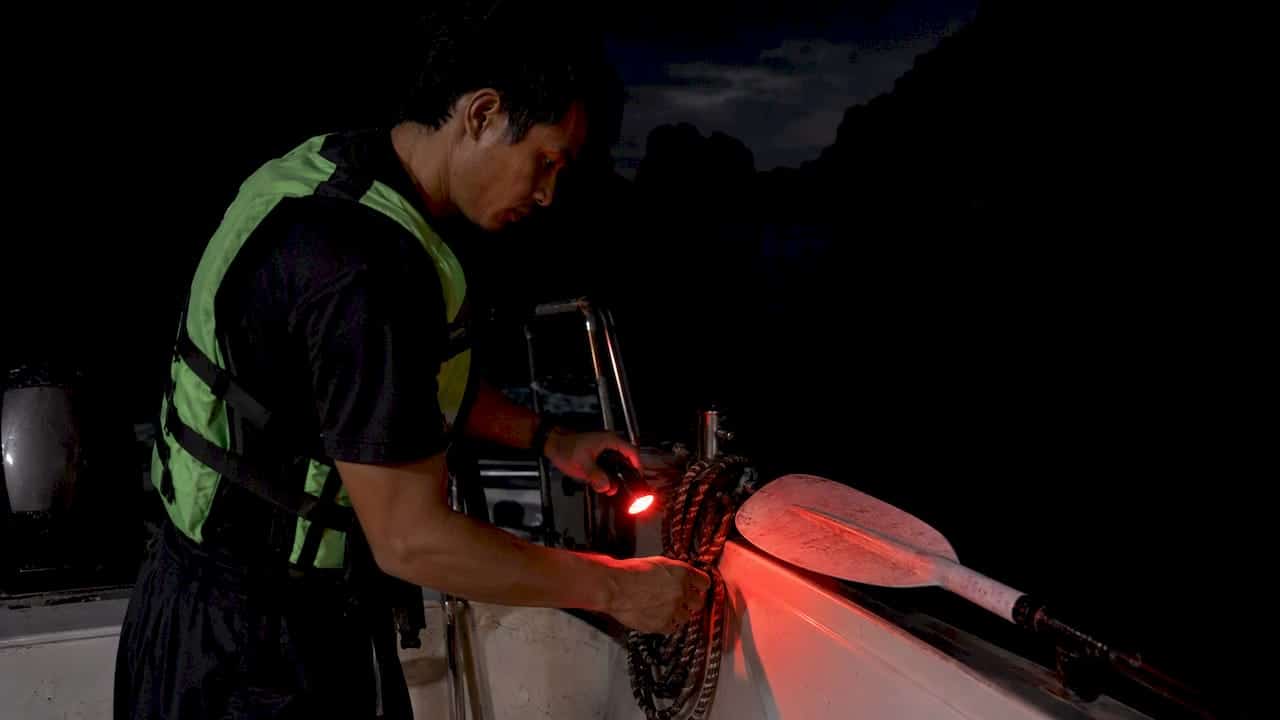
- Bring a red-filter torch for safety only, since white light will wash out the glow for everyone nearby.
Avoid swimming in thick, discoloured blooms, since dense red tides can sometimes carry skin or respiratory irritants, and it is worth rinsing exposed skin afterwards and following any local advisories. Keep white lights off once you are near the water, stay reasonably quiet, never scoop up or collect the organisms, and respect any rules your operator or local authority sets for the site.
Pro Tip: If you only remember one thing, remember this: a red light preserves your night vision and keeps the display visible for everyone on the boat, a white light kills it instantly.
On-the-water lessons that sharpen moon-phase planning
Years of running night tours around sheltered lagoons and bays have taught us that location often matters as much as the date on the calendar. Enclosed, shallow lagoons consistently outperform open, exposed beaches, because calm water holds blooms in place rather than scattering them with every gust, a pattern we lay out in more detail on our page about where to see bioluminescence near Phuket.
Before confirming any night departure, we check:
- Local wind forecasts for the hours of the tour, not just the general daily outlook.
- Recent daylight sightings of discoloured water as a working clue, never a guarantee.
- Tide windows and boat access, since some lagoons are only reachable at certain tide heights.
When wind, tide or recent conditions do not line up, we postpone rather than run a weak trip, a trade-off we cover further in our comparison of Phang Nga lagoons against open Krabi beaches.
What actually matters most on the night
If I had to prioritise one thing over the calendar, it would be moonrise and moonset timing against sheltered water, not chasing an exact new moon date. A quarter moon that sets early in calm water beats a new moon fighting choppy seas every time. Check conditions on the day, not just the week before.
— Carl
Book a guided trip for a reliable night out
Chasing the right moon window, wind forecast and tide height on your own takes time most holidaymakers simply do not have, and that is where a guided trip earns its keep. We run real-time checks on wind, tides and recent sightings before every departure, so you are not relying on a calendar app alone to judge whether a night is worth going out for.

Our bioluminescent plankton tours in Phang Nga Bay are built around sheltered waters that hold their glow better than open coastline, with safety gear and local knowledge included. Browse the full line-up on our tours page to find a night that fits your stay.
- Guided safety gear and local knowledge come included on every departure.
- Real-time condition checks on wind, tide and recent sightings before each trip.
- Sheltered-water routes chosen specifically for stronger, steadier glow.
FAQ
What moon phase is best for a bioluminescent bay?
New moon nights, roughly three days either side of the exact new moon, give the darkest skies and the strongest contrast for spotting bioluminescence, a window used by most bioluminescence moon calendars. Always pair this with a check on moonrise and moonset for your specific tour time.
Can you still see bioluminescence with a full moon?
Yes, bioluminescence is still produced during a full moon, it is simply harder to see because the brighter sky reduces contrast. If the moon sets or rises outside your tour window, a full moon night can still work well.
How do I know when there will be bioluminescence?
No calendar can guarantee a display, since bloom strength depends on species, temperature, salinity and recent weather as much as the moon, as noted in research on environmental drivers of bioluminescence. A daytime red tide and a recent operator sighting are the most useful practical clues.
How often does bioluminescence occur?
Bioluminescent organisms are present in many coastal waters year round, but visible blooms strong enough to see clearly come and go with water temperature, nutrients and calm conditions. Checking with a local operator close to your travel date gives a far more reliable answer than any fixed schedule.
Sources
- Diurnal variations of dinoflagellate bioluminescence with implications for lunar influence
- Moon phases and the bioluminescent experience
- What is sea sparkle? Why Japan’s ocean glows blue
- Effects of salinity and environmental factors on dinoflagellate bioluminescence (2024)
Useful links for checking moon phases and the science
For planning, a lunar calendar app or site showing moonrise, moonset and illumination percentage for your exact location is the quickest way to shortlist dates, alongside guidance from moon phases and the bioluminescent experience. For the biology behind the glow, the PMC review on dinoflagellate circadian rhythms and research on salinity and bioluminescence intensity are solid starting points, and nocturnal photographers may find this guide to light quality in landscape images useful for capturing the glow itself.


