

Where to see bioluminescence near Phuket
Phang Nga Bay is your best bet for seeing bioluminescence near Phuket, and the sheltered lagoons around Hong Island and Koh Panak deliver the most consistent glow you’ll find in the region. The most reliable way to see it is a guided night sea-canoe or kayak tour timed to arrive after sunset, when the sky is fully dark and your eyes have had a chance to adjust. Book a trip that specifically schedules its paddling window after full twilight, not one that squeezes it in at dusk while there’s still light in the sky. Operators such as Qbic Travel run exactly this kind of day-to-night itinerary through Phang Nga Bay, and it’s worth checking that any tour you book follows the same sequence before you hand over a deposit.
Key Takeaways
Seeing genuine bioluminescence near Phuket comes down to choosing Phang Nga Bay, timing your trip around dark moon phases, and booking a guided night canoe or kayak tour rather than a daytime excursion.
| Point | Details |
|---|---|
| Where to go | Phang Nga Bay, especially Hong Island lagoons and Koh Panak’s caves, offers the most reliable viewing near Phuket. |
| When to go | Choose nights near the new moon with calm, clear water for the strongest possible glow. |
| How to go | Book a guided night sea-canoe or kayak tour that paddles after full twilight, not at dusk. |
| Manage expectations | The glow is usually subtle and rarely photographs well on a phone; sightings are never guaranteed. |
| Book locally | Qbic Travel runs day-to-night Phang Nga Bay itineraries with hotel pickup, lifejackets and safety briefings included. |
Table of Contents
- Bioluminescence Phuket: where to see it and how reliable each spot is
- When is the best time to see glowing plankton near Phuket?
- What a typical bioluminescence tour from Phuket looks like
- What to actually expect, and how to see it responsibly
- Planning and booking: what to bring and what it costs
- How to spot a reputable local operator
- An insider’s view on getting the timing right
- Book your night bioluminescence trip with Qbic Travel
- Sources
Bioluminescence Phuket: where to see it and how reliable each spot is
If you’re searching for bioluminescence in Phuket, where to see it comes down to one simple rule: darker and calmer beats open and exposed, every time. The plankton responsible for the glow are dinoflagellates that emit blue-green light when physically disturbed, whether by a paddle, a fish, or your hand trailing through the water, and that reaction shows up far more clearly in still, black water than anywhere near ambient light or chop.
Here’s how the main spots near Phuket stack up.
- Hong Island lagoons (Phang Nga Bay): the enclosed lagoons here are shielded from wind and swell, which keeps plankton concentrated and the water glassy. This is the most frequently recommended bioluminescent plankton site near Phuket.
- Koh Panak caves and interior lagoons: the caves are pitch dark even on a bright night, so this is often where guides head when the moon is working against them.
- Panak Island’s sheltered coves: similar profile to Koh Panak, good as a backup stop within the same bay.
- Racha Islands and open beaches: these see far more boat traffic, ambient light, and wave action, so the glow here is inconsistent at best.
| Location | Why it’s good | Reliability | Best for |
|---|---|---|---|
| Hong Island lagoons | Enclosed, calm, shielded from wind | High | First-time viewers wanting the classic experience |
| Koh Panak caves | Total darkness even under moonlight | High | Nights close to a full moon |
| Panak Island coves | Sheltered, low boat traffic | Medium to high | A secondary stop on the same route |
| Racha Islands / open beaches | Exposed to wind, swell and light | Low | Not recommended for a dedicated glow trip |
One practical note before you book anything: confirm your tour’s actual meeting point against a map rather than trusting the island name alone. Phang Nga Bay is a large area, and transfer times from your hotel can shift by an hour or more depending on which pier the boat departs from. Checking the bay’s coordinates against your pickup location takes two minutes and saves a lot of confusion on the day.
When is the best time to see glowing plankton near Phuket?
Aim for the darkest nights of the month and calm, clear water, and you’ll dramatically improve your odds of a strong sighting. Bioluminescence is a natural phenomenon, not a switch someone flips on, so timing matters more here than on almost any other Phuket excursion.
A few conditions decide whether your night turns out epic or underwhelming:
- Moon phase: new moon or the days either side of it give you the darkest sky and the strongest contrast for the glow. A full moon washes it out almost completely.
- Time of night: wait until full twilight has passed, roughly 45 to 60 minutes after sunset in Phuket. Paddling out too early, while the sky still holds light, is one of the most common reasons people say they “didn’t really see it.”
- Weather and sea state: flat, calm water with no wind chop lets the light show without being scattered or diluted.
- Artificial light: boat lights, phone torches, and even nearby resort glow all reduce what your eyes can pick up. Visibility genuinely varies night to night, and even seasoned guides can’t promise a big show every trip.
Pro Tip: Give your eyes at least ten minutes in total darkness before judging the display. Human night vision takes time to kick in properly, and switching on a white light resets that adaptation instantly, so resist the urge to check your phone the moment you’re in the canoe.
What a typical bioluminescence tour from Phuket looks like
Most trips near Phuket run as a day-to-night combination: pickup from your hotel in the early to mid-afternoon, daytime sightseeing around the bay, dinner around sunset, then a night paddle once darkness has properly set in. You’re not booking a quick after-dark dash out and back. You’re booking a full afternoon and evening built around getting you into the water at exactly the right moment.
Formats vary depending on group size and how much flexibility you want.
A sample night runs roughly like this: hotel pickup, speedboat transfer into Phang Nga Bay, an afternoon of sightseeing at limestone karsts or floating villages, dinner as the sun goes down, then a switch to sea canoes or kayaks once it’s genuinely dark, paddled quietly into a lagoon or cave. Total time including transfers commonly runs 5 to 8 hours or more, so treat this as an evening commitment rather than a quick add-on to your day. Hotel pickup, lifejackets, a guide, and dinner are standard inclusions on nearly every version of this trip.
What to actually expect, and how to see it responsibly
The glow is usually subtle rather than spectacular to the naked eye. It shows up as sparks and streaks around your paddle or hand, brighter the darker and stiller the water, and it’s genuinely difficult to capture on a phone camera. Manage that expectation before you go, and you’ll enjoy the experience far more than someone chasing a photo that phones simply aren’t built to take.
Here’s what to expect on the water, safety wise and etiquette wise:
- Visitor experience: small sparks when you move your hand or paddle, occasionally a broader glowing streak in calmer, darker spots like caves.
- Safety steps: lifejackets are standard, guides run a safety briefing before you get in the water, and it’s worth taking motion sickness precautions if you’re prone to it, since the transfer out can involve some open-water time.
- Conservation etiquette: no white lights near the water, nothing poured or sprayed into the lagoon, and minimal splashing so you’re not stressing the plankton or disturbing the habitat unnecessarily.
Pro Tip: Use slow, gentle paddle strokes rather than fast splashy ones. You’ll trigger just as much glow, disturb far less of the ecosystem, and the guide will thank you for keeping the group calm and quiet, which matters more here than on almost any other tour.
Planning and booking: what to bring and what it costs
Expect a long afternoon-to-evening trip, typically five to eight hours or more once transfers are included, and treat cost as something that varies by format rather than a fixed number. Shared group tours run cheaper than private charters, and a full-day combo naturally costs more than a shorter evening-only option. Always ask the operator directly what’s included in the price and exactly how long the day runs before you commit.
Pack light but pack smart: comfortable clothing you don’t mind getting damp, a towel, a full change of clothes for the ride home, and motion sickness tablets if you’re at all prone to it. Bring a torch with a red filter if you have one, or simply disable the white LED on your phone, since red light preserves night vision far better than white. On cameras: leave the expectation at the door. Phones struggle badly with bioluminescence because the light is faint and constantly moving, and even a proper camera generally needs a long exposure and a stable base, which isn’t practical from a moving canoe. Go to enjoy it with your eyes, not through a screen.
Before you book, ask the operator a few direct questions:
- What’s the maximum group size on this trip?
- Where exactly is the meeting point, and how far is it from my hotel?
- What’s the policy if visibility is poor on the night, is there a reschedule option?
- Are lifejackets provided and mandatory for the paddling section?
- What happens if we don’t see much glow, is that factored into expectations upfront?
How to spot a reputable local operator
Reputable operators near Phuket structure their timing around sunset and darkness deliberately, not by accident, and that single design choice is the clearest signal you’re dealing with people who know what they’re doing. A well-run trip won’t rush the paddling segment in at dusk just to tick a box on the itinerary.
Look for these signals before you hand over any money:
- A clear written itinerary that states the meeting point, pickup time, and total trip duration upfront.
- Small group sizes or a genuine private option, rather than cramming as many people as possible into one boat.
- Visible safety measures: lifejackets on board, a proper briefing before you enter the water.
- Verified reviews on an independent booking platform, not just testimonials on the operator’s own site.
A well-timed itinerary generally looks like this: late-afternoon hotel pickup, an hour or two of daylight sightseeing around the bay, dinner as the sun sets, then canoeing only once full twilight has passed. That sequencing isn’t arbitrary.
Moonlight is one of the biggest variables an operator has to manage on the night. When the moon is bright, experienced guides move guests into Koh Panak’s caves rather than open lagoons, because the darkness inside is far more consistent than anything an open beach can offer, regardless of the calendar.
An insider’s view on getting the timing right
Ask any experienced local guide and they’ll tell you the single biggest lever they pull isn’t the tour route, it’s where they choose to paddle on a given night based on the moon. On a bright night close to full moon, a guide who genuinely knows the bay will steer the group towards Koh Panak’s caves rather than staying in open lagoons, because the interior darkness there barely changes regardless of what’s happening in the sky outside.
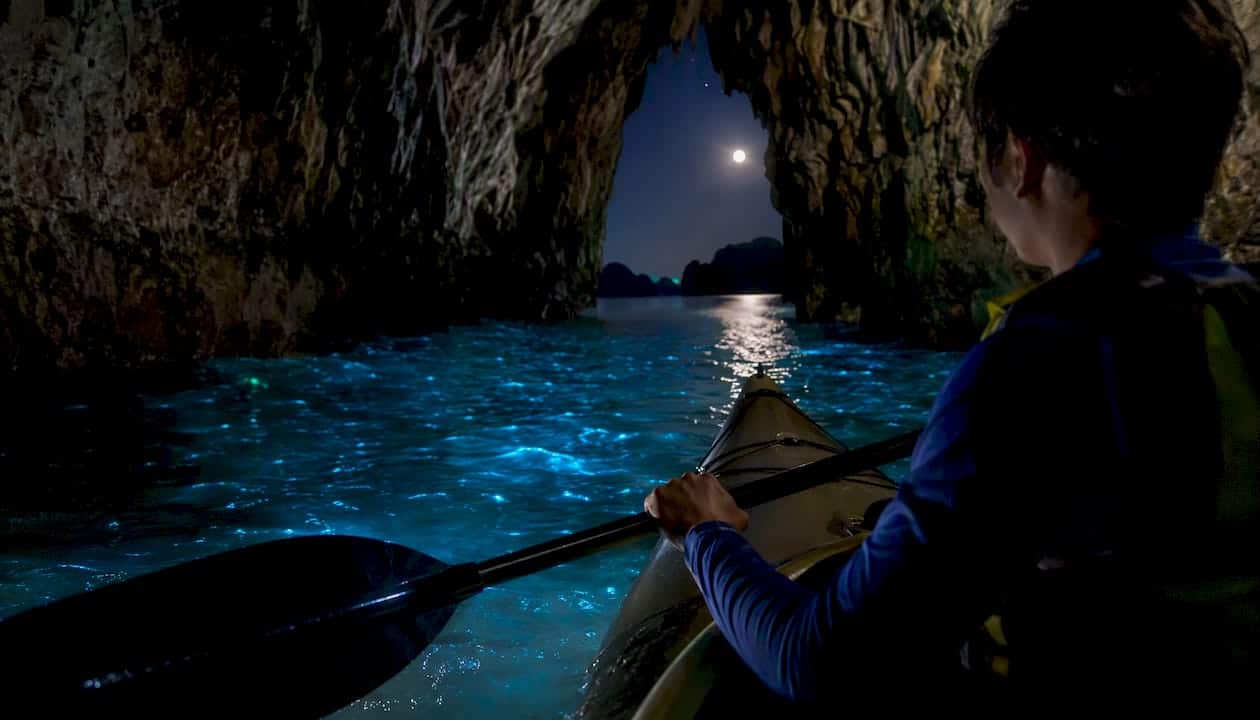
That’s the adjustment that separates an average trip from a memorable one, and it’s rarely advertised upfront because it depends entirely on the night you happen to book. If you’re planning a trip, it’s worth asking your operator directly whether they adjust routes based on moon phase, and what their policy is if conditions on the night turn out to be genuinely poor. A guide who has a clear answer to that question, rather than a vague reassurance, is usually one who has actually spent enough nights on the water to know the difference.
Book your night bioluminescence trip with Qbic Travel
Qbic Travel runs its Phang Nga Bay night trips exactly the way this guide describes: afternoon pickup, daylight sightseeing, dinner, then sea canoes into the lagoons once it’s genuinely dark, timed for the best chance of a real glow rather than a rushed dusk paddle. As a local operator based in Phuket, Qbic Travel offers both group and private boat options, so if you’d rather have a smaller, more flexible night out, that’s on the table too, alongside the standard safety briefing and lifejackets you’d expect on any properly run water trip.

Sightings are never guaranteed, and no honest operator will promise you a dramatic glow every single night; conditions like moon phase and cloud cover are simply outside anyone’s control. What you can control is asking the right questions before you book: check the tours page for current Phang Nga Bay itineraries, and ask directly about moon timing and the reschedule policy if visibility looks poor on your chosen date. If you’d rather build a bespoke evening around your own schedule, Qbic Travel’s private boat tours are worth a look too. Reach out via the website or WhatsApp to check availability and lock in a date that lines up with a darker night sky.
Sources
- Phang Nga Bay coordinate — Google Maps


