

Life jackets and jet ski safety: your 2026 guide
A life jacket, formally known as a personal flotation device (PFD), is the single most effective piece of safety equipment a jet ski rider can wear. About 85% of recreational boating drowning deaths involve victims who were not wearing one. That figure alone defines the role of life jackets in jet ski safety more clearly than any regulation ever could. Whether you are riding the turquoise waters off Phuket or carving through a lake back home, a properly fitted PFD is non-negotiable. This guide covers the right types, how to wear them correctly, and why the habit matters far more than most riders realise.
What is the role of life jackets in jet ski safety?
Life jackets keep you afloat when you cannot keep yourself afloat. That sounds obvious, but the real danger on a jet ski is not always a dramatic crash. A sudden ejection at speed can knock you unconscious before you hit the water. At that point, your swimming ability counts for nothing. A PFD provides passive buoyancy, meaning it works even when you do not.
US Coast Guard-approved life jackets are mandatory for all jet ski operators and passengers as of 2026. This legal requirement exists because the data is unambiguous. Riders without PFDs face dramatically higher drowning risk, regardless of experience level. Wearing one is the fastest, simplest way to shift the odds in your favour.
What types of life jackets are suitable for jet skiing?
Not every PFD is built for jet ski use. The US Coast Guard classifies life jackets into types, and understanding the differences helps you choose correctly.
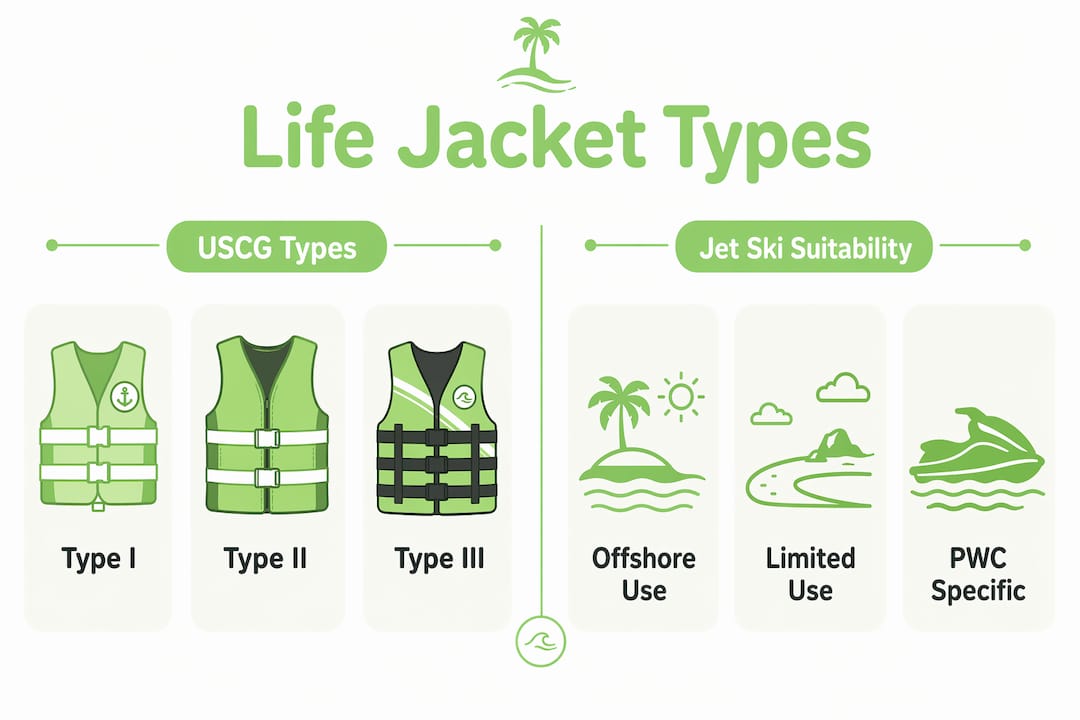
| PFD Type | Buoyancy | Best Use | Suitable for Jet Skiing? |
|---|---|---|---|
| Type I | 22+ lbs | Offshore, rough water | Yes, but bulky |
| Type II | 15.5 lbs | Calm, inshore water | Limited |
| Type III | 15.5 lbs | Active water sports | Yes, recommended |
| Inflatable | Variable | Calm recreational use | No |
Type III foam vests provide around 15.5 pounds of buoyancy while allowing the freedom of movement that jet ski riding demands. They sit close to the body, do not restrict arm motion, and many models feature a high-cut back designed specifically for personal watercraft (PWC) use. That design detail matters because a standard vest can bunch up uncomfortably when seated on a jet ski for extended periods.
Inflatable life jackets are a firm no for jet ski riders. States like Michigan explicitly prohibit inflatable PFDs on personal watercraft, requiring traditional foam-based USCG-approved Type I, II, or III jackets instead. The reason is impact protection. An inflatable vest must be triggered to inflate, and that process takes time you simply do not have during a high-speed ejection.
-
Type III foam vest: The go-to choice for jet ski riders. Offers buoyancy, mobility, and impact cushioning.
-
Type I: Provides maximum buoyancy but is bulkier. Better suited to offshore conditions than recreational riding.
-
Type II: Lighter and cheaper, but less suitable for the active, high-impact nature of jet skiing.
-
Inflatable PFDs: Prohibited for PWC use in many jurisdictions. Do not use them on a jet ski.
Pro Tip: Look for PWC-specific labels when buying a life jacket. These vests are designed with jet ski riders in mind, featuring shorter backs, secure zip closures, and impact-resistant foam panels.
How does proper fit improve your safety on a jet ski?
A life jacket that does not fit correctly can fail you at the worst possible moment. Loosely fastened jackets can ride up over your face during ejection, leaving your torso unprotected and your airway blocked. Every strap and zip must be fully fastened before you leave the dock.
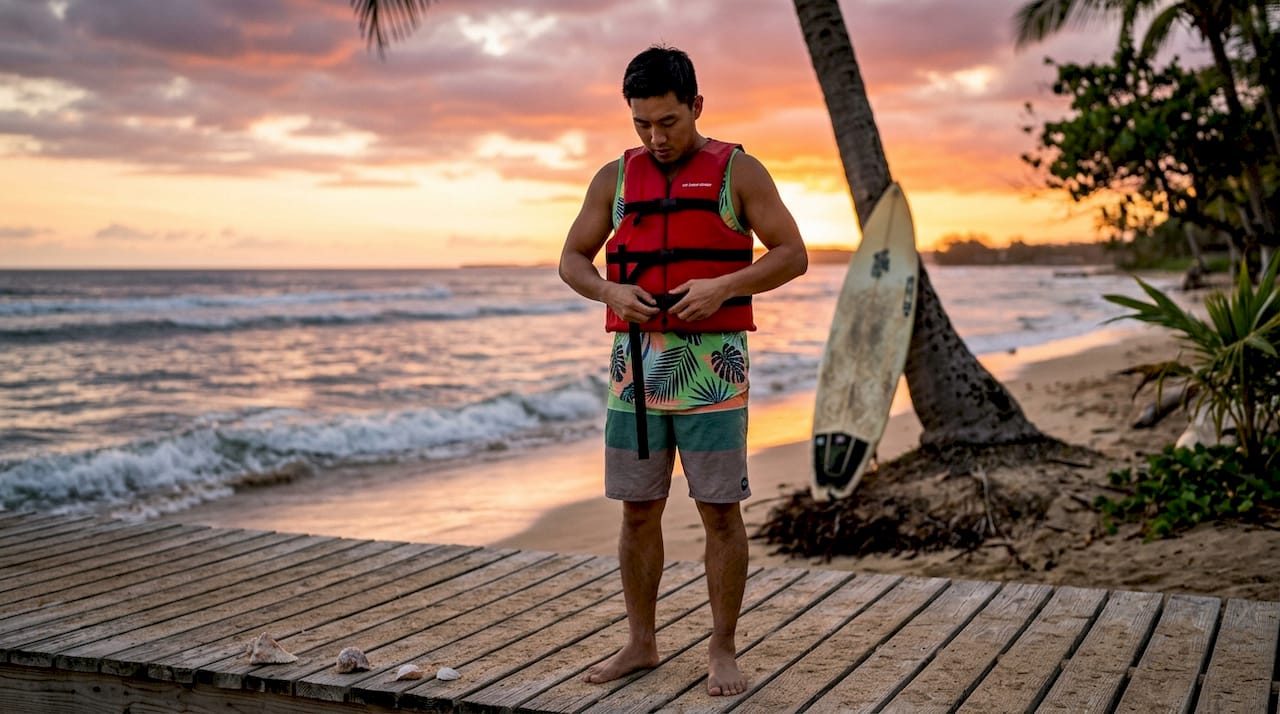
Hitting water at around 40 mph is comparable to hitting concrete. A properly fitted foam Type III jacket absorbs some of that impact and keeps the vest in position when your body takes the force. A loose vest, by contrast, shifts on impact and provides far less protection.
The standard fit check for any PFD is the lift test. The lift test involves pulling the shoulders of the vest upward firmly. If the vest rides up over your chin or ears, it is too loose. Tighten the straps and repeat until the vest stays in place. PWC-specific jackets often include additional adjustment points at the waist and chest to help you achieve a secure fit.
Follow these steps to check your fit before every ride:
-
Put on the life jacket and fasten every clip, zip, and strap fully.
-
Perform the lift test by pulling upward firmly on the shoulder straps.
-
Check that the vest does not rise above your chin or ears.
-
Confirm you can move your arms freely without the vest shifting.
-
Ask a companion to check the back panel sits flat and does not bunch up.
Pro Tip: Children and smaller adults should always try a life jacket on before purchasing. Sizing charts are a starting point, not a guarantee. A vest that passes the lift test on your body is the right vest.
What other safety equipment works alongside your life jacket?
A life jacket is your primary protection, but it works best as part of a complete safety kit. Several other pieces of jet ski safety equipment interact directly with your PFD and your overall safety on the water.
-
Engine kill-switch lanyard: The kill-switch lanyard must be attached to your life jacket or wrist at all times. If you are ejected, the lanyard pulls free and cuts the engine immediately. This stops the jet ski from circling back and striking you or another rider. Never leave the dock without it clipped on.
-
Protective eyewear: Water spray at speed is blinding. UV-protective goggles or wraparound sunglasses keep your vision clear and protect your eyes from sun damage during longer rides.
-
Sun protection: Phuket’s UV index regularly reaches extreme levels. Apply water-resistant SPF 50+ sunscreen before riding and reapply after every swim stop. A rash vest or UV-protective top adds an extra layer of defence.
-
Hydration: Dehydration affects concentration and reaction time faster on the water than on land. Carry a sealed water bottle and drink regularly, especially on tours lasting more than an hour.
-
Communication signals: Know the hand signals used by your guide or group before setting off. A raised fist means stop. A thumbs up means all clear. Clear communication keeps the group together and reduces the risk of collisions.
For a full breakdown of what to bring on the water, the jet ski safety tips guide from Qbictravel covers Phuket-specific conditions in detail.
Why does consistent life jacket use build a safer water sports culture?
Wearing a life jacket every single time is the habit that saves lives. Even strong swimmers face drowning risk when unconscious or injured in the water. A PFD provides buoyancy passively. It does not require you to be conscious, calm, or physically capable. That is the point.
Adults who model consistent life jacket use significantly improve compliance among children and peers around them. Safety culture does not come from rules alone. It comes from watching the people around you treat safety gear as normal, not optional. If you ride with a group, wearing your PFD without being asked sets the tone for everyone else.
Comfortable, sport-specific life jackets increase long-term compliance among jet ski riders. Discomfort and restricted movement are the two most common reasons riders skip wearing one. A well-fitted Type III PWC vest solves both problems. When your gear feels good, you wear it without thinking twice.
Practical habits that build consistent compliance:
-
Treat the life jacket like a seatbelt. Put it on before you start the engine, every time, without exception.
-
Buy gear that fits your activity. A PWC-specific vest designed for active water sports feels different from a bulky offshore jacket. The right gear removes the excuse not to wear it.
-
Inspect your PFD regularly. Check for worn straps, damaged foam, and faded buckles. A compromised vest offers compromised protection.
-
Normalise it socially. Compliment others who wear their PFDs correctly. Positive reinforcement works better than lectures.
Pro Tip: Store your life jacket somewhere visible and accessible, not buried in a bag. If it is easy to grab, you are far more likely to put it on.
Key takeaways
A properly fitted, USCG-approved Type III foam life jacket is the most effective single action a jet ski rider can take to prevent drowning and reduce injury during ejection.
| Point | Details |
|---|---|
| Life jackets prevent drowning | About 85% of recreational boating drowning deaths involve victims not wearing a PFD. |
| Type III foam vests are the right choice | They provide 15.5 lbs of buoyancy with the mobility jet ski riding requires. |
| Fit determines effectiveness | The lift test confirms a vest is snug enough to stay in place during ejection. |
| Kill-switch lanyards are essential | Attach the lanyard to your jacket or wrist before every ride to stop a runaway jet ski. |
| Consistent wear builds safety culture | Adults modelling PFD use improve compliance across the whole group, including children. |
Why I think riders still underestimate the life jacket
After spending time on the water in Phuket and watching hundreds of riders gear up before a session, I have noticed the same pattern repeatedly. Experienced riders are often the worst offenders. They clip the buckles loosely, skip the lift test, and treat the vest as a formality rather than a genuine safety tool. The logic seems to be: “I’ve done this before, nothing has happened, so I’m fine.”
That reasoning fails the moment something unexpected occurs. A rogue wave, a sudden collision, a mechanical fault at speed. None of those scenarios give you time to reconsider your approach to safety gear. The riders I have seen take it most seriously are the ones who have had a close call, or who have seen someone else have one.
The good news is that the gear has genuinely improved. Modern PWC-specific Type III vests are comfortable, well-designed, and nothing like the stiff orange blocks people associate with old-fashioned life jackets. There is no longer a reasonable comfort argument against wearing one. The only barrier left is habit, and habits are changeable.
My honest advice: do the lift test every single time, even if you have worn the same vest a hundred times. Straps loosen. Foam compresses. A thirty-second check before you ride costs nothing and could matter enormously.
— Carl
Safe jet ski adventures in Phuket with Qbictravel
Qbictravel builds safety into every jet ski experience it offers in Phuket. Every rider receives a USCG-approved life jacket, fitted properly before departure, along with a full safety briefing that covers kill-switch lanyard use, hand signals, and riding protocols.

The team at Qbic Travel holds a 4.5-star rating from 237 verified reviews and maintains a 99% issue-free service record, verified by Trustindex. That track record reflects genuine attention to safety, not just marketing language. Whether you book a jet ski tour to the Khai Islands or a Phuket jet ski 7 islands tour, your safety gear is sorted before you hit the throttle. All you need to bring is enthusiasm.
FAQ
Are life jackets legally required for jet ski riders?
Yes. US Coast Guard-approved life jackets are mandatory for all jet ski operators and passengers as of 2026, and similar requirements apply in most international jurisdictions.
Can I use an inflatable life jacket on a jet ski?
No. Inflatable PFDs are prohibited for personal watercraft use in many jurisdictions, including Michigan, because they do not provide adequate impact protection during high-speed ejection.
What is the best life jacket type for jet skiing?
A Type III foam vest is the recommended choice. It provides 15.5 pounds of buoyancy, allows freedom of movement, and offers impact cushioning suited to jet ski speeds.
How do I know if my life jacket fits correctly?
Perform the lift test. Pull the shoulder straps upward firmly. If the vest rises above your chin or ears, it is too loose and needs adjusting before you ride.
Do strong swimmers still need to wear a life jacket on a jet ski?
Yes. Strong swimmers remain at risk of drowning if they are unconscious or injured after ejection. A PFD provides passive buoyancy that requires no physical effort from the wearer.


