
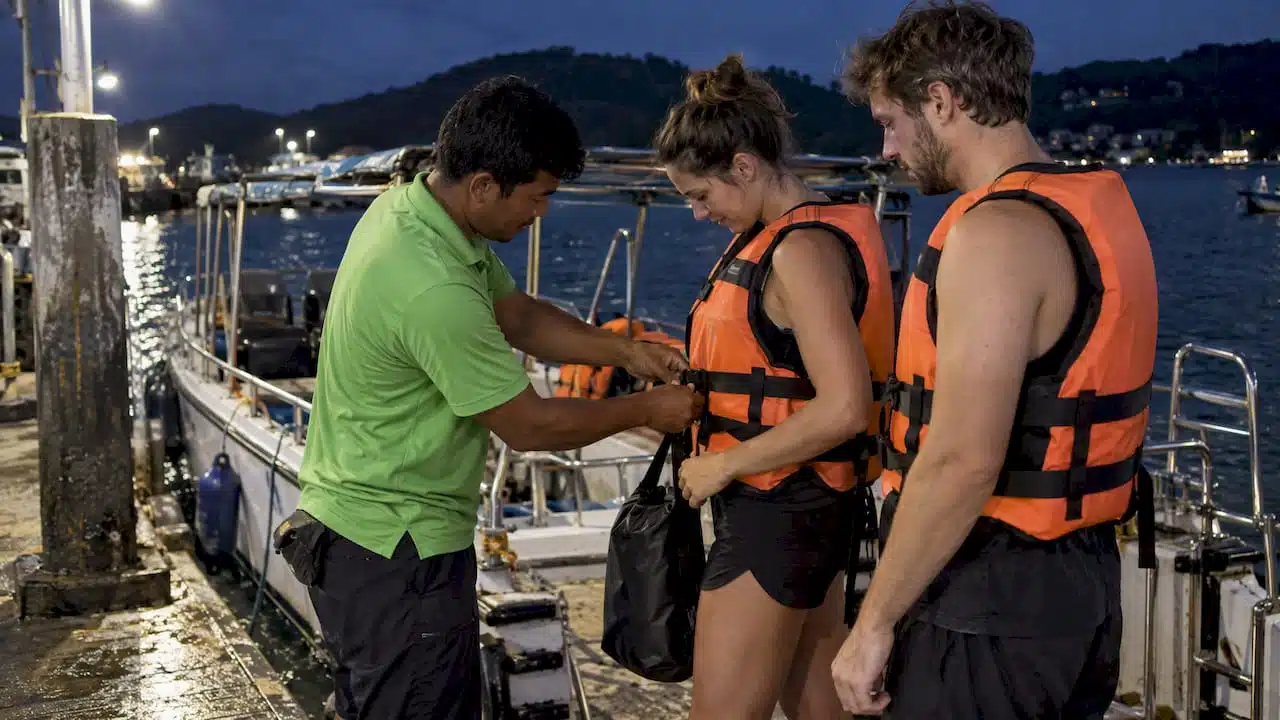
Check Life Jackets and Permits on Thailand Bioluminescent Night Tours
Bioluminescent night tours in Thailand are safe when you book a reputable operator and follow the guide’s instructions. Above all, stay with the group and use the flotation gear provided. Choose an outfit registered with Thai marine authorities, keep your phone charged for emergencies, and you’re set for a genuinely magical night on the water.
TL;DR:
- Confirm that the operator has valid permits from Thailand’s Marine Department for night tours, including GPS on vessels with over 12 passengers.
- Ensure life jackets are issued to every passenger throughout the trip and that crew members are trained in first aid and emergency response.
- Pack waterproof gear, a small torch, reef-safe sunscreen, and medication in advance to prevent stress during preparation.
- Practice strict buddy systems, keep electronics sealed, and follow the guide’s signals to stay safe and oriented while in the water at night.
- Verify that the operator uses navigation lights, monitors weather and tides, and has contingency plans for weather cancellations or emergencies.
Table of Contents
- What reputable operators must provide and Thailand’s legal basics
- How to prepare before the tour: packing, health and paperwork
- On-tour safety behaviours for swimmers, snorkellers and paddlers at night
- Boat, kayak and clear-craft safety: navigation and collision risks at night
- Protecting the environment and the bioluminescent life
- When you should cancel or reschedule a night bioluminescence tour
- How to check and vet a tour operator before you book
- Qbic Travel Phuket: how we run safe bioluminescent night tours
- A travel-practical view on night bioluminescence safety
- Experience Phuket’s glowing waters the safe way with Qbic Travel
- Sources
- FAQ
What reputable operators must provide and Thailand’s legal basics
Before you hand over your money, it helps to know what a properly run operator actually looks like in Thailand. The rules aren’t complicated, but they matter. A quick check before booking can save you a miserable night, or worse.
Thai marine authorities require life jackets for every passenger on a tour boat, and the Tourism Authority of Thailand consistently advises travellers to wear them at all times on the water, not just keep them nearby. The Marine Department’s safety measures also mandate drug and alcohol checks for boat crews and require GPS equipment on any vessel carrying more than 12 passengers. That’s not red tape for the sake of it: it’s the difference between a crew that can locate your group in open water at 10pm and one that’s guessing.
A trustworthy operator in Phuket or Krabi should tick these boxes without hesitation:
- Life jackets issued to every passenger, fitted properly before departure, not just stacked on deck.
- At least one crew member trained in first aid and basic emergency response.
- A written emergency plan covering medical incidents, capsizing and lost swimmers.
- VHF radio or equivalent communication kit on larger boats, with GPS fitted where required.
- Valid operator registration and permits for night-time marine activity.
Thailand’s Marine Department requires GPS on vessels carrying more than 12 passengers and mandates life jackets for all boat passengers, a baseline safety standard worth confirming before you book any night tour. If a company can’t answer a direct question about permits or crew training, treat that as a warning sign rather than an oversight.
You can usually confirm compliance with a short message before booking. Ask the operator directly whether they hold a Marine Department permit for night excursions and whether life jackets are compulsory throughout the trip, not optional. A company with nothing to hide will answer in minutes.
How to prepare before the tour: packing, health and paperwork
Good preparation starts days before you step onto the boat, not the morning of. A little planning turns a potentially stressful night into a smooth, genuinely epic one.
Pack with the conditions in mind: it’s dark, it’s humid, and you’ll likely get wet.
- Bring a dry bag or waterproof pouch for your phone, cash and documents.
- Wear quick-dry clothing and non-slip sandals, since decks get slippery once splashed.
- Pack a small torch or headlamp with a red-light mode so you don’t disturb the glow.
- Carry reef-safe sunscreen if you’re arriving in daylight, since standard sunscreens can harm marine life.
- Bring any personal medication, including seasickness tablets, in its original packaging.
Health matters more on a night tour than most people expect. Seasickness is common on open-water routes, so take your preferred remedy an hour before departure rather than after symptoms start. Pregnant travellers and anyone with heart conditions, recent surgery or chronic back problems should ask the operator directly whether the route involves jumping into water or extended time on a kayak, since both put strain on the body that’s easy to underestimate at night.
Confirm your travel insurance covers water activities before you leave home. Many standard policies exclude snorkelling or kayaking unless you’ve added an adventure sports rider, and that’s not something you want to discover after an incident. It’s also worth checking whether the operator carries its own liability cover, which a legitimate business should be able to confirm without fuss.
Pro Tip: Pack your dry bag the night before and do a trial close in bright light, since fumbling with a waterproof seal in total darkness wastes precious minutes.
If your trip involves kayaking rather than a larger boat, it’s worth matching your fitness level to the route before you commit, since paddling against tide at night is tougher than it looks from the brochure photos.
On-tour safety behaviours for swimmers, snorkellers and paddlers at night
Once you’re in the water, the rules get simpler but stricter. Darkness removes most of your visual reference points, so the behaviours that feel optional in daylight become essential at night.
Stick to the buddy system without exception. Pair up with someone in your group, keep each other in sight, and agree on a simple check-in rhythm, a tap on the shoulder or a quick word every few minutes. Solo swimming away from the group, even thirty metres to chase a better view of the glow, is one of the easiest ways to lose your bearings in open water.
- Stay within arm’s reach or clear sight of your guide at all times.
- Never swim ahead of or behind the group formation.
- Keep electronics and valuables sealed in a waterproof pouch clipped to your body, not floating loose.
- Learn the guide’s hand signals and torch patterns before entering the water.
- Respond immediately if the guide calls everyone back, even mid-photo.
Guides typically use a consistent light pattern or a specific sighting point on the boat to keep the group oriented in the dark, and following that cue without hesitation is the single easiest way to avoid drifting off course. If something feels wrong, a current pulling harder than expected, a cramp, disorientation, raise your hand and call out immediately rather than trying to push through it alone.
Pro Tip: Agree on a simple “I’m okay” hand signal with your buddy before you enter the water, since shouting over wind and waves at night rarely works.
A well-run tour will also brief you on what happens if something goes wrong: who blows the whistle, where the nearest rescue craft is, and which direction to swim if you hear the recall signal. If your operator skips this part of the briefing, ask for it. You’re entitled to know the plan before you’re the one who needs it.
Boat, kayak and clear-craft safety: navigation and collision risks at night
Darkness plays tricks with distance and depth that most travellers don’t anticipate. A gap that looks like plenty of room between kayaks at dusk can close fast once the light’s gone, and judging how far your craft is from the next one becomes genuinely difficult without a reference point. That’s exactly why guides insist on wider spacing and slower speeds once the sun sets.
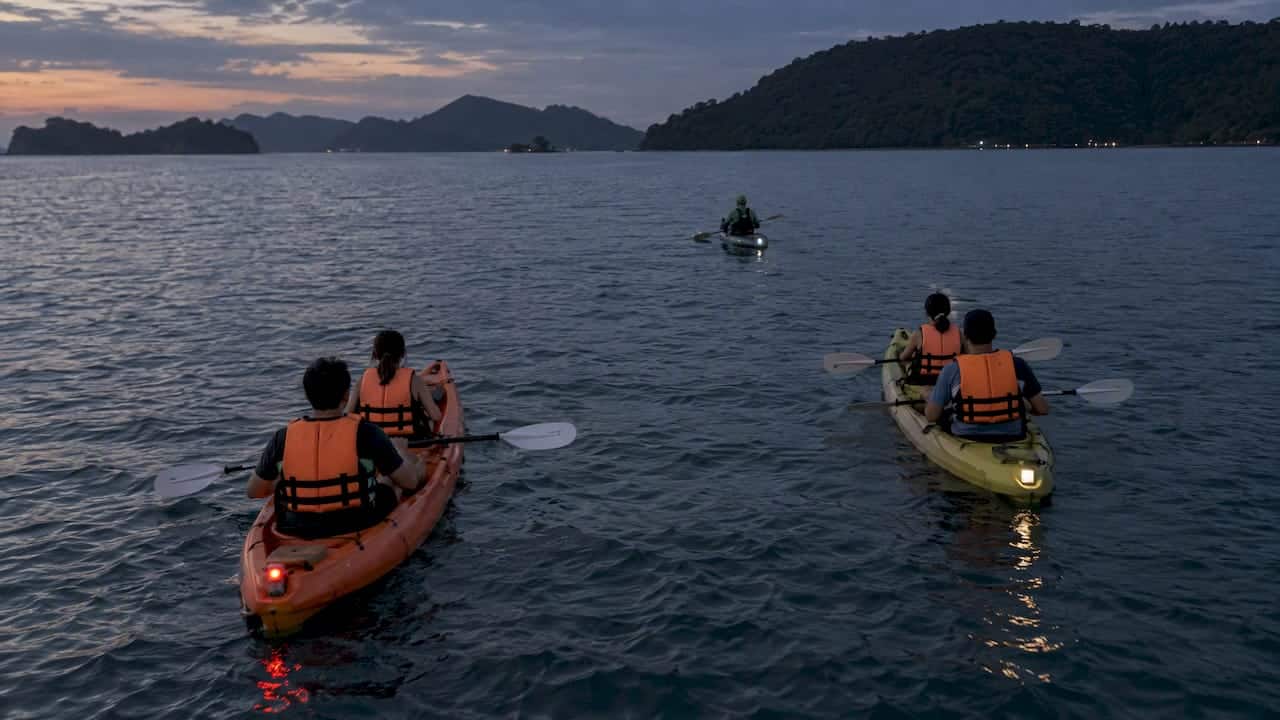
A properly equipped vessel for night tours carries navigation lights, an anchor light if moored, and some form of GPS or chart plotter for larger boats. Kayaks and clear-bottom craft used for bioluminescence viewing typically carry a small attached light or reflective marker so the lead boat can track the group’s position.
Guides carry real responsibilities on a night excursion:
- Planning the route in advance, including tide timing and any known hazards.
- Monitoring tide and current changes throughout the trip, not just at launch.
- Keeping radio or phone contact with a shore-based coordinator.
- Maintaining visual or light-based contact with every paddler or swimmer in the group.
- Adjusting formation and spacing as conditions change.
If you ever find yourself drifting away from the group, whether paddling a kayak or swimming, the instruction is always the same: stop moving forward, make noise, and use your torch or whistle to signal your position. Don’t try to paddle hard to catch up in the dark, since that’s when collisions and capsizes happen. Staying still and visible is far safer than closing the gap blind.
Protecting the environment and the bioluminescent life
The glow you’re there to see comes from living plankton, and how you behave in the water directly affects whether that glow keeps showing up season after season. Treat the water the same way you’d treat a fragile reef, because in a real sense, it is one.
Chemical sunscreens containing oxybenzone and octinoxate are increasingly discouraged around Thailand’s coastal waters because of their effect on marine organisms, plankton included. Switching to a mineral, reef-safe sunscreen before you arrive at the dock is a simple swap that protects the exact phenomenon you’ve come to see.
- Choose mineral-based sunscreen over chemical formulas before you get in the water.
- Never touch, scoop or bottle the glowing water to take home.
- Avoid using soap, insect repellent or lotion right before swimming.
- Pack out everything you bring, including food wrappers and bottle caps.
- Keep noise and splashing to a minimum near sensitive shoreline areas.
Thai researchers have developed PRBIO and BEACHBIOS, home-grown biotechnology aimed at reducing coastal pollution and supporting cleaner tourism, presented by Walailak University at Hotel Expo Krabi Go Green 2026. These innovations point to a broader push within Thailand’s tourism sector to treat coastal water quality as something worth actively protecting, not just enjoying. For more general sustainability habits worth adopting on any small-boat trip, this guide to eco-conscious sailing offers a useful starting point.
When you should cancel or reschedule a night bioluminescence tour
Sometimes the safest decision is simply not going out, and a good operator will tell you that themselves rather than push ahead for the sake of a booking.
- Strong winds, choppy seas or an approaching storm, particularly common during the monsoon season, are reasons to reschedule rather than push through.
- A full or near-full moon washes out much of the glow and reduces the point of going at all, so ask your operator about the lunar calendar before booking a date.
- Fast-moving tides or unusually strong currents on the night in question increase the risk of drifting and should prompt a guide to shorten or cancel the water portion of the trip.
- Travellers with a fever, recent ear infection, open wound or any condition that affects balance should sit out the swimming portion rather than risk it.
- A legitimate operator will offer a clear reschedule or refund policy for weather cancellations, which is itself a sign they’re following safety guidance rather than chasing bookings regardless of conditions.
If your tour company cancels on short notice due to weather, that’s not poor service, it’s the system working the way Thai marine safety guidance intends it to.
How to check and vet a tour operator before you book
A few direct questions before you pay can tell you more about an operator’s safety culture than any number of glossy photos on their website.
Ask about permits first. A company running night excursions in Thai waters should hold registration with the relevant marine authority and be able to confirm it without hesitation. Ask next about life jacket policy: are they compulsory throughout, or just handed out at the start? Request the written emergency procedure, including what happens if a swimmer goes missing or a kayak capsizes. Confirm whether the company carries liability insurance and whether that extends to night activities specifically.
- Confirm Marine Department registration and permits for night tours.
- Ask whether life jackets are mandatory for the entire excursion.
- Request a written emergency procedure, not just a verbal reassurance.
- Check recent reviews specifically for mentions of safety briefings and group control.
- Ask about maximum group size and the guide-to-guest ratio.
- Confirm communication equipment carried on the boat, such as VHF radio or GPS.
| What to check | Why it matters |
|---|---|
| Marine Department permit | Confirms the operator is legally cleared for night marine activity |
| Life jacket policy | Thai authorities recommend wearing them throughout, not storing them |
| Crew first aid training | Determines how quickly an injury or medical issue is handled on board |
| Group size and guide ratio | Smaller groups mean closer supervision in low visibility |
| Communication equipment | VHF radio or GPS lets the crew call for help or confirm position |
A quick read through recent reviews can confirm whether these policies hold up in practice, not just on paper. Look specifically for mentions of the safety briefing, how the guides handled group control, and whether anyone mentioned feeling rushed or unsupervised. If those details are consistently positive, you’re in good hands.
Qbic Travel Phuket: how we run safe bioluminescent night tours
We build our night tours around the same principles outlined throughout this guide, because a glowing lagoon only stays magical if everyone goes home safely.
Every guest receives a properly fitted life jacket before departure, and our crews carry first aid training as standard, not as an add-on. Our boats and kayaks used for night excursions carry navigation lights and communication equipment appropriate to the craft, and our guides brief every group on hand signals, buddy pairing and recall procedures before anyone enters the water.
- Life jackets fitted and worn throughout the water portion of the tour.
- Crew trained in first aid and emergency response procedures.
- Clear pre-tour briefing covering buddy pairing, signals and recall protocol.
- Group sizes kept manageable so guides can maintain visual contact with every guest.
- Weather and tide conditions checked ahead of departure, with rescheduling offered when conditions don’t meet our safety threshold.
If you’re booking with any operator, not just us, it’s entirely reasonable to ask for these same assurances before you pay. A company confident in its safety record will answer without hesitation. You can see how our tours are structured on our tours page or get a feel for the local logistics in our guide to coastal adventure tours.
A travel-practical view on night bioluminescence safety
The biggest mistake I see travellers make isn’t ignoring safety advice outright, it’s assuming a glowing lagoon is automatically gentle because it looks peaceful. Dark water at night carries the same currents and depth illusions as any open sea, glow or no glow, and the guides who insist on buddy checks and tight formations aren’t being overcautious, they’re applying lessons learned from the nights that didn’t go smoothly.
My honest advice: put the phone away until the guide tells you it’s safe to shoot photos, and keep your eyes on your buddy rather than on the glow for the first few minutes. The water isn’t going anywhere, and neither is the magic.
If you’d rather skip the guesswork and book with an operator that builds these habits into every trip by default, get in touch with us directly and we’ll talk you through what a safe night out actually looks like.
— Carl
Experience Phuket’s glowing waters the safe way with Qbic Travel
Plenty of operators around Phuket offer a bioluminescence trip, but fewer build genuine safety structure into every step of the night, from the briefing to the recall signal. That’s the gap we focus on closing.

Our private boat tours give you a smaller, more controlled group than a packed public excursion, which means closer guide supervision when you’re in the water at night. Our island tours can be arranged around the lunar calendar so you’re not paying for a trip on a night when a full moon washes out the glow.
- Private boat charters keep group sizes small for closer safety supervision.
- Island tour itineraries can be timed around the tide and moon phase on request.
- Life jackets, trained crew and a pre-tour safety briefing come as standard, not an upgrade.
If you’d like specific safety measures confirmed before you pay, such as crew first aid certification or communication equipment on board, it’s advisable to ask the operator directly through their contact channels to confirm what’s included. Browse our tours page to see current availability, or check Jet Ski and other adventure options if a daytime excursion suits your schedule better. Ready to book a night out that’s planned properly from start to finish? Get your dates confirmed with us today.
Sources
For readers who want to verify the rules directly or dig deeper into the research behind this guide, these are worth bookmarking.
- Marine safety measures and regulations in Thailand – TAT Newsroom
- Walailak University showcases microbial biotechnology at Hotel Expo Krabi Go Green 2026
FAQ
Does Betalbatim beach glow every night?
Bioluminescence depends on the presence of specific plankton and dark conditions, so it isn’t guaranteed every single night at any one location. A new moon or darker sky typically produces a stronger, more visible glow than a night near a full moon.
What month is best for bioluminescence?
Visibility depends more on moon phase and water conditions on a given night than on a fixed calendar month, since a dark, calm night during a new moon generally shows the glow best. Checking the lunar calendar before booking is more reliable than picking a month alone.
Is it safe to swim in Thailand’s waters at night?
Swimming at night is safe when you wear the flotation provided, stay within sight of your guide and follow the buddy system throughout. Thai marine authorities require life jackets for boat passengers and recommend wearing them at all times on the water, which extends sensibly to night swimming activities too.
What is bioluminescent plankton?
Bioluminescent plankton are tiny marine organisms that emit a visible blue-green glow when disturbed by movement in the water, such as a paddle stroke or a swimmer’s hand. The glow is a natural defence response, which is also why guides ask you to avoid excessive touching or splashing near the organisms.


