

ATV Rain Poncho in Phuket: What to Wear and What to Skip
A cheap poncho is fine for a short walk, but it is not the best layer for an ATV. A loose, flapping poncho can catch on moving parts or blow up in front of your face. For a Phuket ATV ride, a quick-dry top, closed shoes, a properly fastened helmet and a poncho that is tucked in and secured (or no poncho at all) is the safer plan. Here is how to decide, what to pack and how to ride when the trail turns slick.
TL;DR
- Rain is normal in Phuket’s wet season, and it can arrive fast. Plan for a wet ride rather than hoping to dodge it.
- Ponchos are cheap and easy to find, but a loose one is a snagging and vision risk on an ATV. Tuck it in or choose quick-dry clothing you don’t mind getting wet.
- Your helmet matters more than any rain layer. The chin strap must be fastened correctly.
- Wet trails mean mud, ruts and slower riding. Smooth throttle, lower speed and both hands on the bars.
- Ask your operator what rain gear is provided when you book, so you know what to bring.
Table of Contents
- When does it actually rain in Phuket?
- Is a rain poncho safe on an ATV?
- What to wear instead of a poncho
- Where to buy a poncho in Phuket (and what it costs)
- Do ATV tours provide ponchos?
- What wet-season trails are really like
- How to ride when the trail turns slippery
- Our perspective
- Plan your ride with us
- A simple rainy-day packing checklist
- FAQ
- Sources
When does it actually rain in Phuket?
Phuket’s rainy season runs from mid-May to mid-October, when the southwest monsoon brings frequent rain, according to the Thai Meteorological Department. The same source shows September as the wettest month, with roughly 350 to 400 mm of rain over about 22 days.
So if you ride between May and October, treat rain as part of the plan. Showers often come as short, heavy bursts rather than all-day drizzle, and the sun can be back within the hour. That is why a gear plan matters more than a weather forecast. You can’t always know when a shower will hit, but you can be ready for it.
Outside those months you can still get a passing shower, especially in the shoulder weeks. A light, quick-dry kit works year-round, so you don’t need to pack twice.
Is a rain poncho safe on an ATV?
A poncho is not banned, and it is not automatically dangerous. The problem is the shape. A poncho is a big, loose sheet of thin plastic, and an ATV is a moving machine with a wide stance, handlebars you need to turn freely and rotating wheels on either side of you.
There are three practical concerns.
1. Snagging. Loose material can catch in moving parts. Thai media reported in September 2024 on a boy whose oversized rain poncho caught in a motorcycle’s rear wheel, trapping his arm in the spokes and breaking it. An ATV is not a motorbike, but the lesson carries over: anything that flaps near a wheel, a footrest or a control is a problem.
2. Vision. A hood that isn’t secured can balloon in the wind and block your view. On a jungle track with ruts and roots, you need your eyes on the trail.
3. Helmet fit. Your helmet is your main protection. Thailand’s Sing Buri public-relations office explains that a standards-compliant helmet protects against head impact, and that the chin strap must be fastened correctly so the helmet doesn’t come off. Never wear a poncho hood over a helmet in a way that loosens the strap or shifts the fit.
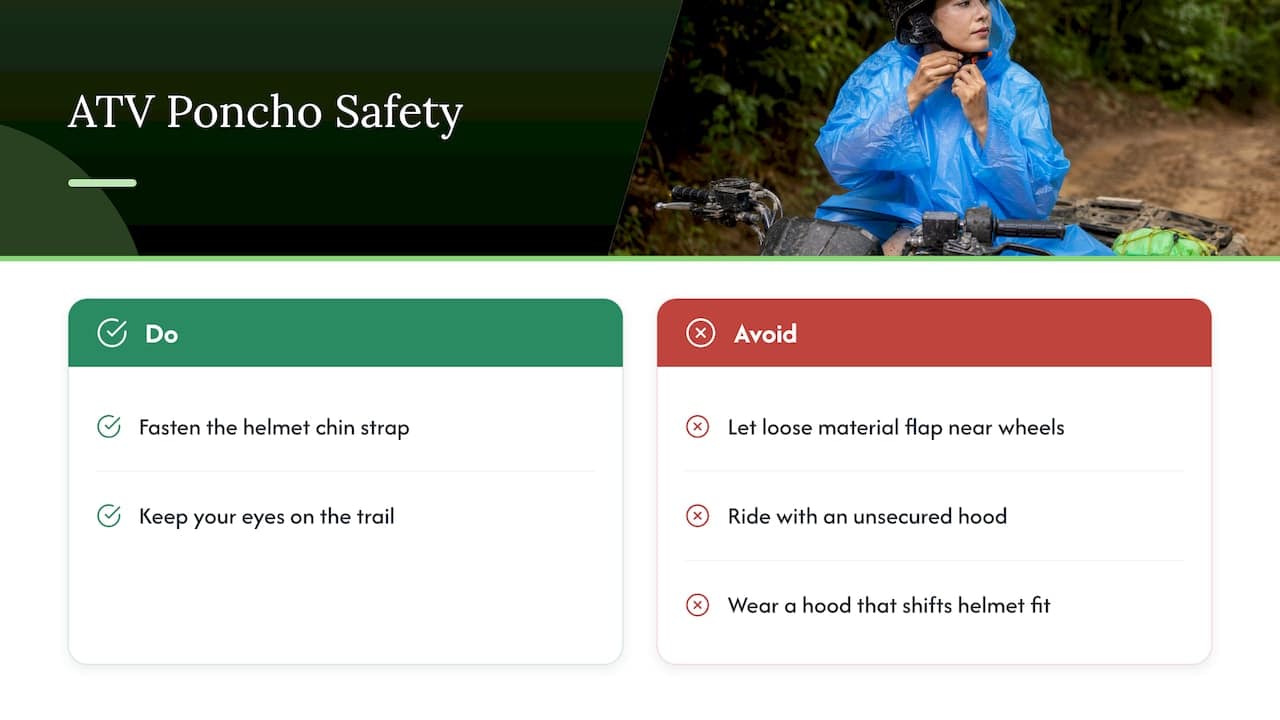
How to wear a poncho more safely if you do use one
If you want one, keep it short and keep it controlled:
- Choose a snug or short poncho rather than a baggy, ankle-length one.
- Tuck the tail and the sides under you or into your waistband so nothing hangs near the wheels or footrests.
- Keep the hood off your head. Put it inside the garment rather than letting it flap.
- Make sure your arms can reach the handlebars, brake and throttle freely.
- If it still flaps, take it off and accept the rain. In Phuket’s heat, getting wet is rarely a problem.
On guided tours, the safest answer is often simpler: wear clothes that are fine to get soaked and let the warm rain do its thing. Our full ATV clothing guide covers the whole outfit.
What to wear instead of a poncho
Phuket is warm and humid even when it pours, so you are rarely cold. What you want is gear that dries fast and grips well.
| Item | What to choose | Why it helps |
|---|---|---|
| Top | Quick-dry T-shirt or light long-sleeve | Dries quickly; sleeves protect arms from branches and spray |
| Bottoms | Long, light trousers or quick-dry shorts you don’t mind muddying | Mud will happen; long legs protect from scrapes |
| Shoes | Closed-toe shoes with good tread | Wet footrests are slippery; sandals can slip or come off |
| Helmet | Properly fitted, strap fastened | The key safety item, rain or shine |
| Gloves | Light gloves with grip | Better hold on wet handlebars |
| Eyes | Clear glasses or goggles | Keeps mud and rain out of your eyes |
| Phone and valuables | Waterproof pouch or dry bag | Rain and mud get everywhere |
| Spare | Dry T-shirt and a small towel in the car | Comfortable ride back to the hotel |
An ATV guide for Phuket recommends wearing the helmet properly and using gloves, alongside choosing an established operator that gives a safety briefing.
Where to buy a poncho in Phuket (and what it costs)
If you still want one for the trip to and from the trail, they are easy to find. Disposable ponchos are sold at convenience stores, and one packing guide puts them at 30 to 60 baht at 7-Eleven. Market stalls and roadside shops in tourist areas such as Patong, Kata and Karon also sell them, and prices can vary with the shop and the weather.
The cheap disposable type is thin and tears easily, which makes it more likely to flap and rip on a moving vehicle. Think of it as a cover for walking between the hotel van and the ATV base, not as your riding layer.
If you want something reusable, a fitted, lightweight rain jacket is a better pick than a baggy poncho for riding. Keep it for the transfer or for waiting around, and check with your guide before riding in it.
Do ATV tours provide ponchos?
Practice differs by operator, and it can change with the season, so don’t assume. The simplest approach is to ask when you book. A short message on WhatsApp is enough: ask what is provided (helmet, poncho, closed shoes, a place to store your bag) and what you should bring yourself.
Good questions to send before you pay:
- Is a helmet provided, and is it a proper fit for adults and children?
- Is rain gear provided, and is it safe to ride in?
- Is there somewhere dry to leave a bag and phone?
- What happens if the weather is too bad to ride? Can I reschedule or get a refund?
- Is the tour insured for ATV-specific injuries?
That last one is worth taking seriously. A Phuket ATV guide warns that some cheap, unlicensed roadside operators carry no accident insurance, and advises checking whether the insurance covers ATV-specific injuries before signing anything. Our pre-ride safety checks walk through what to look for.
What wet-season trails are really like
Rain changes the ride more than it changes the scenery. The jungle gets lush and green, and the air is cooler, but the track itself behaves differently. Phuket’s ATV tracks can become muddy and slick during the monsoon, which makes the ride slower and more challenging.
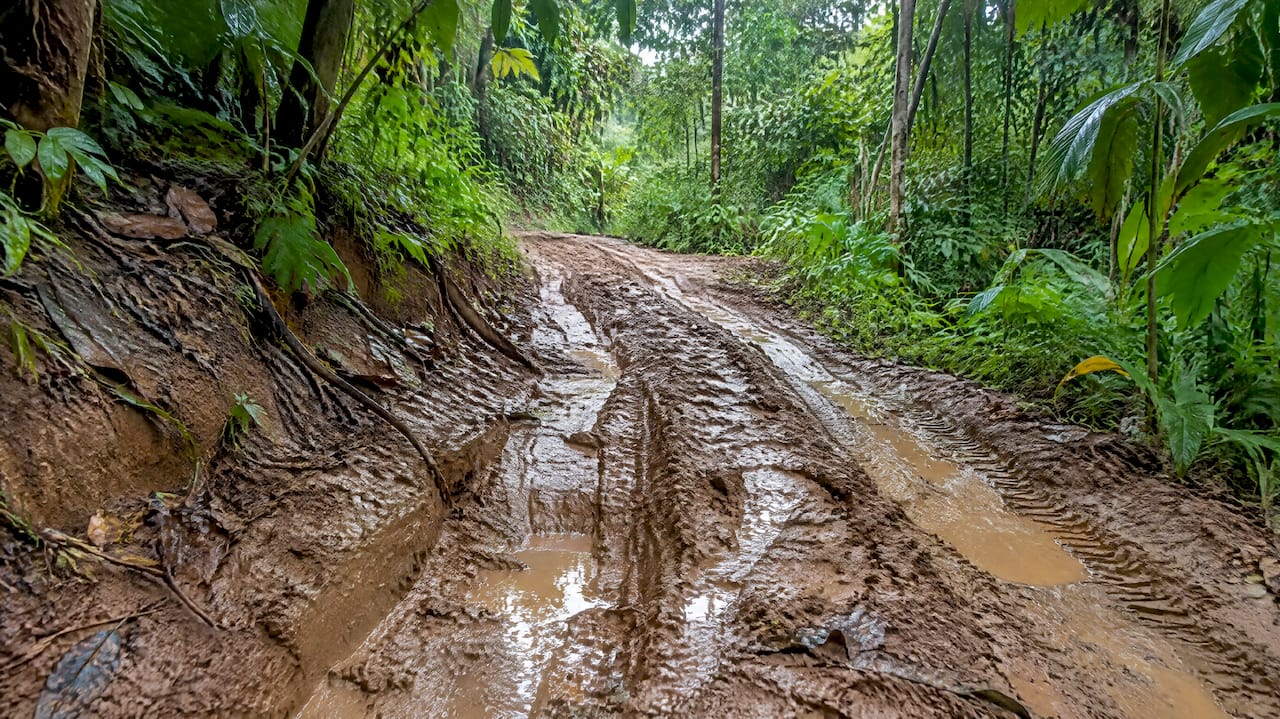
That has two effects. First, you spend more energy steering and balancing. Second, the trail may not suit everyone. One Phuket hotel guide notes that wet-season trails can be muddier and more challenging, and may not be ideal for beginners or families with young children. If you are new to quad bikes, or you are riding with small kids, a morning slot on a dry-ish day or a passenger seat with an experienced guide can be a better fit. For a sense of how machines differ, dealers of dirt bikes and ATVs show how much vehicle choice changes how a machine feels in the mud.
If you like the idea of riding in the wet season, pick your time of day. Our guide to morning ATV slots from May to October explains why early rides often suit the season.
How to ride when the trail turns slippery
The most common ATV trouble in Phuket isn’t a high-speed crash. A local guide describes low-speed tip-overs as the typical accident, with a quad catching a rut on a muddy track, and lists wrist and ankle fractures among the injuries seen. That tells you what to focus on: smooth, slow, controlled riding.
- Slow down before corners, not in them. Braking mid-turn on mud is how machines slide. Beginners should avoid speeding, especially around corners and on slopes.
- Keep both hands on the handlebars. The same guide stresses this for first-timers. Wet grips make it even more important.
- Follow your guide’s line. The guide knows where the ruts, puddles and soft patches are. Stay in the track and keep a safe gap.
- Be gentle with the throttle. Sudden power makes the rear wheels spin.
- Don’t fight a slide. Ease off, look where you want to go and steer gently.
- Take breaks. Wet riding is tiring, and tired hands make mistakes.
- Say so if you’re uncomfortable. A good guide will slow the group, change the route or let you stop.
The Phuket Travel Safety Guide gives the same general advice for road riding: avoid driving at night or in the rainy season where possible, drive carefully, don’t speed and wear a helmet. Off-road riding on a guided tour is a different setting, but the principle holds.
Our perspective
We run ATV and adventure tours in Phuket, and the question we hear most in the wet season is “should I buy a poncho?” Our honest answer: a poncho is for the walk to the vehicle, not for the ride.
Riding in the rain is part of the fun in Phuket. The water is warm, the jungle is green, and a bit of mud is half the story you tell afterwards. What makes the day good is preparation: quick-dry clothes, closed shoes, a helmet that fits properly and a guide who knows the track.
That is why we build our trips around planned itineraries, flexible booking and clear communication before you arrive. If the weather looks rough, message us on WhatsApp and we will talk you through your options. We would rather you ask a simple question than turn up unsure.
Not every ride has to be a mud-fest, either. If you want a gentler day, ask about timing, or mix in something else, such as an island trip, so you are not relying on one slot.
Carl
Plan your ride with us
If you are ready to ride, you can look at our ATV tours in Phuket and book online or through WhatsApp, with hotel pick-up and flexible last-minute booking available on our tours. Guests rate us 4.5 from 237 reviews, and our site cites a 99% issue-free rate verified by Trustindex.

Not sure which ride fits your group? Compare ATV vs buggy options, read the full ATV riding guide, or browse our adventure tours for jet ski and ATV options. If you are weighing the weight limit, our page on ATV weight limits tells you what to check before booking.
A simple rainy-day packing checklist
Keep this short and light, so you are not carrying much on the ride:
- Quick-dry top and light trousers or shorts
- Closed shoes with grip (a spare dry pair for after)
- Light gloves and clear glasses or goggles
- Waterproof pouch for phone, cash and room key
- Small towel and a dry T-shirt for the way back
- Sunscreen, because the UV index can stay high behind clouds
- Water and a little cash for snacks
- Optional: a short fitted rain jacket or disposable poncho for transfers only
If you travel with kids, check helmet sizes and age rules with the operator in advance, and consider whether a wet-season trail is right for younger children.
FAQ
Can I wear a poncho while riding an ATV in Phuket?
You can, but it needs care. A loose poncho can catch on moving parts or blow up over your face. If you wear one, keep it short, tuck it in and keep the hood off your helmet. Otherwise, quick-dry clothing is the simpler and safer choice.
How much is a rain poncho in Phuket?
Disposable ponchos are sold at convenience stores for roughly 30 to 60 baht at 7-Eleven, according to one packing guide. Prices at tourist stalls can be different, so check before you buy.
Will my ATV tour be cancelled if it rains?
Light and moderate rain does not always stop a ride, but conditions vary by day and trail. Ask your operator about their weather policy, rescheduling and refunds when you book. You can message us on WhatsApp for guidance on your date.
Is the wet season a bad time to ride an ATV in Phuket?
Not at all, but the trails are muddier and slower. Rainfall peaks from mid-May to mid-October, with September the wettest month. Many riders enjoy it, while beginners and young families may prefer a guided ride at a calmer time of day.
Sources
- Thai Meteorological Department: weather calendar
- Sing Buri Public Relations Office: helmet safety
- The Thaiger: boy’s poncho caught in a motorcycle wheel
- ATV & Quad Biking in Phuket: Safety, Routes, Prices
- A Complete Guide To The Best ATV Tours In Phuket
- Thailand Packing List by Month
- Phuket Travel Safety Guide
- High Performance Dirt Bikes, ATVs & Electric Bikes


