
Phi Phi Snorkelling Rules: What You Can and Can’t Do
The short version: you can snorkel at the Phi Phi Islands, but you must wear a life jacket, keep clear of the reef, never touch, stand on or feed marine life, and stay out of the zones that are roped off or closed. Break the rules and Thai law allows a fine of up to 200,000 baht, up to two years in prison, or both. Here is what that means on the water, so you can relax and enjoy the fish.
TL;DR
- Wear a life jacket, keep your distance from the reef, and never touch or stand on coral or marine life.
- Don’t feed fish or monkeys, don’t drop litter, and don’t anchor on a reef. Fines can reach 200,000 baht.
- Maya Bay and its neighbouring bays close every year from 1 August to 30 September, and swimming in Maya Bay is not allowed at any time.
- Foreign visitors pay a national park fee, listed at 400 THB for adults and 200 THB for children. Check whether your tour includes it.
- Use reef-safe sunscreen, wear a rash vest, and know the vinegar rule for jellyfish stings.
Table of Contents
- Why Phi Phi has strict snorkelling rules
- The core rules every snorkeller must follow
- Where you can and can’t snorkel
- Park fees and permits
- Safety on the water
- Snorkelling etiquette in practice
- What to expect from a good operator
- Our perspective
- Pick a trip that follows the rules for you
- FAQ
- Sources
Why Phi Phi has strict snorkelling rules
The Phi Phi Islands sit inside Hat Noppharat Thara–Mu Ko Phi Phi National Park. That means national park law applies on the water as well as on land. Thailand’s Department of National Parks says it is pursuing conservation tourism and stricter protection of marine resources, and park officials stress that not knowing the rules is no excuse. Signs are posted in several languages at the main sites.
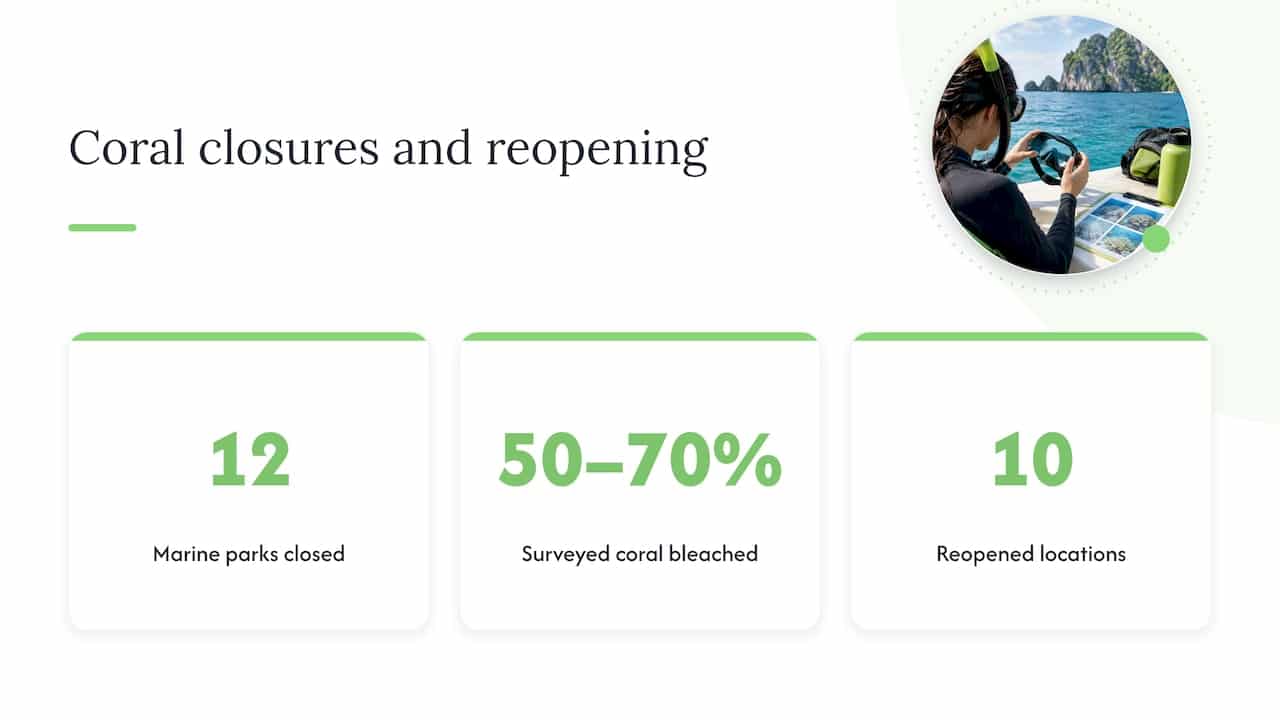
There is a practical reason too. In May 2024, the Department of National Parks announced that Hat Noppharat Thara–Mu Ko Phi Phi was one of 12 marine national parks closed after 50–70% of surveyed coral showed bleaching. Snorkelling and diving reopened in 10 designated locations in April 2025, while western Koh Kai (Ao Khang Khao) stayed closed to protect fragile coral. The reefs you swim over today are still recovering, and the rules are what keep them healthy.
The core rules every snorkeller must follow
Thailand’s Department of Marine and Coastal Resources (DMCR) sets out the legal measures for reef diving and snorkelling. In plain English, they come down to this:
- Wear a life jacket. Snorkellers must wear one and keep their distance from the reef. It also keeps you floating flat, which stops you kicking coral by accident.
- Don’t touch or step on coral or marine life. That includes “just a quick stand” in shallow water. Coral is a living animal and a single footprint can kill a patch that took years to grow.
- Don’t feed aquatic animals. Feeding fish changes their behaviour. A park guide on a boat may hand out nothing for the same reason.
- Don’t throw rubbish into the sea. Carry everything back to the boat, including bottle caps and snack wrappers.
- Don’t anchor on reefs. This one is for your boat crew, but a good operator will tell you where they moor and why.
The penalty for breaking these rules can be up to two years’ imprisonment, a fine of up to 200,000 baht, or both. Most visitors will never come close to that, but it shows how seriously the rules are taken.
A few extra park rules worth knowing
- No feeding monkeys. Feeding fish or monkeys is prohibited because it harms their health and makes animals more aggressive.
- Drones need permission. The same source notes that drones must be registered in Thailand and need a park permit, so leave yours at the hotel unless you have arranged this.
- Don’t collect anything. Shells, coral pieces and starfish stay where they are. Thailand’s Government Public Relations Department also advised visitors at Maya Bay to follow park rules on collecting sea creatures and to use reef-safe sunscreen.
Where you can and can’t snorkel
Not every beach or bay at Phi Phi is open for snorkelling. Access depends on the spot and the season.
Maya Bay: look, don’t swim
Maya Bay is the famous one, and it has the tightest rules. Swimming in Maya Bay is prohibited, and boats land passengers at the Loh Samah pier on the other side of the island rather than in the bay itself. Visit rules there have included time-limited visitor rounds, so expect to follow staff directions on arrival.
If you are choosing between a full-day Phi Phi trip and a shorter one, the good news is that the best snorkelling is elsewhere. Read our guide to the best snorkelling spots in the Phi Phi Islands for where to actually get in the water.
Viking Cave and marked zones
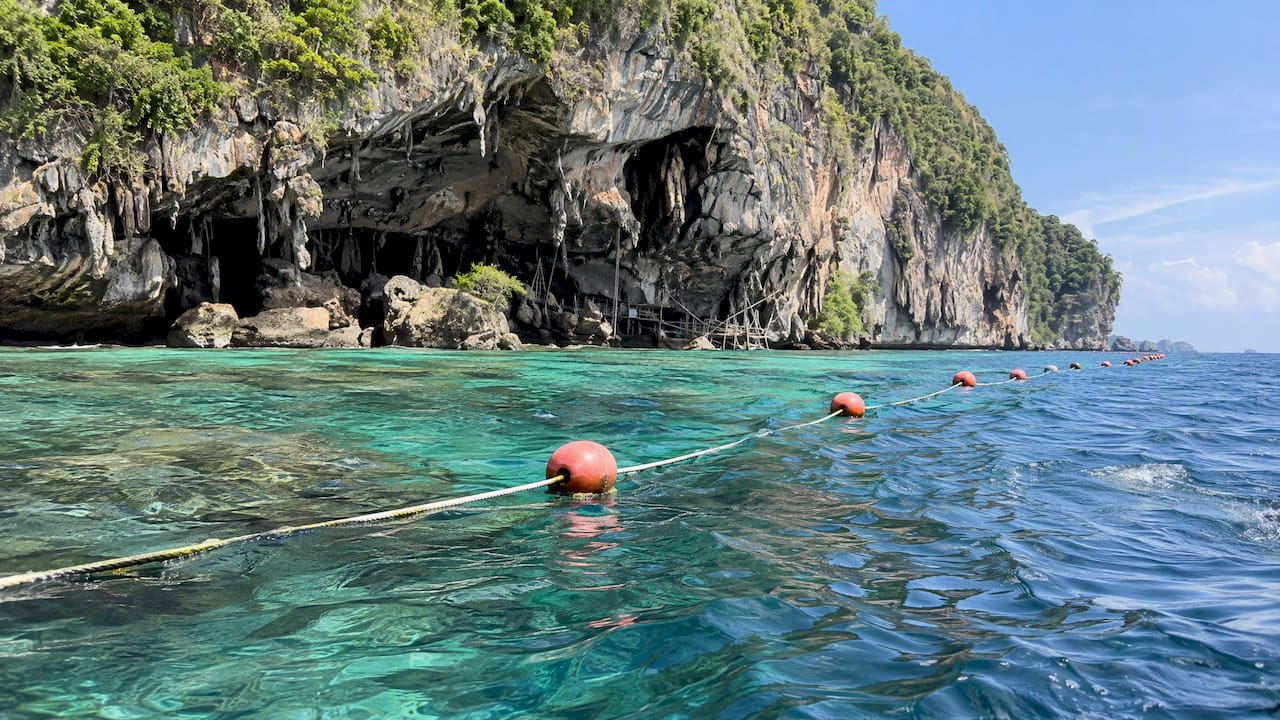
At Viking Cave, red buoys and rope barriers mark the zones. Local reporting describes the inner shallow-reef sections as off-limits, with some outer areas designated for snorkelling. The rule of thumb is simple: if there is a rope or a red buoy, stay on your side of it. Your guide will show you the open area before you jump in.
Seasonal closures
Every year, Maya Bay, Loh Samah Bay and Lo Ko Bay close to visitors from 1 August to 30 September. Thailand’s Government Public Relations Department says the closure gives the bays time to rehabilitate and protects visitors during the monsoon, since rough seas affect the Loh Samah pier. Other parts of the national park stay open during this time. The official closure notice confirms the same dates.
The closure has run on this schedule in recent years, but exact dates are set by the park authority, so check before you book a trip in the rainy season. We keep a page on the Maya Bay closure and where to go instead.
Temporary reef closures
Specific snorkelling and diving sites can also close for reef recovery, as happened after the 2024 bleaching event. If a site you read about online is not on your tour’s route, there is usually a conservation reason. Ask your operator which sites are open on your travel day.
Park fees and permits
There is no separate snorkelling licence for a normal guided trip. What you do pay is the national park entry fee. One published guide to park rules lists it as 400 THB for foreign adults and 200 THB for children, and notes it may or may not be included in tour prices. Fees can change, so confirm the current amount when you book.
This catches people out most often. Some tours quote a low headline price and collect the park fee in cash on the day. Others include it. Our page on Phi Phi island fees for visitors explains how it works with our trips, so you know what to put in your wallet before you leave the hotel.
If you are planning a longer trip around the Andaman Sea by yacht rather than a day boat, this Phuket sailing itinerary is a handy outline of how to link up the islands, and the park fee still applies when you stop in Phi Phi.
Safety on the water
The rules protect the reef. These habits protect you.
Jellyfish and sea snakes
The DMCR notes that box jellyfish occur on both the Andaman and Gulf coasts of Thailand. For stings, use vinegar and do not use fresh water. The same DMCR page advises avoiding contact with sea snakes and wearing protective clothing to help prevent jellyfish stings. A thin rash vest or lycra suit is an easy, cheap fix.
We have two longer guides if you want the detail: jellyfish season and vinegar first aid and our 10 safety checks for snorkelling in Phuket.
Boats and swim zones
- Listen to the crew’s briefing. Boats move around snorkel areas, and a good crew will tell you where you can swim.
- Stay near the boat or your guide. Currents around the islands can be stronger than they look from the deck.
- Don’t swim toward other boats or long-tail engines. Keep your head up and look around every few minutes.
- Count heads. If you are travelling with children, keep them within arm’s reach and in child-sized life jackets.
Weather and sea state
The rainy season brings rougher seas and lower visibility on some days. Crews decide whether to run a trip based on conditions, and that is good news: a reschedule or refund policy is part of a safe trip. Ask about it when you book, not when the clouds roll in.
Snorkelling etiquette in practice
The law covers the big things. A few small habits make you the kind of visitor the reef can handle.
- Choose reef-safe sunscreen, or cover up. A rash vest does more than any lotion and leaves nothing in the water.
- Defog your mask before you get in the sea. Constantly fiddling with it in shallow water is how people end up standing on coral.
- Practise breathing on the boat’s ladder first. If you are nervous, spend a few minutes at the edge before swimming off.
- Keep fins high. Flutter kicks from the surface are fine, but stay horizontal and keep your fins well above the coral.
- Look with your eyes only. Don’t chase turtles, sharks or rays. Black-tip reef sharks are typically shy, and following them stresses them.
- Take only photos. If you use a waterproof camera, check that your strap isn’t dragging over the reef.
What to expect from a good operator
You don’t need to memorise everything. A well-run tour will do most of the work for you. Here is what to look for:
| What to check | What good looks like |
|---|---|
| Life jackets | Provided and fitted for every guest, including children |
| Briefing | Rules explained before the first stop, in your language |
| Route | Only open, permitted sites, with no landing at closed bays |
| Park fee | Clear on whether it is included or paid in cash |
| Weather policy | A stated reschedule or refund option |
| Group size | Enough crew to watch swimmers in the water |
Our perspective
We run Phi Phi trips every week, and our honest view is that the rules make the day better, not worse.
The reefs and lagoons that people travel here for only stay worth seeing if visitors treat them carefully. That is why our briefings cover life jackets, no touching and no feeding before anyone gets in the water, and why we plan routes around what is open rather than what looks good on a postcard.
Most guests are surprised by how much they see once they stop trying to get close. Fish come to you when you float still. If you want a relaxed pace, a private or small-group boat gives you more time at each stop. If you prefer to cover more islands, a speedboat gets you to the open sites quickly.
We would rather you enjoy a calm, legal, great snorkel than chase a closed bay. Tell us who is coming, how confident you are in the water, and when you are travelling, and we will build the day around the rules.
Carl
Pick a trip that follows the rules for you
The easiest way to stay on the right side of the rules is to join a trip where the crew handles routes, equipment and briefings. We run Phi Phi day trips by boat tour, by speedboat and on a private boat, with hotel pick-up and flexible last-minute booking. Our service has a 99% issue-free rate verified by Trustindex, and a 4.5 rating from 237 reviews.

Browse all our Phuket island tours or message us on WhatsApp and we will suggest the right option for your group.
FAQ
Do I need a licence to snorkel at Phi Phi?
No. Snorkelling on a guided trip needs no licence or certification. You do need to wear a life jacket and follow the national park rules. Scuba diving is different, and beginners usually do an introductory dive with an instructor.
Can I swim at Maya Bay?
No. Swimming in Maya Bay is prohibited, and the bay itself, plus Loh Samah Bay and Lo Ko Bay, closes every year from 1 August to 30 September. You can still snorkel at other sites around Phi Phi, which usually offer better marine life anyway.
What is the penalty for touching coral or feeding fish?
The DMCR lists penalties of up to two years in prison, a fine of up to 200,000 baht, or both, for breaking the reef rules. These include touching or stepping on coral, feeding animals and dumping rubbish. In practice, a guide’s warning is far more common, but treat the rules as firm.
How much is the Phi Phi national park fee?
A published guide to park rules lists 400 THB for foreign adults and 200 THB for children. Some tours include it and some charge it separately in cash, so confirm when you book and check the current amount before travelling.
Is it safe to snorkel at Phi Phi with children?
Yes, with the right precautions. Use properly fitted child-sized life jackets, keep children within arm’s reach, add a rash vest for sun and jellyfish protection, and stay close to the boat. Choose a calm-water stop and a crew that watches swimmers closely.
Sources
- Legal measures for reef diving and snorkelling (DMCR)
- Department of National Parks: conservation tourism and stricter protection
- 12 Marine National Parks Closed to Combat Coral Bleaching (PRD)
- Thailand Reopens Snorkeling, Diving in Phi Phi Islands (Tempo)
- Maya Bay reopening and park rules (PRD)
- Phi Phi National Park Rules & Fees
- Officials react after tourist caught coral walking (The Phuket News)
- Maya Bay and nearby areas to close (PRD)
- Maya Bay and nearby areas closed to visitors (PRD)
- Toxic marine life guide (DMCR)
- Phuket sailing itinerary


