
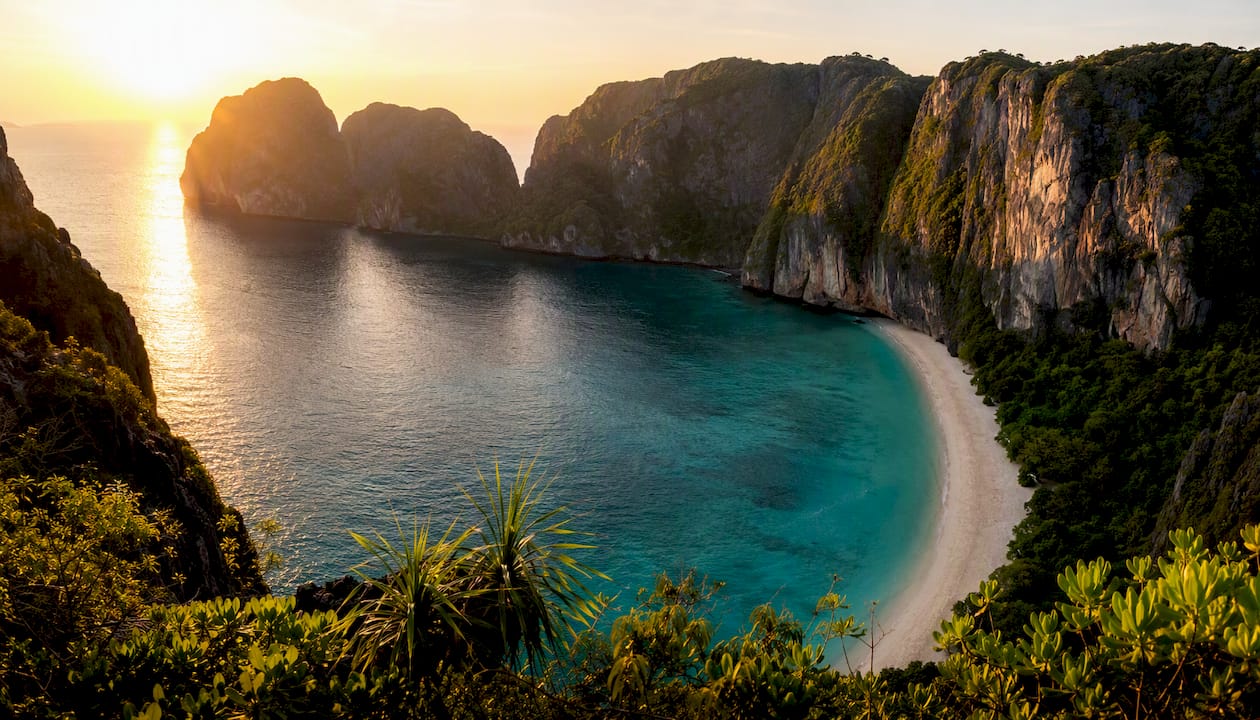
Where was The Beach filmed? All locations explained
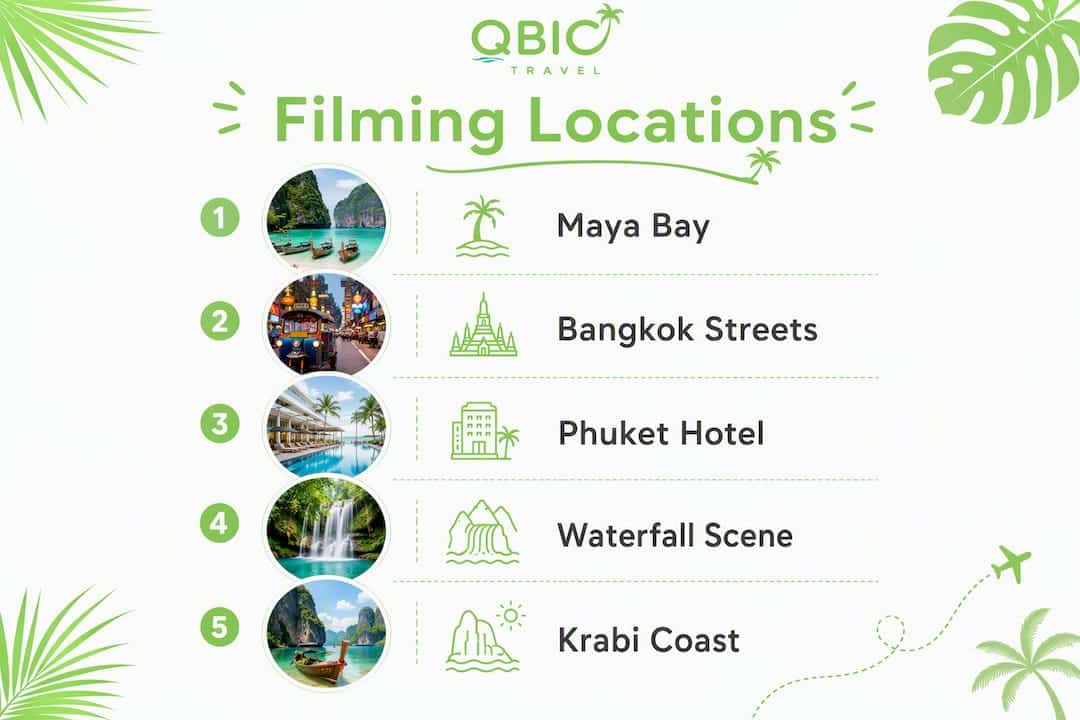
The Beach (2000), directed by Danny Boyle and starring Leonardo DiCaprio, was filmed primarily at Maya Bay (Hat Maya) on Ko Phi Phi Leh), a small uninhabited island in the Phi Phi archipelago, southern Thailand. Beyond that iconic cove, the production used several other credited sites across the country:
- Ko Phi Phi Don and the wider Phi Phi archipelago (island logistics and surrounding seascapes)
- Khao San Road, Bangkok (backpacker arrival scenes)
- The Memory at On On Hotel, Phuket Town (hotel interior sequences)
- Krabi province (supplementary island and coastal shots)
- Haew Suwat Waterfall, Khao Yai National Park (the waterfall jump sequence)
Access to Maya Bay is managed by Thailand’s Department of National Parks, Wildlife and Plant Conservation (DNP), which sets visitor rules, seasonal closures, and entry conditions. Check the DNP’s official notices before you book anything.
Table of Contents
- Where was The Beach filmed at Maya Bay?
- How do you reach Ko Phi Phi Leh from the Phi Phi islands?
- What scenes were filmed on Khao San Road in Bangkok?
- What was filmed at The On On Hotel in Phuket Town?
- Where was the waterfall jump scene filmed?
- What other Krabi locations appear in the film?
- How did filming change Maya Bay, and what happened next?
- Can you still visit Maya Bay and the film locations?
- What in the film was staged or digitally altered?
- How do you choose a responsible tour to visit film locations?
- What permits and regulations apply beyond Maya Bay?
- Key takeaways
- The gap between the film image and the real bay
- See Maya Bay the right way with Qbictravel
- Useful sources and further reading
Where was The Beach filmed at Maya Bay?
Maya Bay sits on the south-western tip of Ko Phi Phi Leh at approximately 7.6784° N, 98.7676° E. It is the location of the film’s most recognisable sequences: the first arrival by boat through the narrow channel, the establishing wide shots of the crescent beach framed by towering limestone cliffs, and the community camp scenes on the sand itself.
| Scene type | Location detail |
|---|---|
| Boat arrival sequence | Narrow channel entrance to Maya Bay, Ko Phi Phi Leh |
| Beach camp and daily life | Main sand crescent, Maya Bay |
| Wide establishing shots | Clifftop viewpoints above the bay |
| Swimming and underwater scenes | Waters within the bay and surrounding coves |
The cliffs you see in those wide shots are real. What the camera did not show you is the crowd. On a typical pre-closure day, visitor numbers peaked at several thousand people before access controls were tightened. The film image of a deserted paradise bears almost no resemblance to what the bay looked like during peak tourism years.
Pro Tip: Arrive at Maya Bay as early as your boat permit allows. The golden morning light hits the cliffs from the east, giving you the closest match to the film’s warm, cinematic look. By mid-morning, the bay fills quickly, so early arrival is both more photogenic and more peaceful.
How do you reach Ko Phi Phi Leh from the Phi Phi islands?
Ko Phi Phi Don is the inhabited, larger island of the Phi Phi group and serves as the main gateway to Ko Phi Phi Leh. You cannot stay overnight on Ko Phi Phi Leh itself; all accommodation is on Phi Phi Don or back in Phuket. Here is how to get to Maya Bay:
- From Phuket by speedboat — the most popular option for day-trippers. Journey time is roughly 45 minutes direct to the Phi Phi area, with most tours stopping at Maya Bay as part of a wider island circuit. Phuket to Phi Phi day trips typically depart early morning to maximise time at the bay.
- From Phi Phi Don by longtail boat — a short 20-minute crossing from Ton Sai pier. Longtails are the classic local option and give you flexibility, though they are subject to sea conditions.
- From Phi Phi Don by chartered speedboat — faster and more comfortable for groups, with the option to combine Maya Bay with snorkelling stops at nearby coves like Loh Samah Bay.
- From Krabi by ferry or speedboat — Krabi Town and Ao Nang both have regular connections to Phi Phi Don, from where you transfer to Ko Phi Phi Leh.
For scenery that rivals Maya Bay with far fewer people, the limestone karsts around Phi Phi Don’s eastern bays and the waters near Bamboo Island offer a genuinely quieter experience. Snorkelling spots around Phi Phi include some of the clearest water in the region, and they are accessible without the same access restrictions.
What scenes were filmed on Khao San Road in Bangkok?
Khao San Road, in the Banglamphu district of Bangkok, appears in the film’s opening act. It is where Richard (DiCaprio) arrives as a backpacker, checks into a guesthouse, and first encounters the mysterious map that sets the story in motion. The street’s dense rows of budget guesthouses, street-food stalls, and neon signs made it the perfect shorthand for the Southeast Asian backpacker trail of the late 1990s.
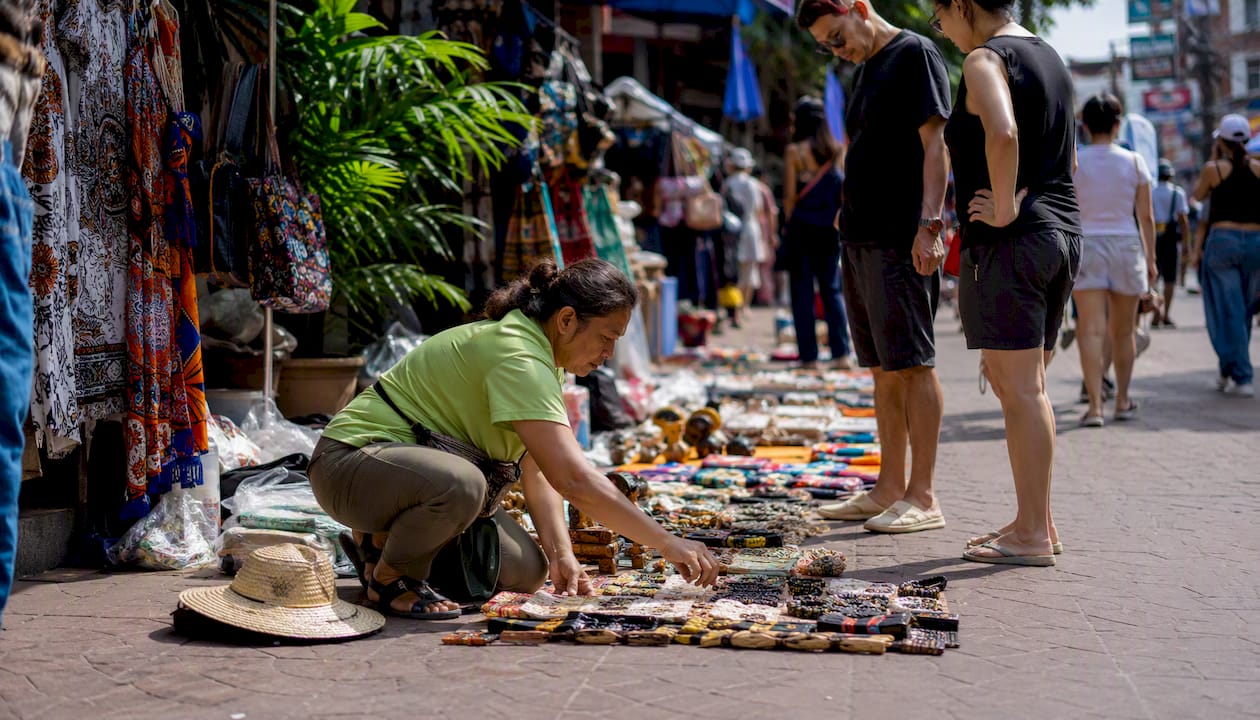
Walking Khao San Road now, you will still recognise the general atmosphere, though specific shopfronts from the film have changed over two decades; for deeper insight, see The Symbology of Ganesha in Thailand which explores important cultural contexts relevant to respectful travel here. The street is busiest from late afternoon into the evening. If you want to photograph it without crowds, aim for early morning on a weekday. Be respectful of local residents and traders when pointing a camera around.
What was filmed at The On On Hotel in Phuket Town?
The hotel interior scenes in The Beach were shot at what is now known as The Memory at On On Hotel on Phang Nga Road in Phuket Town. Built in 1929, it is one of Phuket’s oldest hotels and its Sino-Portuguese façade and tiled corridors gave the production an authentic, slightly faded colonial feel that suited the film’s aesthetic perfectly.
The hotel has leaned into its film connection and remains a draw for visitors who want to see the actual corridors and lobby that appeared on screen. It is still operating as a hotel, so you can book a room and experience the location from the inside.
For a short walking circuit of Phuket Town’s filmed and historic sites:
- Start at The Memory at On On Hotel on Phang Nga Road
- Walk south to Dibuk Road and Thalang Road for the best-preserved Sino-Portuguese shophouses
- Continue to Soi Romanee, a short lane of colourful restored buildings frequently used in film and photography
- Finish at Surin Circle for a broader view of the old town’s architecture
The whole circuit takes around an hour on foot and works well in the cooler morning hours before the midday heat builds.
Where was the waterfall jump scene filmed?
The dramatic waterfall jump sequence was filmed at Haew Suwat Waterfall inside Khao Yai National Park, a UNESCO World Heritage Site on the Khorat Plateau in central Thailand. This is a mainland location, a substantial distance from the Phi Phi archipelago, and is most commonly visited as a day trip from Bangkok or from towns near the park.
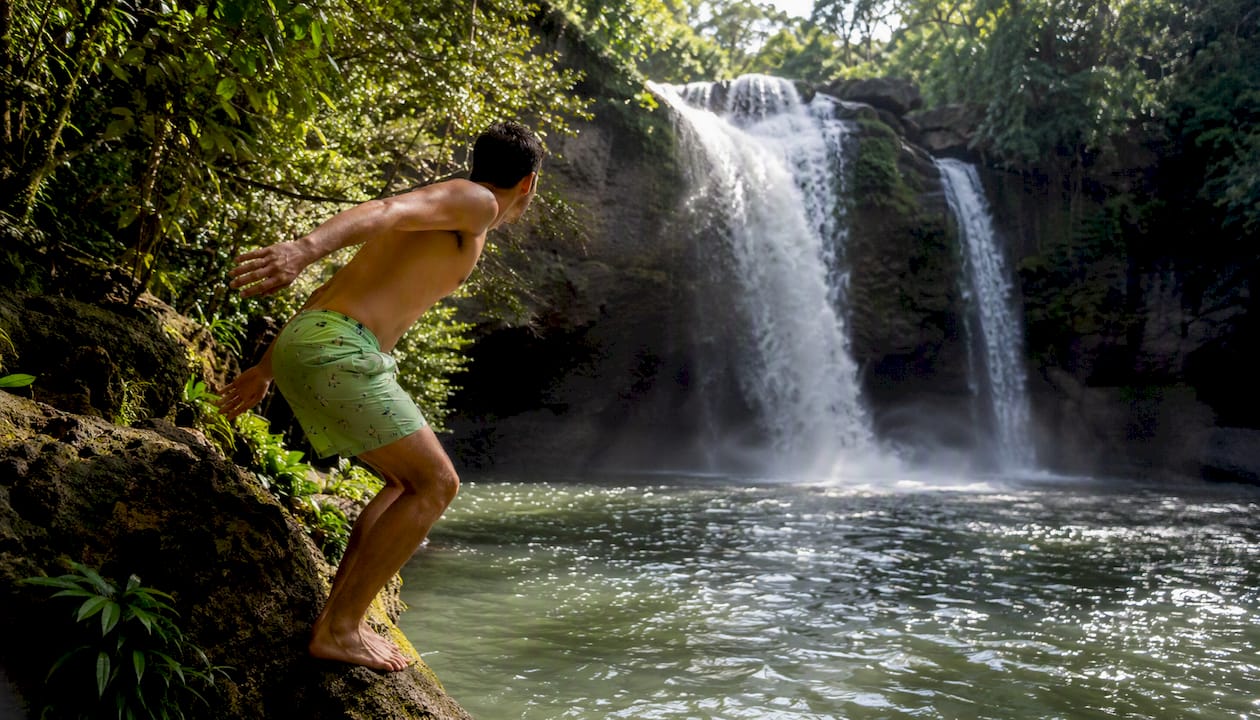
Khao Yai National Park is open daily, though entry fees and specific trail access can change seasonally. Always check current conditions and entry requirements with the park directly or via the DNP’s official channels before visiting.
Pro Tip: Haew Suwat is most impressive between June and October when rainfall keeps the flow strong. Outside monsoon season the waterfall can reduce significantly. That said, wet-season trails can be slippery, so wear proper footwear and follow the park’s safety guidance on approach paths.
What other Krabi locations appear in the film?
Krabi province provided supplementary coastal and island scenery for The Beach, with its dramatic karst limestone formations and turquoise waters offering a visual palette very similar to the Phi Phi islands. Specific credited Krabi-area locations include:
- General Krabi coastal waters for wide ocean and cliff shots
- Railay Beach area (accessible only by boat from Krabi Town or Ao Nang), which shares the same limestone geology as Ko Phi Phi Leh
- Ao Nang as a logistical base for boat-based filming
Combining Krabi with a Phi Phi visit makes excellent itinerary sense. A practical approach is to base yourself in Krabi Town or Ao Nang for two to three nights, take a day trip to Phi Phi Don and Ko Phi Phi Leh, then use remaining days to explore Railay and the Four Islands. Boat transfer schedules between Krabi and Phi Phi are most reliable between November and April. During the monsoon months (roughly May to October), services can be reduced or cancelled at short notice due to sea conditions, so build flexibility into your plans.
How did filming change Maya Bay, and what happened next?
The production’s physical impact on Maya Bay was significant and well-documented. The crew bulldozed sand dunes and removed native vegetation) to widen the beach for camera angles, and imported non-native palm trees to dress the set. The studio established a restoration fund in response to the controversy, but environmentalists argued the damage was lasting.
| Year | Event |
|---|---|
| — | Filming takes place; beach vegetation removed and dunes altered |
| 2000 | Film released; global interest in Maya Bay surges |
| 2000–2004 | Visitor numbers climb steadily; coral damage reported |
| 2004 | Indian Ocean tsunami reshapes the bay’s shoreline naturally |
| 2004–2018 | Tourism continues to grow; daily visitors peak at over 4,000 |
| 2018 | DNP closes Maya Bay to allow coral and vegetation recovery |
| — | Staged reopening with strict visitor limits and new rules |
| Ongoing | Seasonal closures and access controls remain in place |
The 2004 tsunami, while devastating regionally, paradoxically contributed to reshaping the bay’s shoreline in ways that partially reversed some artificial alterations. Natural recovery since the 2018 closure has been encouraging, with coral regrowth reported in the bay’s waters.
Pro Tip: Choose operators who pay the official DNP park entry fee as part of your tour cost and who follow the no-anchor rules in the bay. Anchoring on coral is one of the most damaging practices still associated with boat tourism in this area.
Can you still visit Maya Bay and the film locations?
Yes, but with conditions. Maya Bay reopened after its extended closure with a set of rules designed to protect the recovering ecosystem. Before you travel, here is what to know:
- Check DNP notices first. Seasonal closures can be announced with limited advance notice. The Department of National Parks, Wildlife and Plant Conservation publishes updates; verify access status close to your travel date.
- Visitor limits apply. Group sizes and daily visitor caps are enforced. Book with an operator who confirms their permit status and group-size compliance.
- No touching coral or marine life. This applies in the water and from the boat.
- No food or drinks on the beach. Waste management is strictly controlled.
- Sunscreen rules. Reef-safe sunscreen only; chemical sunscreens are harmful to the coral recovery.
- No overnight stays on Ko Phi Phi Leh. All visitors must leave by the designated cut-off time.
- Swim zones are marked. Stay within them.
For up-to-date entry rules and the best time to visit Maya Bay, check current guidance before booking. The November to April dry season generally offers calmer seas and better visibility, making it the most reliable window for a visit.
What in the film was staged or digitally altered?
The Beach is an adaptation of Alex Garland’s 1996 novel) and was never presented as a documentary. Several elements of the on-screen paradise were created or enhanced for the camera:
- Digital cliff closure. Post-production used visual effects to narrow the gap between the limestone cliffs, creating a more enclosed, secret-feeling cove than exists in reality.
- Planted palms. Non-native palm trees were imported and placed on the beach as set dressing; the natural vegetation is different in species and arrangement.
- Colour grading. The film’s saturated turquoise tones were enhanced in post-production.
- Authentic elements retained. The limestone cliff formations, the bay’s general shape, the colour of the water, and the surrounding jungle are all real and still visible today.
Pro Tip: For a photograph that captures the film’s spirit without misrepresenting the location, shoot from the clifftop viewpoint above Maya Bay rather than from the crowded beach level. The elevated angle shows the full sweep of the bay and the surrounding karst, and it is far closer to the establishing shots Boyle actually used.
How do you choose a responsible tour to visit film locations?
Not all boat tours to Maya Bay operate with the same standards. Here is a practical checklist before you book:
- Operator licence. Confirm the operator holds a valid Thai tourism licence and is registered with the Tourism Authority of Thailand.
- DNP park permit. Ask specifically whether the DNP entry fee is included and whether the operator holds the required permit to enter Maya Bay.
- Group size. Smaller groups cause less impact. Ask the maximum number of passengers on your boat.
- No-anchor policy. Confirm the boat uses mooring buoys rather than anchoring on the seabed.
- Waste management. Ask how rubbish is handled on board and whether single-use plastics are used.
- Conservation contribution. Some operators contribute a portion of fees to reef restoration or beach clean-up programmes.
- Emergency plan. Confirm there is a qualified guide and a clear emergency or rescue protocol.
Sample questions to ask before booking: “Is the DNP park entry fee included in the price?” “What is the maximum group size on the boat?” “Do you use mooring buoys at Maya Bay?” “What is your policy on single-use plastics?”
Qbictravel’s Phi Phi and Maya Bay excursions are run with small groups, certified guides, and full compliance with DNP access rules, making them a straightforward choice for travellers who want to visit responsibly without having to vet every detail themselves.
What permits and regulations apply beyond Maya Bay?
Maya Bay gets most of the attention, but other filming locations carry their own rules:
Khao Yai National Park charges a separate entry fee for foreign visitors (payable at the park gate) and requires visitors to stay on marked trails. No independent vehicle access is permitted in some zones; guided tours are the standard approach for international visitors.
Khao San Road and Bangkok have no special permits for visitors, but photography of individuals requires consent, and commercial filming in public spaces requires a permit from the Bangkok Metropolitan Administration.
Phuket Town (including The Memory at On On Hotel) is a public area, though the hotel itself is private property. If you want to photograph the interior, ask staff for permission. The old town is a designated heritage area; respect for the architecture and local residents is expected.
Krabi coastal waters and Railay fall under marine national park jurisdiction in some areas. Boat operators are required to hold the relevant permits, and visitors should not collect shells, coral, or marine life.
Key takeaways
Maya Bay on Ko Phi Phi Leh is the primary filming site for The Beach, and visiting it responsibly means checking DNP access rules, booking with a licensed operator, and following the bay’s strict visitor guidelines.
| Point | Details |
|---|---|
| Primary filming site | Maya Bay (Hat Maya), Ko Phi Phi Leh — the beach camp and arrival scenes were shot here. |
| Other credited locations | Khao San Road (Bangkok), The Memory at On On Hotel (Phuket), Haew Suwat Waterfall (Khao Yai), and Krabi coastal waters. |
| Environmental impact | The production altered the beach physically; visitor numbers peaked at over 4,000 per day before closures were imposed. |
| Check before you go | DNP seasonal closures apply; always verify current access status before booking any tour to Maya Bay. |
| Responsible booking | Qbictravel offers small-group Phi Phi and Maya Bay excursions with DNP-compliant guides and park fees included. |
The gap between the film image and the real bay
The Beach sold a fantasy, and Maya Bay paid for it. What Danny Boyle’s camera captured was a curated, digitally enhanced version of a genuinely beautiful place. The real bay is still extraordinary, but it is not deserted, it is not untouched, and it is not the secret that Richard finds on his map.
What strikes me most, from a local operator’s perspective, is how the film’s legacy cuts both ways. It brought global attention to one of Thailand’s most fragile ecosystems, and that attention caused real damage. The closures and restoration work since 2018 have made a measurable difference, and the rules now in place exist for good reason. Visiting with a small, responsible group, following the DNP’s guidelines, and choosing operators who take conservation seriously is not just the ethical choice. It is the way to see the bay at its best, because a recovering ecosystem is genuinely more beautiful than a degraded one.
Support the park rules. Keep your group small. Leave the beach exactly as you found it.
See Maya Bay the right way with Qbictravel
If visiting the filming locations of The Beach is on your list, Qbictravel’s Phi Phi Maya Bay Island tour is built around exactly that experience, without the stress of organising permits, transfers, and group logistics yourself.

Every excursion runs with small groups, a certified local guide, and full DNP park fee inclusion. Boat transfers use mooring buoys rather than anchors, and the itinerary is timed to give you the bay at its quietest and most photogenic. Beyond Maya Bay, the same tour covers snorkelling stops at nearby coves and the wider Phi Phi scenery that also featured in the film’s production. If you want to add more adventure to your Thailand trip, Qbictravel’s full tours programme covers everything from speedboat island circuits to ATV rides through Phuket’s lush interior. Book directly via the website or drop a message on WhatsApp to check availability for your dates.
Useful sources and further reading
Before booking any visit to Maya Bay or the other filming locations, verify current access conditions with primary sources. These are the most authoritative references:
- The Beach (film) — Wikipedia): Full production credits, filming location list, and documented environmental controversy.
- IMDb filming locations for The Beach (2000): Industry-standard location credits cross-referencing Maya Bay, Phuket, Khao Yai, and Bangkok.
- Movie-Locations.com — The Beach: Detailed scene-by-scene location breakdown with photographs and notes on digital alterations.
- MovieLoci.com — The Beach: Snapshot-based location database; useful for cross-checking but verify access status independently.
- Thailand Magazine — Maya Bay: Covers the tourism impact story and visitor number data in detail.
- Aleenta Phuket — Is Maya Bay Still Closed?: Practical summary of closure history and current reopening conditions.
- WhereFilmed.org — The Beach (2000): Coordinates, map embeds, and scene-specific location notes.
- Tourism Authority of Thailand: Official tourism information for planning travel across all Thai regions.
Always check the Department of National Parks, Wildlife and Plant Conservation (DNP) official channels for the most current Maya Bay access status, entry fees, and seasonal closure announcements before confirming any booking.


