
Avoid Rough Seas: Read Phuket Boat Trip Weather and Ask 5 Questions
Boat trips run safely in Phuket most of the year, but November to April is when the Andaman Sea plays fair, with calm west-coast waters and reliable visibility. From May to October, the southwest monsoon roughs up the west coast, so lean towards sheltered east-coast routes or check that day’s marine forecast before you book anything. Before you do either, check wind speed, wave height, and tide right now, this morning, not last night’s forecast.
TL;DR:
- During November to April, calm west-coast waters and clear visibility make for reliable boat trips, especially with wind speeds below 10 knots and wave heights under 1 meter.
- From May to October, rougher sea conditions with waves reaching 2 to 4 meters and westerly winds over 20 knots often lead to cancellations on exposed west coast routes.
- Operators prefer east-coast departures during monsoon months, where sheltered bays like Chalong and Ao Po offer safer sailing even in unsettled weather.
- Proper planning involves checking real-time wind, wave, tide, and storm activity each morning, and asking operators about cancellation policies and shelter options.
- Combining official forecasts with local observations enhances trip safety; experienced skippers read signs like water color and swell angles for early warnings.
Table of Contents
- Marine forecast essentials: what to read and what matters
- Month-by-month and seasonal guide for boat trips in Phuket
- East coast vs west coast: which departures to pick by season
- Safety, cancellations and operator questions to avoid surprises
- How to check live forecasts for Phuket: best sites, models and a morning checklist
- A local operator’s view on reading the sea beyond the app
- Book your Phuket boat trip with weather-aware planning
- Sources
- FAQ
Marine forecast essentials: what to read and what matters
Reading a Phuket weather forecast for boat trips isn’t complicated once you know which numbers actually matter. Wind speed is your first checkpoint: under 10 knots feels calm, 10 to 20 knots means a choppier but manageable ride, and anything above 20 to 25 knots usually triggers cancellations on smaller vessels.
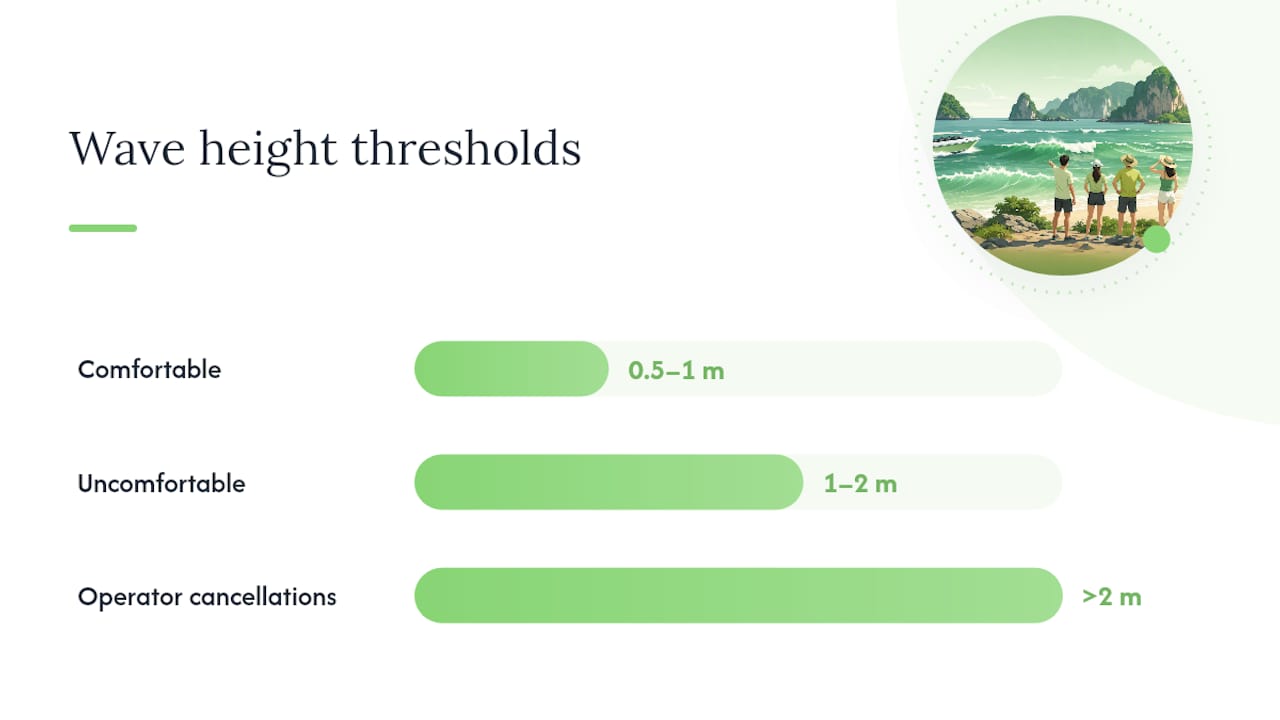
Wave height tells the rest of the story. Swells of 0.5 to 1 metre are comfortable for most passengers, 1 to 2 metres gets uncomfortable for anyone prone to seasickness, and above 2 metres is where operators start cancelling routinely. Swell period matters too. A long-period swell rolling in from the open Andaman Sea produces bigger, lumpier crossings on exposed west-coast routes than short local chop of the same height, even though both might show the same number on a forecast app.
Thunderstorms and poor visibility are non-negotiables, not judgement calls. No operator worth booking will run a boat into an active lightning cell, regardless of how calm the water looks.
Before any departure, run through this quick check:
- Current wind speed and direction
- Wave height and swell period
- Tide state, especially for pier transfers
- Any thunderstorm activity forecast within the next six hours
- Confirmation from your operator that the trip is still on
Month-by-month and seasonal guide for boat trips in Phuket
Phuket sea conditions by month swing between two clear seasons. December through March is the sweet spot: dry, sunny, and calm, with the Andaman Sea at its most cooperative. April brings the warmest sea temperatures, peaking around 30°C, making it a strong month for snorkelling and diving before the monsoon arrives. September is the wettest month of the year, with average rainfall between 386 and 400 millimetres and west-coast swells that can reach 2 to 4 metres.
| Month | Sea conditions | Best for | Swim safety |
|---|---|---|---|
| January | Calm, dry | Island hopping, snorkelling | Excellent |
| February | Calm, dry | Diving, longer charters | Excellent |
| March | Calm, warming | Snorkelling, sunset cruises | Excellent |
| April | Calm, warmest sea | Diving, swimming | Excellent |
| May | Transitional, choppier | East-coast trips | Good with caution |
| June | Monsoon onset | Sheltered bays | Caution |
| July | Rough west coast | East-coast, cruising | Caution |
| August | Rough west coast | East-coast, cruising | Caution |
| September | Wettest month, roughest seas | Flexible east-coast plans | Caution advised |
| October | Improving, still unsettled | East-coast, shorter trips | Caution |
| November | Calming down | Island hopping resumes | Good |
| December | Calm, dry | Island hopping, diving | Excellent |
If snorkelling or diving is the priority, aim for December to April, when visibility and warm water combine for the best underwater conditions of the year.
East coast vs west coast: which departures to pick by season
The Andaman Sea’s west coast faces open water, which means it takes the full brunt of southwest-monsoon swells between May and October. The east coast, by contrast, sits in the lee of Phuket island, so bays like Chalong and Ao Po stay comparatively sheltered even when the west coast is churning.
That geography should shape your route choice:
- Dry season (November to April): west-coast departures for Phi Phi, Racha, and Coral Island make sense, since sea conditions are at their calmest.
- Monsoon months (May to October): favour east-coast departures from Chalong Bay or Ao Po, where operators often keep running speedboat services even when west-coast trips pause.
- Phang Nga Bay and James Bond Island: more sheltered by surrounding limestone karsts, so these routes stay viable across more of the year than fully exposed west-coast crossings.
If your heart is set on Phi Phi during the wetter months, build flexibility into your itinerary and treat the best time of year to visit Phuket as a rough guide rather than a guarantee.
Safety, cancellations and operator questions to avoid surprises
Cancellations aren’t arbitrary. Reputable operators watch a specific set of thresholds, and knowing them helps you understand why a trip gets postponed rather than feeling blindsided. During a rough-sea alert on Phuket’s west coast, local advisories reported southwesterly winds of 20 to 35 km/h and waves around 2 metres, enough to push several operators into cautious scheduling or outright cancellation. Thunderstorms can push wave heights up fast, so a “borderline” morning can turn into a no-go by lunchtime.
Ask your operator these questions before you hand over payment:
- What’s the current wave height and forecast for departure time?
- How will pier transfers work if the sea is choppy?
- Are lifejackets provided and mandatory for the whole trip?
- Where will the boat shelter if conditions worsen mid-trip?
- What’s the refund or reschedule policy if the trip is cancelled for weather?
Smaller longtail boats and speedboats often cancel at lower wind thresholds than larger crewed charters, so don’t assume every operator is working from the same safety margin.
Pro Tip: Ask specifically whether the cancellation decision gets made the night before or the morning of departure. Operators who check morning conditions tend to catch late-breaking changes that overnight forecasts miss.
How to check live forecasts for Phuket: best sites, models and a morning checklist
A reliable Phuket weather forecast for boat trips comes from combining an official source with a high-resolution commercial one, not relying on either alone. Start with the Thai Meteorological Department’s shipping forecasts for the official regional outlook, then cross-check with PredictWind, which layers wind, wave, and swell data from multiple models for sharper local detail.
Windfinder is a solid second opinion, particularly for wind-sensitive activities around Chalong Bay. For tide times and sea temperature, tide-forecast’s Phuket page and MeteoConsult’s marine bulletins fill in the gaps that wind-only apps miss.
Behind these tools sit two main forecast models, ECMWF and GFS. ECMWF tends to handle swell propagation more accurately over longer ranges, while GFS updates more frequently, which matters when wind is shifting fast. Your morning routine should be simple: TMD bulletin, one high-resolution app, tide table, and a message to your operator confirming the day is still on.

A local operator’s view on reading the sea beyond the app
Forecasts get you most of the way there, but crews on the water still read signs no app captures. Cloud build-up over the hills, the angle a swell hits a headland, the colour of the water near a pier, these tell experienced skippers something is shifting before any model updates.
Pier transfers in choppy seas often take longer than the schedule suggests, sometimes twenty extra minutes just for careful boarding. Good crews adjust routes on the fly too, swapping an exposed swim stop for a sheltered bay, or shortening a crossing rather than cancelling it outright. That kind of judgement call is exactly why local experience still matters alongside a good forecast.
— Carl
Book your Phuket boat trip with weather-aware planning
Some operators plan departures around live marine conditions rather than a fixed schedule, so travelers are not stuck choosing between missing their trip entirely or riding out seas they’d rather avoid.

With a 4.5 rating from 237 reviews and a claimed 99% issue-free service rate verified by Trustindex, Qbictravel backs that planning approach with a track record travellers can check for themselves. Whether you’re after a private boat tour with full control over timing, a charter boat with your own crew, or a scheduled island-hopping day out, the team builds flexibility into the plan from the start.
Ready to lock in your dates? Browse current tours and boat trips and message the team directly to confirm sea conditions for your chosen day before you pay.
Sources
- Phuket Weather: Best & Worst Months for Every Activity 2026
- Marine Forecast: Phuket, Thailand
- Phuket’s west coast stays under rough-sea conditions through Sept. 11
- Phuket, Thailand average weather
- Weather board sports area Phuket — METEO CONSULT MARINE
FAQ
What are the current sea conditions in Phuket?
Conditions vary by season and change day to day, so check a live marine forecast rather than relying on general guidance. During calmer months, expect wind under 10 knots and wave heights under 1 metre; during the southwest monsoon, waves around 2 metres and gusty southwesterly winds are common on the west coast.
Which month should I avoid visiting Phuket for boat trips?
September carries the highest risk, with average rainfall near 400 millimetres and west-coast swells that can reach 2 to 4 metres. If you must travel then, plan around east-coast departures from Chalong Bay or Ao Po, which stay more sheltered.
What is the best boat tour in Phuket during mixed weather?
When forecasts are uncertain, a flexible option like a private boat tour with Qbictravel works well, since departure timing and routes can adjust around the day’s actual conditions rather than a fixed schedule. Sheltered east-coast trips to Phang Nga Bay also tend to run more reliably than exposed west-coast crossings.
What are the current sea conditions in the Gulf of Thailand?
The Gulf of Thailand sits on the opposite side of the peninsula from Phuket and follows a different seasonal pattern, generally calmer during Phuket’s monsoon months and rougher during Phuket’s dry season. For Phuket-specific boat trips, always check Andaman Sea forecasts rather than Gulf conditions, since the two coasts don’t share the same weather timing.


