

The Phang Nga park fee: what you’ll actually pay in 2026
The official Ao Phang Nga National Park entrance fee is THB 300 for foreign adults and THB 150 for foreign children. Thai nationals pay a reduced rate of THB 30 for adults and THB 15 for children. This is the same charge many people call the “James Bond Island fee”, though the island itself isn’t billed separately. Your immediate move: check whether your booking already includes it, and pack small THB notes just in case it doesn’t.
- Foreign adult: THB 300
- Foreign child: THB 150
- Thai adult: THB 30
- Thai child: THB 15
- Most Phuket day tours bundle this fee into the ticket price, but not all of them do
Key Takeaways
Ao Phang Nga National Park charges foreign adults THB 300 and foreign children THB 150, with Thai nationals paying a reduced THB 30 and THB 15, and most Phuket shared tours bundle this into the ticket price.
| Point | Details |
|---|---|
| Official rate | Foreign adults pay THB 300, foreign children THB 150, per the Tourism Authority of Thailand listing. |
| No separate island fee | The “James Bond Island fee” is simply the Ao Phang Nga National Park entrance charge. |
| Cash matters | Rangers collect fees at bay checkpoints, usually cash-only, so bring small THB notes. |
| Confirm inclusion first | Shared speedboats often bundle the fee; private longtails frequently don’t. |
| Qbic Travel handles logistics | Qbic Travel Phuket states fee inclusion clearly upfront and manages checkpoint logistics for guests. |
Table of Contents
- What the Phang Nga park fee actually covers
- What are the official Phang Nga Park admission prices?
- How and where is the park fee collected?
- Does the park fee change which tour you should book?
- Your pre-trip checklist for Ao Phang Nga
- How Qbic Travel handles park fees for you
- Are there extra charges once you’re inside the park?
- How long does your park entrance ticket last?
- Who qualifies for reduced or exempt entry?
- Where to check current rates and operator practices
- Why the “James Bond Island fee” confusion keeps costing travellers
- Skip the fee confusion entirely with Qbic Travel
- Sources
What the Phang Nga park fee actually covers
Ao Phang Nga National Park isn’t just James Bond Island. It’s a sprawling-protected area covering limestone karsts, tidal mangrove forests, sea caves, and the marine habitats that sit beneath your longtail boat as it glides through the bay. The entrance fee applies the moment your boat enters those protected waters, whether you actually step onto an island or simply pass through on the way to Koh Panyee.
That money doesn’t vanish into a government fund with no purpose. It pays for the rangers who patrol the bay, the maintenance of walkways and jetties, and ongoing conservation work protecting the mangroves and coral that make this coastline worth visiting in the first place.
Why this matters for your trip:
- Rangers use the funds to maintain checkpoints and patrol boat traffic
- Fees support mangrove and marine habitat conservation
- Entering the bay by any route, not just landing on an island, triggers the charge
A quick note on conduct while you’re out there: use biodegradable sunscreen, take your litter back to the boat, and follow whatever your ranger or guide tells you. It’s a small ask that keeps the bay looking the way it does in every brochure photo.
What are the official Phang Nga Park admission prices?
The rates set by Thailand’s national park authority and listed by the Tourism Authority of Thailand are as follows:
| Visitor type | Fee (THB) |
|---|---|
| Foreign adult | 300 |
| Foreign child | 150 |
| Thai adult | 30 |
| Thai child | 15 |
The gap between foreign and domestic pricing is roughly tenfold, which surprises a lot of first-time visitors who assume national park fees are flat across the board. They’re not, and Ao Phang Nga isn’t unusual in Thailand for pricing this way.
A few things worth knowing before you budget:
- The Department of National Parks sets and periodically revises these rates, so treat any figure you read online, including this one, as worth double-checking closer to your travel date.
- “Foreign child” typically applies to a set age bracket rather than height or size, so carry a passport or ID copy if there’s any doubt at the checkpoint.
- Some seasonal or promotional adjustments have occurred at various Thai parks in past years, though Ao Phang Nga’s rate has stayed broadly consistent.
- If you’re combining this trip with other parks, such as Similan or Khao Sok, each one charges separately.
Confirm the current rate with your tour operator or check the park listing directly if you’re planning months ahead. Prices printed in a 2023 brochure aren’t a guarantee for 2026.
How and where is the park fee collected?
Fees aren’t paid at a booth before you set sail. They’re collected mid-trip, at ranger checkpoints stationed around the bay, as your boat enters the protected zone. A park officer will usually come alongside or wait at a floating station, check headcounts, and collect payment there and then.
This catches people off guard more often than you’d expect, because it happens on the water rather than at a gate you can see coming.
- Shared speedboat tours from Phuket almost always fold the THB 300 fee into the advertised price, since operators buy in bulk and build it into the ticket.
- Private longtail hires frequently leave it out, meaning you’ll be asked for cash once the boat reaches the checkpoint.
- Payment is typically cash-only. Card machines don’t tend to work well bobbing about on a ranger boat in the middle of a bay.
Pro Tip: Message your operator before you leave the hotel and ask them directly: “Is the national park fee included?” Get the answer in writing via WhatsApp or email, then bring 500-baht notes anyway, just in case someone at the checkpoint asks for exact change.
Does the park fee change which tour you should book?
The fee itself is fixed, but how it appears in your total price varies a lot depending on which boat you choose, and that changes the maths more than most people realise.
Shared speedboat day trips from Phuket often land somewhere in the THB 1,400 to 2,500 per adult range, with the park fee already folded in, alongside stops for sea canoeing and a lunch visit to the floating village of Koh Panyee. Longtail or big-boat cruise trips can look cheaper on the surface, often THB 1,000 to 2,000 per person, but that number sometimes excludes the park fee and offers fewer included activities.
- Shared speedboats: faster, usually all-inclusive, better for tight schedules
- Longtails: slower, occasionally cheaper upfront, but check what’s missing
- Private charters: most flexible, but the park fee is frequently listed as a separate line item rather than baked into the headline price
One thing worth flagging if you’re island-hopping over several days: fees don’t transfer between parks. Visit Ao Phang Nga on Monday and Similan on Wednesday, and you’ll pay both entrance charges separately, since tickets aren’t interchangeable across different protected areas.
Your pre-trip checklist for Ao Phang Nga
Get this sorted the night before, not while you’re standing on a jetty at 7am wondering where your wallet is.
- Small THB notes — 100s and 500s, since checkpoints rarely carry change for a 1,000-baht note.
- A passport copy — useful if a ranger questions your fee category.
- Sun protection — biodegradable sunscreen specifically, since standard formulas are increasingly discouraged in Thai marine parks.
- Water and a light snack — trips run long and shore stops are limited.
- A screenshot of your booking confirmation — showing whether the park fee is listed as included.
Pro Tip: Book the earliest departure slot your operator offers. Not only do you dodge the midday crowds at James Bond Island, you also get first pick of canoe spots at the limestone caves before the queue builds.
On conduct: stick to marked paths, don’t touch or stand on coral, and use toilets only where the park provides them. Rangers do enforce these rules, and ignoring them slows down the group behind you as much as it damages the site.
How Qbic Travel handles park fees for you
Booking through a local operator who already knows the checkpoints removes most of the guesswork above. Qbic Travel Phuket runs Phang Nga Bay excursions alongside its jet ski and ATV adventures, and it’s built a 4.5 rating from 237 reviews with 99% issue-free service, verified by Trustindex.
What that looks like in practice:
- Transparent pricing that states clearly whether the national park fee is included before you pay
- Hotel pick-up, so you’re not coordinating transport on top of fee logistics
- Local guides who know the ranger checkpoints and conservation rules, so nobody’s caught out mid-bay
- Equipment and safety standards checked ahead of departure, not assumed
A traveller who doesn’t have to think about cash-only checkpoints or whether a fee is bundled is a traveller who actually enjoys the limestone cliffs instead of counting baht notes.
Guides covering James Bond Island excursions walk through exactly what’s included, so you know the total cost before you commit.
Are there extra charges once you’re inside the park?
The THB 300 entrance fee gets you into the protected area, but it doesn’t automatically cover every activity you’ll want to do once you’re there. Sea canoeing through the hongs, the hidden limestone caves accessible only by paddling under low rock archways, usually carries a separate charge, whether that’s a standalone canoe rental or a fee wrapped into your tour package.

Landing at Koh Panyee, the stilted fishing village built on the water, doesn’t cost extra to visit, but lunch there is priced separately unless your tour explicitly states it’s included. Some boat operators also charge a small mooring or landing fee at specific island stops, distinct from the national park charge itself.
If your itinerary includes snorkelling gear, kayak hire, or a stop for professional photos near Koh Tapu, ask upfront whether those sit inside your ticket price or get added on the day. The pattern worth remembering: the park fee covers your right to be in the protected waters. Anything involving equipment, an activity, or a specific attraction inside the bay is usually a separate line item, and operators vary wildly in how clearly they disclose that before you board.
Reading the fine print on a tour listing, or simply asking a direct question in the booking chat, saves you from an awkward surprise when someone hands you a canoe paddle and a price card at the same time.
How long does your park entrance ticket last?
The entrance fee covers a single day, from the moment you enter the protected waters until you exit them. It’s not a multi-day pass, and there’s no option to buy an extended ticket that covers, say, a return visit the following week.
This matters if you’re planning to explore Phang Nga Bay across separate outings, perhaps a morning speedboat tour one day and a sunset paddle another. Each entry requires its own fee, paid fresh at the checkpoint, regardless of whether you visited the exact same spot 48 hours earlier.
For most travellers this is a non-issue, since the typical visit is a single day trip covering James Bond Island, Koh Panyee, and the canoe caves in one outing. But if your schedule involves splitting activities across days, perhaps a jet ski tour on one date and a cultural boat trip on another, budget for the fee twice rather than assuming a single payment carries over.
There’s no indication that overnight stays within the park boundary (rare, but technically possible via certain camping arrangements) extend the ticket validity beyond the calendar day it was issued. Treat it as a strictly single-day charge and plan your itinerary, and your cash, accordingly.
Who qualifies for reduced or exempt entry?
The clearest concession is nationality-based: Thai citizens pay THB 30 for adults and THB 15 for children, a fraction of the foreign visitor rate. This isn’t a loophole or a special arrangement, it’s simply how the Department of National Parks structures pricing across most of Thailand’s protected areas.
Beyond the nationality split, there’s no widely documented senior or student discount specifically for Ao Phang Nga that applies to foreign visitors. Some Thai national parks offer concessions to Thai students or elderly Thai citizens on presentation of valid ID, but these categories generally sit within the domestic pricing tier rather than creating a separate international concession.
Children below a certain height or age are typically categorised at the reduced “child” rate rather than exempted entirely, and very young children (commonly under a specified height, though this can vary by checkpoint) sometimes enter free. If you’re travelling with a toddler, it’s worth asking your operator what threshold the park is currently applying, since enforcement at checkpoints isn’t always perfectly consistent.
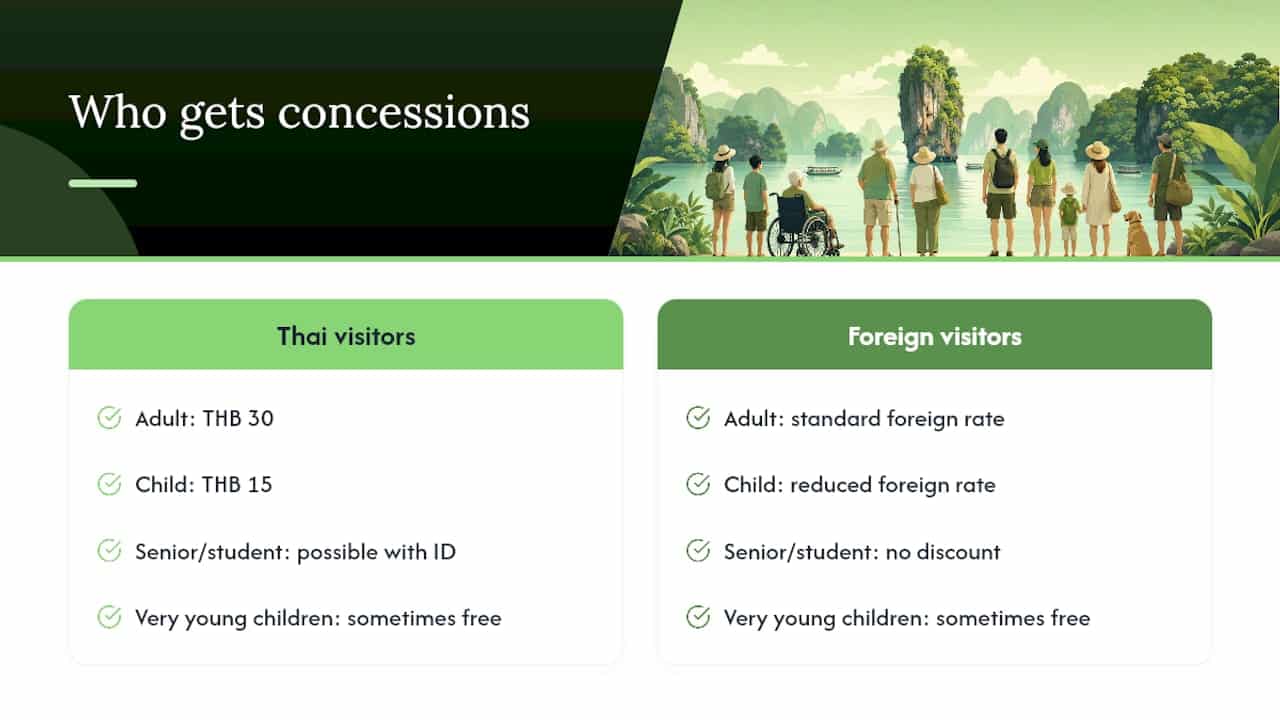
The practical takeaway: don’t expect a foreign senior or student discount here. Budget for the standard foreign adult or child rate unless you’re travelling on a Thai ID, and confirm any age-based child pricing with your operator before the trip so there are no surprises when the ranger boat pulls alongside.
Where to check current rates and operator practices
- Tourism Authority of Thailand’s Phang Nga Bay listing for official rates
- 5 Star Marine Phuket’s guide on how park fees are collected and bundled
- AsiaByLocals’ James Bond Island guide for typical day-tour price shapes
Why the “James Bond Island fee” confusion keeps costing travellers
Most of the friction around this fee has nothing to do with the amount. THB 300 isn’t a lot of money by any measure. The real problem is that people go looking for an “island fee” that doesn’t exist as a separate line item, then get blind sided when a ranger asks for cash mid-trip because they assumed the ticket price covered everything.
The conventional advice out there, “just book a tour and don’t worry about it”, is only half right. It works fine with a reputable shared speedboat operator. It falls apart the moment someone books a bargain longtail hire without asking the one question that actually matters: is the park fee included?
If you take one thing from this guide, make it that question. Ask it before you pay, get the answer in writing, and carry cash regardless of what you’re told. Everything else, the checklist, the timing tips, the conservation reminders, matters far less than that single confirmation.
— Carl
Skip the fee confusion entirely with Qbic Travel
Qbic Travel is the straightforward alternative to booking blind with an unfamiliar operator and hoping the park fee is included. Every Phang Nga Bay itinerary states upfront whether the national park entrance charge is bundled into your price, so there’s no cash surprise waiting at a ranger checkpoint. Beyond the bay itself, Qbic Travel Phuket runs jet ski tours, ATV adventures, and cultural excursions with hotel pick-up included, all backed by a 4.5 rating from 237 reviews and 99% issue-free service verified by Trustindex.

If you’re planning a wider Thailand trip beyond Phuket, this Bangkok itinerary guide is a useful companion for combining floating markets with your island days. For your Phang Nga plans specifically, check availability on a Phang Nga South Sea tour or send a quick WhatsApp message to confirm dates and pricing before your trip fills up.
Sources
- Phang-Nga Bay (Ao Phang Nga National Park)
- National Parks & Fees When Island Hopping Around Phuket (What You’re Actually Paying For) – 5 Star Marine Phuket
- James Bond Island 2026: Tours, Cost & Tips | AsiaByLocals


