
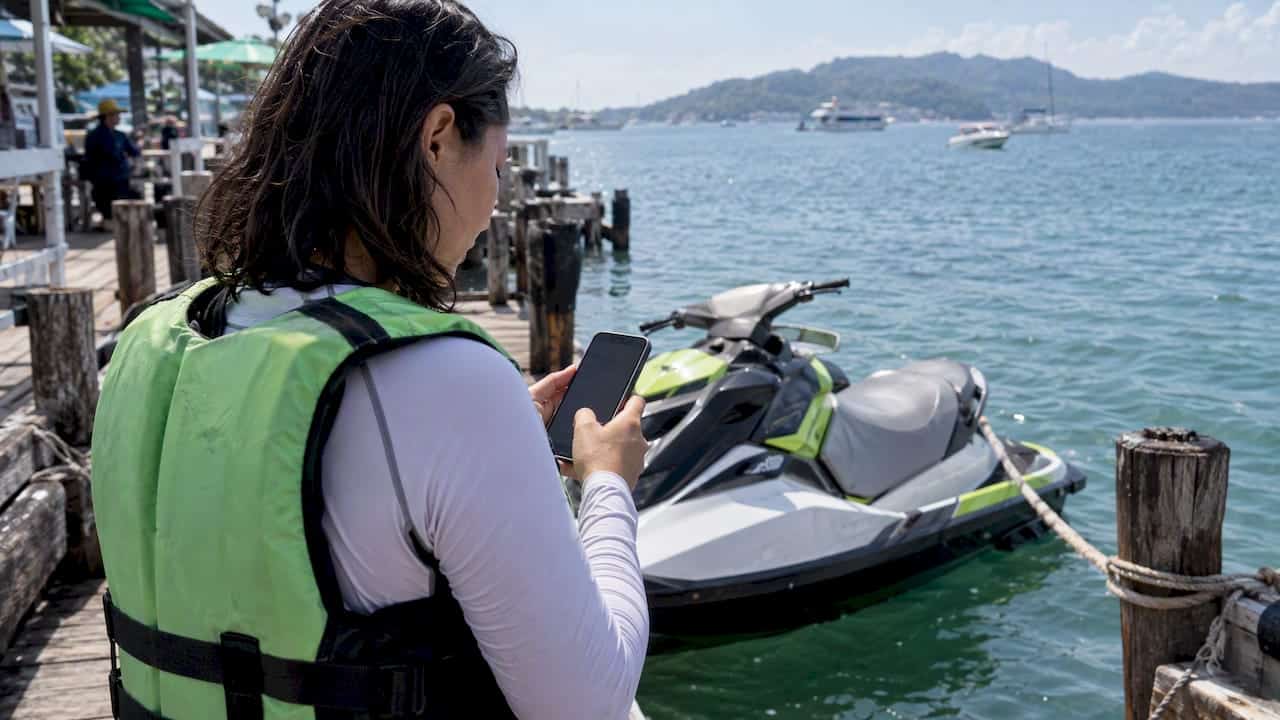
Jet Ski Insurance: Thailand’s 50,000 THB Floor Isn’t Your Cover
Do not assume your travel insurance covers a jet ski crash in Thailand. Many standard policies list jet-skiing under racing or extreme-sports exclusions unless you add an adventure-sport rider. Operator cover may exist, but it is usually modest and no substitute for your own medical and evacuation protection. Before you ride, read your exclusions and upgrade your policy if needed.
TL;DR:
- Search policy exclusions for racing, extreme sports, and water sports, then verify any rider applies to your travel dates and Thailand.
- Local reporting cites 50,000 THB as a vendor insurance benchmark for injury, death, and damage; it protects the operator, not your full medical costs.
- Check the evacuation limit, rehabilitation coverage after returning home, and emergency assistance; island or remote itineraries may call for a specialist plan with higher limits.
- Ask the operator for a current insurance certificate, clarify any damage deposit and excess, and save written insurer confirmation and emergency contact details on your phone.
Table of Contents
- How are jet ski incidents insured in Thailand?
- What do exclusions, limits and medevac mean for you?
- How do you check your policy wording?
- What policy options exist in Thailand?
- What should you ask before you ride?
- What should foreign visitors know about jet ski insurance?
- Our view on insurance for jet ski tours
- Book a vetted jet ski tour with us
- FAQ
- Sources
How are jet ski incidents insured in Thailand?
Two layers of protection sit behind most jet ski tours here, and they do very different jobs. Knowing which one you would be relying on is the key to avoiding an unpleasant surprise after an accident.
Operator cover exists mainly to satisfy local rules and protect the vendor. Local reporting from Pattaya documents municipal proposals and industry discussion citing a 50,000 THB minimum benchmark for vendor insurance covering damage, death and serious injury. That is a floor for the business, not a promise of full care for you.
Your own travel insurance is your main protection for hospital treatment and medical evacuation. The catch is the wording. Thai insurers publish policy documents that spell out what falls outside cover, and jet-skiing can sit in those lists.
Here is how the two layers usually compare:
- Operator policy: Often held to meet municipal expectations, with limits that reflect the 50,000 THB benchmark rather than serious trauma costs.
- Your travel policy: Covers treatment and evacuation, but only if the activity is not excluded.
- Adventure-sport rider: An add-on that can bring activities such as jet-skiing back into scope, depending on the insurer.
- Written proof: Sample insurer wording and operator certificates are the evidence you can actually check, so ask to see them.
The practical takeaway: treat operator insurance as a small safety net for the business, and treat your own policy as the thing that must actually work for you.
What do exclusions, limits and medevac mean for you?
The biggest financial risk is not a damaged jet ski. It is a serious injury far from a major hospital, followed by transfer and rehabilitation. That is where thin cover hurts.
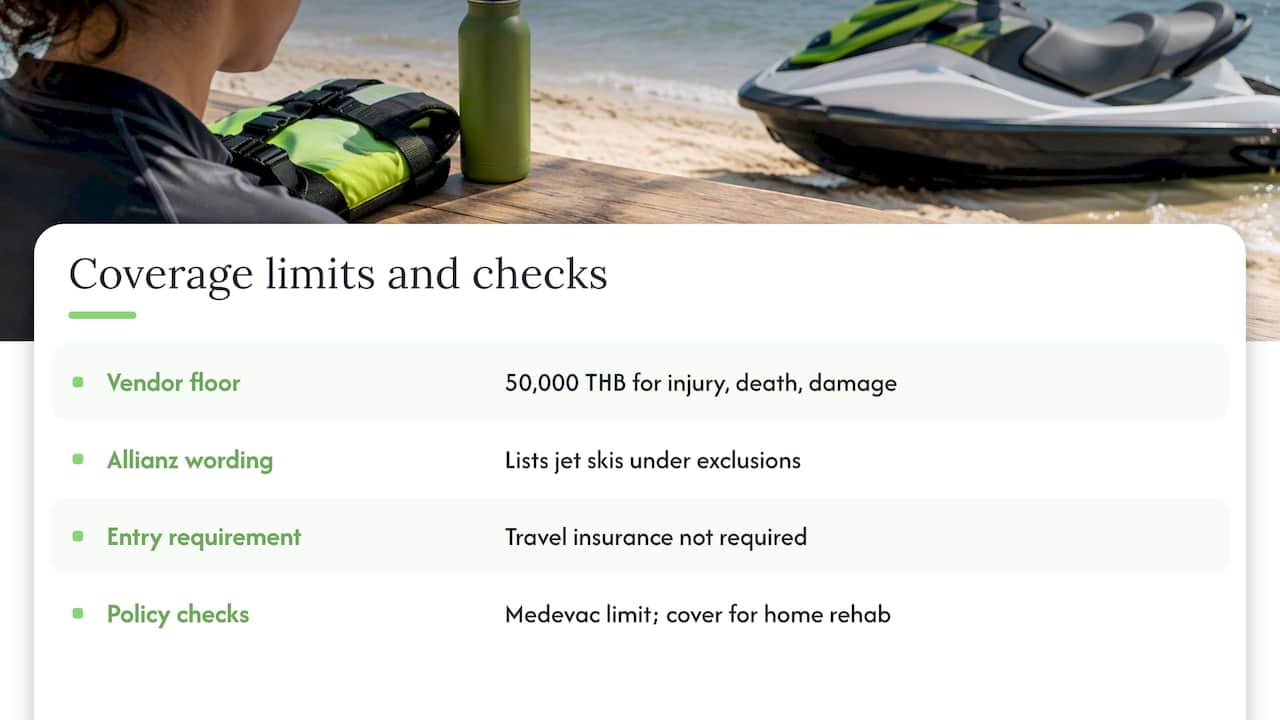
Many policies name jet-skiing directly. A sample Thai travel policy wording from Allianz lists jet skis within its racing and extreme-sports exclusions, alongside its notification and claims procedures. If an exclusion applies, your claim may not be covered. Check the policy wording and ask your insurer how the exclusion affects claims.
Operator benchmarks cited in Thailand sit at 50,000 THB for injury, death and damage. That is a minimum for vendors, and it is small next to the cost of a serious trauma case or an evacuation.
Why does that matter? Evacuation and specialist care can add substantially to the cost of an accident. A vendor minimum of that size is unlikely to stretch across both. So check two things in your own policy: the medevac limit, and whether rehabilitation after you return home is covered.
Thailand does not require travel insurance at entry, as RatesChaser’s market analysis points out. Nobody will check your policy at the pier, which is exactly why you should check it yourself.
How do you check your policy wording?
You do not need to read every page. Use search and look for the right phrases.
- Open the policy PDF and search for “exclusions”. Read every line that mentions water, racing or extreme activity.
- Search for “adventure sports”, “racing” and “water sports”. Jet-skiing often hides under racing or extreme sports.
- Look for inclusion language such as “recreational water sports included” or a named adventure-sports rider.
- Search for “medical evacuation” and note the limit, then “personal accident” and “equipment liability”.
- Check effective dates and territorial limits so the rider covers your travel dates and Thailand.
- If anything is unclear, contact your insurer or broker and request written confirmation before you sign any operator waiver.
A Roojai policy wording shows the pattern clearly: activities such as jet-skiing can fall under extreme-sports or racing exclusions, and an endorsement is often needed to obtain cover.
Pro Tip: Screenshot the page of your policy that confirms jet-skiing, or the email from your insurer, and keep it on your phone. If a dispute arises, you can show it in seconds.
What policy options exist in Thailand?
You have two broad routes: upgrade the policy you already hold, or buy a specialist plan built for activities. Which suits you depends on your itinerary and how much medevac cover you want.
- Roojai: Its published policy wording documents the extreme-sports and racing exclusions, and notes that an adventure-sports rider or endorsement is often required.
- Allianz Thailand: Its Travel Plus sample wording lists jet-skiing among its exclusions and sets out how to notify and claim.
- Asinlifes: Another Thai product example to compare for activity wording and assistance services.
- Specialist adventure plans: Short-term adventure or medevac-focused products are an option where available. RatesChaser recommends adventure-focused plans with high medevac limits for island-heavy or remote itineraries, naming World Nomads and IMG as examples.
- Local advice: Phuket-focused guidance suggests adding sports and activities coverage when booking jet ski, surfing or other active tours, and confirming that your policy includes it.
When you compare, line up three things side by side: whether jet-skiing is named as included, the medevac limit, and the emergency assistance service. A cheaper plan with a low evacuation limit can cost far more in the one situation you bought it for.
If your current insurer offers a rider at a sensible price, upgrading is usually the quickest fix. If your policy is basic and your trip involves boats, islands and activities, a dedicated short-term plan may be the better fit. Either way, buy it before you leave, because cover bought after an incident is worthless.
What should you ask before you ride?
Run through this list at booking or on the beach. It should be quick to check.
- Ask the operator to show their insurance certificate and explain what it covers.
- Ask whether a damage deposit or optional damage waiver applies, and what excess you would pay.
- Confirm with your insurer that jet-skiing is covered, whether you need an adventure rider, and what the medevac limit is.
- Ask for written confirmation where you can.
- Read any waiver properly. A general guide to liability waivers explains what these documents mean for you and why written confirmation matters.
We keep our own jet ski tour checklist for Phuket if you want a fuller pre-ride routine.
Pro Tip: Photograph the jet ski from every side before you ride. It protects you if the operator later disputes damage.
What should foreign visitors know about jet ski insurance?
As a visitor, your home-country policy and your Thai experience may not line up neatly. Here is what tends to matter most.
Your policy travels with you, so its wording decides everything. Operators in Thailand will rarely ask which insurer you use. If your plan excludes jet-skiing, the exclusion follows you onto the water, wherever in the world you bought it.
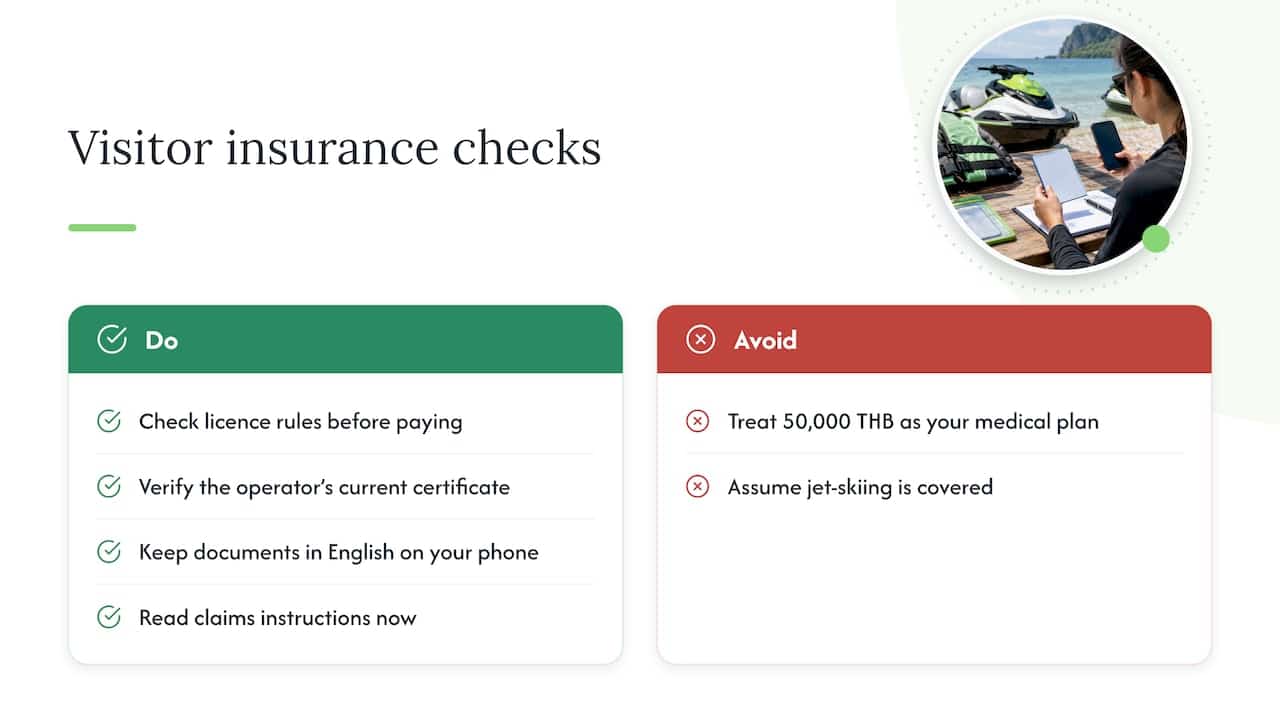
Operator cover is built around the vendor. The 50,000 THB benchmark reported in local coverage of vendor insurance is a business protection standard. Do not treat it as a stand-in for your own medical plan, especially if you may need evacuation off an island.
Licence and rule questions can affect bookings. Our guide to 2026 Phuket jet ski licence rules explains what can cancel a booking, and our overview of safe, legal riding in Phuket covers the local basics. Check these before you pay, because an insurer may look closely at whether the activity was carried out within the rules.
Verify the operator, not just the price. A trustworthy vendor can show you a current certificate, explain what it covers, and tell you plainly what is yours to arrange. If someone cannot or will not do that, treat it as a warning sign and pick another.
Keep paperwork in English and on your phone. If you are hurt, you will want your policy number, your insurer’s emergency line and your written confirmations ready. Hospitals and insurers move faster when you hand them clear documents.
Finally, read the claims instructions now, not later. The Allianz sample wording sets out notification steps, so check your own policy and follow its instructions.
Our view on insurance for jet ski tours
We think most visitors underestimate this decision. People will spend hours choosing a beach and almost no time reading the one document that protects them if something goes wrong. Our advice to guests is simple: read your own wording before arrival and add an adventure-sport rider where you need one. During booking and the pre-departure briefing, our team is available to answer your questions, so nothing comes as a surprise at the pier. The best day on the water is the one where the paperwork is already sorted.
— Carl
Book a vetted jet ski tour with us
Once your cover is sorted, the fun part is easy. We run jet ski tours in Phuket, and we are happy to talk through insurance before you commit. Browse our jet ski tours or see the wider range of Phuket adventure tours, then message us on WhatsApp with any questions.

This article is general information, not a substitute for advice from a qualified doctor. Consult a qualified healthcare professional about your own circumstances before acting on anything here.
FAQ
Does travel insurance cover jet skis?
Often not by default. Many policies list jet-skiing under racing or extreme-sports exclusions, so you may need an adventure-sports rider. A sample Thai policy wording shows this exclusion in practice, so check your own document.
Is travel insurance compulsory for Thailand?
No. Travel insurance is not a condition of entry, but RatesChaser recommends adventure-focused plans with high medevac limits for island-heavy itineraries. Without it, you carry the full cost of any treatment yourself.
Does the operator’s insurance cover me?
Only partly, and usually in a limited way. Operator policies mainly protect the business, and local reporting cites a 50,000 THB benchmark for vendor cover. Ask to see the certificate and keep your own medical cover in place.
What should I do if I am injured on a jet ski tour?
Get medical help first, then contact your insurer’s emergency line and keep every receipt and report. Notify your insurer promptly, because claims procedures set out notification steps that you should follow closely. Photograph the equipment and note the operator’s details.
Sources
- Pattayamail
- Roojai Have Fun Individual International Travel Insurance Policy (Sell through electronic channel (Online))
- Personal Outbound Travel Insurance Policy Travel Plus
- Travel Insurance for Thailand: Is it Required, What to Cover, and Best Plans for 2026 – Rates Chaser


