

Pick Phuket Jet Ski Routes by Pace and Safety, Not Island Count
For most travellers, three route styles cover the field: a classic six-island run for balanced riding and snorkelling, an extended nine-island route for those who want more stops and beach time, and a short Khai islands trip for families or anyone tight on time. Whichever you pick, check the operator displays a visible licence number and runs a proper safety briefing before you climb on.
TL;DR:
- Choosing a route should be based on pace and stops, as nine-island tours can be physically demanding with rushed photo passes, while shorter trips prioritize leisure.
- Operators typically depart from east coast piers near Phang Nga Bay, using loop routes or linear out-and-back paths that influence the scenery and cruising time.
- Confirm whether stops are beach landings or photo passes, as actual pacing and experience depend more on stop quality than the total number of islands visited.
- Weather conditions significantly impact route length and island accessibility, often leading operators to shorten tours or delay departures during monsoon season.
- Safety and licensing are non-negotiable; ensure the operator displays a license, provides a safety briefing, and adheres to environmental regulations on protected coral and wildlife.
Table of Contents
- Jet ski routes Phuket: comparing your options at a glance
- How to read a Phuket jet ski route map
- Detailed route breakdowns: which islands you’ll actually visit
- How to choose the right jet ski route for your group
- Is jet skiing legal and safe everywhere in Phuket?
- What a jet ski tour costs and what’s usually included
- Why route planning quality matters more than route length
- Do you need experience to ride, and are there age limits?
- What happens if something goes wrong on the water?
- Can you customise a route or book a private charter?
- What environmental rules apply along the routes?
- Book your Phuket jet ski route with Qbic Travel
- A local take on choosing jet ski routes in 2026
- Sources
Jet ski routes Phuket: comparing your options at a glance
Every operator markets its trips slightly differently, but almost all guided jet ski routes in Phuket fall into a handful of predictable patterns. Knowing the shape of each one before you book saves you from paying for a nine-island adventure when what you actually wanted was a relaxed morning with the kids.
Here’s how the main route styles stack up:
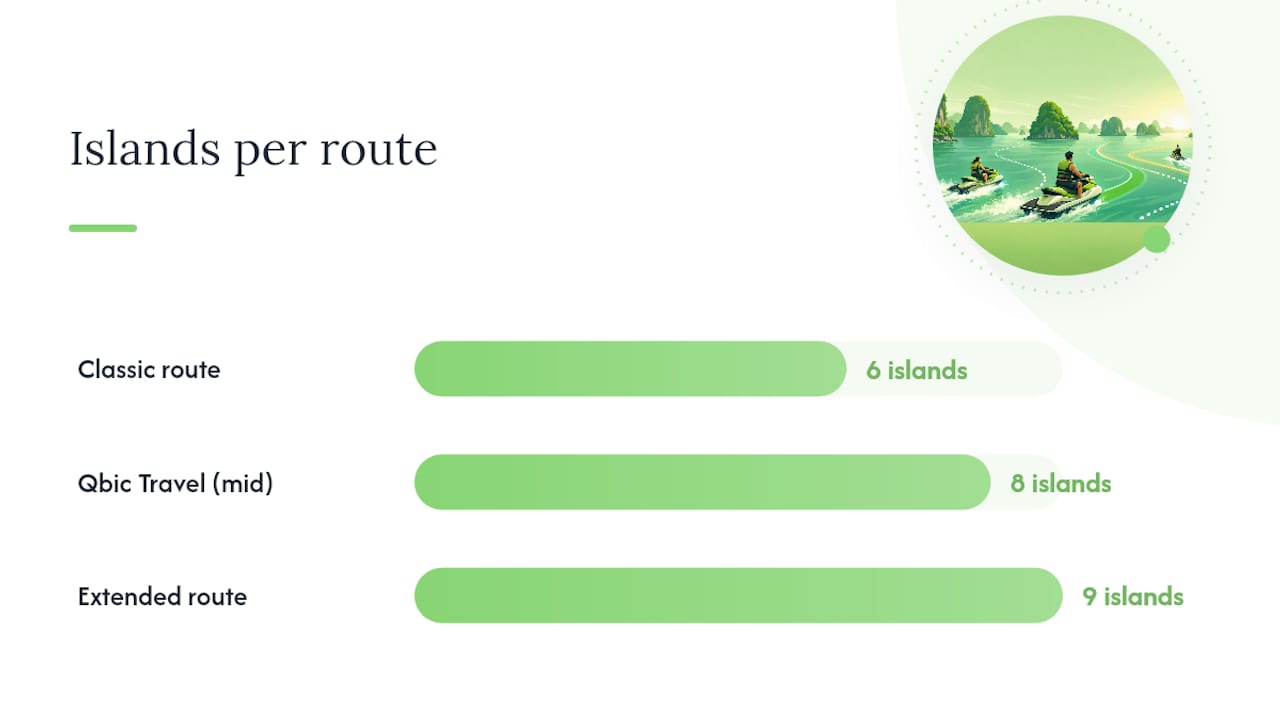
- Classic 6-island route. Roughly 4 hours including transfers, stopping at islands such as Phae, Hum, Monkey Island, Naka Yai, Naka Noi and Rang Yai. Best for riders who want a mix of open-water riding and beach downtime. Typical price tends to be moderate for a half-day tour.
- Extended 9-island route. Around 5 to 6 hours, adding islands and extra snorkel stops to the classic run. Best for experienced riders and keen snorkellers who don’t mind a longer day at sea. Sits at the top of the half-day/full-day price scale.
- Khai islands and short coastal runs. Typically 2 to 3 hours, focused on one or two calm, close-in islands. Best for families, first-timers, or travellers with limited time. The most affordable of the three.
Most guided tours in Phuket run out on the east coast, so expect your route map to trend generally southeast or east from the mainland toward islands scattered between Phuket and the mouth of Phang Nga Bay, rather than west into open sea. That orientation matters for planning: a route map showing islands clustered tightly together usually means shorter transit legs and more time actually stopped, while a spread-out map means longer high-speed cruising between stops.
Build in extra time before the ride itself starts, and see our guide on how to ask directions in Thai for helpful phrases to navigate pickups and transfers smoothly. Hotel transfers, gearing up, and the safety briefing routinely add an hour or more either side of the riding time listed on the tour page, so a “4-hour” tour can easily fill half your day once pickup and drop-off are factored in.
How to read a Phuket jet ski route map
A route map on a tour listing tells you far more than a simple list of island names. Once you know what you’re looking at, you can spot the difference between two tours that sound almost identical.
Start with the departure pier. Most extended island routes leave from piers on the east coast such as Yamu Pier or AA Marina, since these give the most direct access to the island clusters near the mouth of Phang Nga Bay. A pier further north or south changes the whole shape of the loop, so two “6-island” tours departing from different piers can visit genuinely different islands.
Next, work out whether the route is a loop or a there-and-back line. A looping route generally means less repeated scenery and a steadier rhythm of new stops; a linear out-and-back route often means you retrace the same water twice, which some riders enjoy for the extra riding time and others find repetitive.
Finally, distinguish a beach stop from a photo stop. A beach stop means you get off the jet ski, walk on sand, and usually snorkel or eat lunch. A photo stop is a slow pass close to a scenic island or rock formation with no landing. Tour descriptions don’t always separate these clearly, so check the itinerary wording carefully.
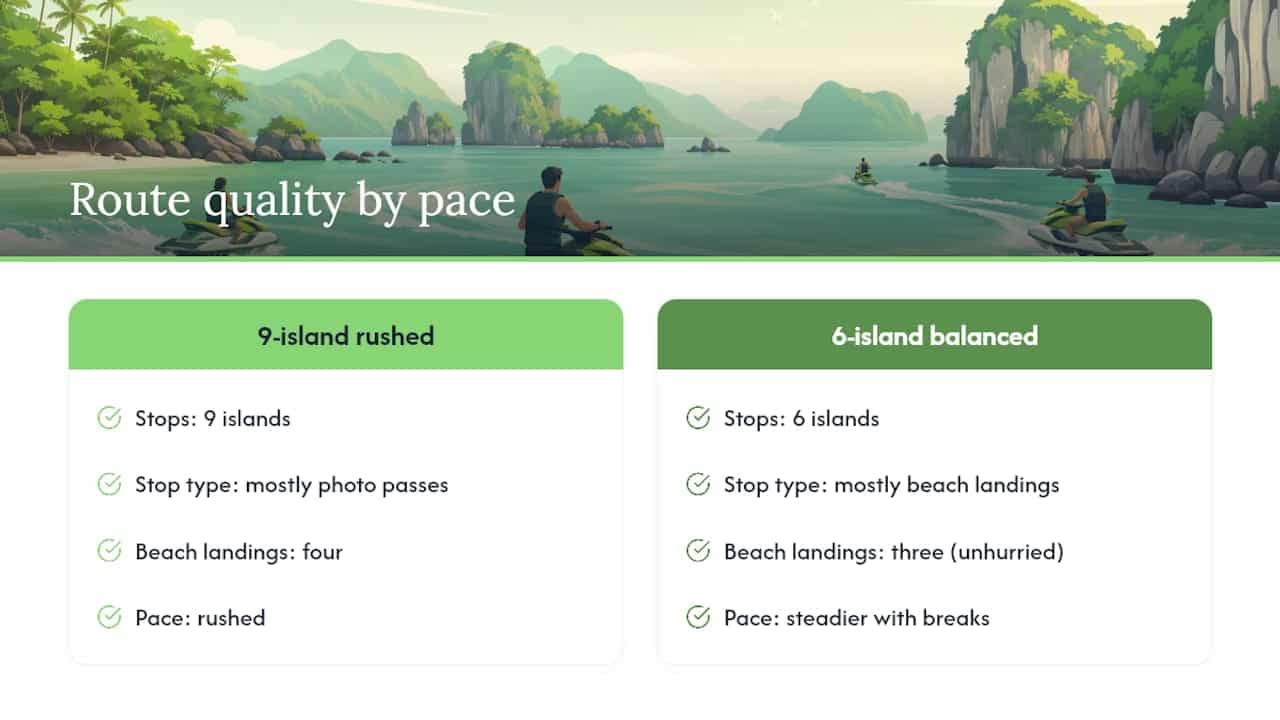
Stop count alone tells you surprisingly little. A nine-island tour with five rushed photo passes and four real beach stops can feel shorter and less satisfying than a six-island tour with three unhurried stops. Operators typically balance rider fatigue by alternating short high-speed legs with longer, slower cruising legs and scheduled beach breaks. Pace matters more than the number printed on the tour title.
Weather also reshapes routes more than most first-time visitors expect. During stronger monsoon swell, particularly from May through October, operators will often shorten a route, swap an exposed island for a sheltered one, or delay departure by an hour or two to let conditions settle.
Pro Tip: Ask the operator directly which stops on the map are beach landings and which are just a slow pass. That one question tells you more about the real pace of the day than the island count ever will.
Detailed route breakdowns: which islands you’ll actually visit
Route names get thrown around loosely in Phuket marketing, so it helps to know what each style genuinely involves before you commit.
-
Classic 6-island route. This is the workhorse itinerary and the one most first-time jet ski tourists book. Expect stops at a combination of Phae Island, Hum Island, Monkey Island, Naka Yai, Naka Noi and Rang Yai, though the exact order and pairing varies by operator. Monkey Island usually gets the most excitement, since long-tailed macaques come down to the shoreline, though guides will remind you not to feed or touch them. Naka Yai and Naka Noi tend to have the calmer, clearer water for a swim, while Rang Yai often serves as the lunch stop with a proper beach and shade. This route suits riders who want variety without an exhausting day.
-
Extended 9-island route. This builds on the six-island pattern by adding further stops, usually pushing further into island clusters with better coral visibility. The extra distance and extra time on the water make this the pick for confident riders who enjoy longer stretches at sea and want more snorkelling time rather than more riding time. Photographers often prefer this option too, since the additional stops usually include quieter coves away from the busier beach landings on the shorter route. The trade-off is straightforward: more islands means a longer, more physically tiring day, and less flexibility if the weather turns midway through.
-
Khai islands and short coastal runs. These trips concentrate on one or two nearby islands, most often variations on the Khai Nok and Khai Nai group, and keep total riding time down to two or three hours. Shorter runs around calmer islands suit families and photographers well because they minimise time spent in open swell and focus almost entirely on calm, shallow snorkel spots. If you’ve got young children, older relatives, or simply half a day free before a flight, this is the sensible choice over a longer island-hopping route.
Private and group variants exist across all three styles. A private charter usually means your own guide and jet ski allocation rather than joining a mixed group, which suits couples wanting a slower pace or families who don’t want to keep up with faster riders. Group tours cost less per person and often run on a fixed schedule, which works fine if your priorities are budget and simplicity over flexibility.
Qbic Travel’s Seadoo GTX 8 point jet ski tour and its 8-island jet ski tour both sit in that extended, multi-stop category, giving riders who want more than the classic six-island loop a well-paced middle ground between the two extremes described above.
How to choose the right jet ski route for your group
Matching the route to your group is mostly a question of four things: experience, fitness, time, and what you actually want out of the day.
If nobody in your group has ridden a jet ski before, or you’re travelling with young kids, lean toward the Khai islands or a short coastal run. If your group is confident on the water and keen to snorkel at several spots, the extended nine-island route rewards the extra stamina. If you want a solid middle ground, the classic six-island route rarely disappoints.
Before you hand over any money, ask the operator these questions:
- What condition is the equipment in, and how old are the jet skis?
- What’s the ratio of guides to riders on the tour you’re booking?
- Is accident insurance included, or is it an optional extra?
- Are hotel transfers included in the price, and how long do they take?
- What happens to your booking if weather cancels the trip?
Watch for red flags too. No visible licence number on the jet ski’s bow, no safety briefing before you set off, or heavy pressure to upgrade to a pricier package on arrival are all signs to walk away and book elsewhere.
Pro Tip: A reputable operator will happily answer every one of those five questions before you pay a deposit. Hesitation or vague answers on safety questions specifically is the clearest warning sign there is.
Is jet skiing legal and safe everywhere in Phuket?
Jet skiing is not permitted at every beach in Phuket. Legal operations concentrate at a defined set of beaches, and licensed operators display a licence number painted on the bow of each craft. Treat that painted number as your first checkpoint before you ride with anyone.
Riders also need to respect designated boundaries once out on the water. Swimming zones are marked and jet skis should keep well clear of them, both for swimmers’ safety and to avoid conflicts with lifeguards or marine police patrolling popular beaches.
Beyond the licence check, a short safety checklist covers most of what actually matters on the day:
- Confirm lifejackets are provided and properly fitted before departure.
- Ask to see the jet ski’s condition; scratches and dents matter less than a working ignition kill-switch and functioning throttle.
- Expect a short weather and conditions briefing, including what happens if the sea state changes mid-tour.
- Clarify age and rider limits with the operator, since these vary by tour and craft.
A visible licence number combined with an obvious, unhurried safety briefing correlates strongly with reputable operators in Phuket, so treat both as non-negotiable before you commit to a tour.
What a jet ski tour costs and what’s usually included
Half-day guided tours in Phuket typically sit in a mid-range price bracket, with full-day or extended nine-island routes commanding a premium over the classic six-island loop. Price tends to rise with total distance covered, number of confirmed beach stops, and whether lunch and insurance are bundled in rather than sold as extras.
Common inclusions across most reputable tours are hotel transfers, snorkel gear, and safety equipment including lifejackets, with some operators also folding in accident insurance as standard. Optional extras usually cover underwater cameras, professional photo packages, and premium lunch upgrades.
A typical day runs roughly like this: hotel pickup in the morning, a 20 to 40 minute transfer to the pier, a safety briefing and gear fitting, then four to five hours of riding and stops before returning to the pier in the early afternoon, followed by the return transfer to your hotel. Build a realistic six-hour window around any “half-day” tour once transfers are counted in.
Why route planning quality matters more than route length
A well-planned itinerary reduces rider fatigue by pacing high-speed legs against slower cruising and proper beach breaks, rather than cramming in stops for the sake of a bigger number on the tour listing. That’s the difference between an exhausting blur of islands and a day you actually remember clearly.
Qbic Travel reports 99% issue-free service, verified by Trustindex, alongside a 4.5 average rating from 237 reviews. Tours commonly bundle transfers, safety gear and guiding into one price rather than nickel-and-diming riders on extras once they arrive at the pier.
Personalised options, such as adjusting stop order or extending time at a favourite beach, cost a little more but suit groups with specific priorities: keen snorkellers wanting longer at one reef, or families wanting extra time at Monkey Island rather than rushing through.
Do you need experience to ride, and are there age limits?
No prior jet ski experience is required for guided tours in Phuket. Every reputable operator runs a safety briefing covering throttle control, turning, and the kill-switch lanyard before anyone leaves the pier, and guides stay close to newer riders for the first stretch of open water.
That said, comfort in water and basic swimming ability matter more than any technical skill. Guided tours involve some open-water riding between islands, and while lifejackets are mandatory, a nervous non-swimmer will have a harder day than someone who’s simply never touched a jet ski before.
Age limits vary by operator and by craft, but most tours set a minimum rider age for solo control of a jet ski, with younger children typically allowed to ride as a passenger behind an adult rather than controlling the throttle themselves. If you’re travelling with kids, confirm the exact minimum age and passenger policy directly with the operator when booking, since this differs from one tour to the next and isn’t always listed clearly on the tour page.
Fitness needs are modest for most routes. The classic six-island and Khai islands routes suit almost any reasonably active adult. The extended nine-island route asks a bit more of your arms and core simply because you’re on the throttle for longer, so anyone with recent back or shoulder issues should mention it before booking.
What happens if something goes wrong on the water?
Every guided tour should cover emergency procedures during the pre-departure safety briefing, not as an afterthought. Guides typically ride at the front and back of the group, which means help is never more than a few minutes away if a jet ski stalls or a rider needs to stop.
Most tours communicate between guides and riders using hand signals for basic instructions like slow down, stop, or follow, since engine noise and wind make shouted instructions useless once you’re moving. Some operators supplement this with waterproof radios carried by lead guides, particularly on longer nine-island routes where the group can spread out over more distance.
If a jet ski breaks down mid-route, standard practice is for a guide to tow the affected craft back to the nearest island stop or all the way to the pier, while the rest of the group either waits at the next scheduled stop or continues with a second guide. Ask about this specific scenario when booking, since it’s a fair test of how organised an operator actually is.
Basic first aid kits are standard kit on the lead and rear guide vessels, and any operator worth booking will have a clear plan for contacting emergency services from open water, whether via mobile signal near the coast or radio further out. If an operator can’t describe this plan when you ask, that’s worth treating as seriously as a missing licence number.
Can you customise a route or book a private charter?
Yes. Most operators offering the classic six-island or extended nine-island routes will adjust the itinerary for private bookings, whether that means spending longer at a favourite beach, skipping a stop nobody in your group cares about, or starting earlier to beat the crowds at popular islands like Monkey Island.
A private charter typically means your own dedicated guide rather than joining a scheduled group departure, and it’s the better option for couples wanting a slower, quieter pace, or families who don’t want to keep pace with faster solo riders. Expect to pay more per person for that flexibility, since the operator isn’t filling every seat on a shared boat and guide.
Customisation usually has practical limits though. Weather and sea conditions still dictate which islands are safely reachable on the day, and some islands sit within zones with restricted access that no amount of private booking can override. A good operator will tell you honestly which parts of a route are fixed and which are genuinely flexible, rather than promising anything you ask for and adjusting on the day.
If your priority is more islands rather than more time at fewer islands, ask about extending a six-island route toward the fuller nine-island pattern rather than booking a separate tour, since operators can often bolt on extra stops for groups willing to add an hour or two to the day.
What environmental rules apply along the routes?
Phuket’s popular jet ski islands carry real environmental pressure from tourism traffic, and most reputable operators build simple protective habits into their routes as standard practice rather than an afterthought.
Monkey Island’s macaques are a major draw on the classic six-island route, but guides consistently instruct riders not to feed or touch the animals, both for visitor safety and to avoid disrupting natural foraging behaviour that repeated tourist feeding can damage over time.
Coral areas around islands like Naka Yai, Naka Noi and the Khai islands are sensitive to contact damage, so snorkel stops typically involve anchoring or mooring away from live coral, with swimmers briefed to avoid standing on or touching reef structures. Sunscreen choice matters here too: reef-safe, mineral-based sunscreen reduces chemical runoff compared with standard formulas, and it’s worth packing regardless of which route you book.
Speed restrictions near shorelines and swimming zones exist partly for swimmer safety and partly to limit wake damage to shallow coral and seagrass beds close to popular beaches. Expect guides to slow the group noticeably as you approach any beach landing, and treat that slowdown as a genuine environmental measure rather than needless caution.
Book your Phuket jet ski route with Qbic Travel
If you’ve read this far, you already know the routes worth choosing between: a classic six-island loop, an extended multi-stop run, or a short family-friendly trip. Qbic Travel runs guided tours that map directly onto those styles, including the Seadoo GTX 8 point jet ski tour and the 8-island jet ski tour, both built around the extended, multi-stop pace this guide recommends for riders who want more than a quick beach loop.

Every route on the jet ski tours page lists duration, stops, and inclusions upfront, so you can compare against the checklist covered above before you commit. Booking runs through the website or WhatsApp, with hotel transfers arranged as part of the package rather than left for you to organise separately. Qbic Travel’s 4.5 average rating from 237 reviews and its 99% issue-free service record, verified by Trustindex, back up what the safety checklist in this guide asks you to look for in any operator.
If you’re still weighing up a shorter option, the 5-island route or 7-island route give you a middle ground between the short Khai islands trip and the fuller nine-island day. Pick your route, check availability for your dates, and book directly online or via WhatsApp to lock in your slot.
A local take on choosing jet ski routes in 2026
The biggest mistake I see travellers make isn’t picking the wrong route style, it’s picking based on island count alone. A nine-island tour sounds like better value than a six-island one until you’re the rider who wanted a slow lunch on Rang Yai and instead got hustled through five rushed photo passes.
Ask about pace before you ask about the map. Thailand’s coastal rules on permitted beaches and licence numbers exist for good reason, and they’re the fastest filter for separating a properly run operator from one cutting corners. Beyond that, match the route to how your group actually wants to spend the day, not to the biggest number on the tour listing.
— Carl
Sources
- Where to Ride Jet Skis in Phuket – Phuket Insider
- Things you need to know when jet skiing — Sunsuri Phuket
- Phuket: Jet Ski Tour to 9 Islands with Lunch & Transfers, Phuket | My Guide Phuket


