

How adventure travel builds local economy: a complete guide
How does adventure travel build local economies?
Adventure travel builds local economies by creating jobs, circulating money through local businesses, and funding community development in rural and underserved areas. Unlike mass tourism, which often funnels spending towards international hotel chains and centralised operators, adventure travel is structurally tied to local supply chains. Guides, guesthouses, food vendors, artisans, and transport providers all benefit directly when travellers choose authentic, place-based experiences.
Here is a quick overview of the core economic impacts:
- Direct job creation in guiding, hospitality, catering, equipment hire, and transport, particularly in rural communities with few alternative income sources
- Support for local businesses including family-run accommodations, independent restaurants, and craft sellers, keeping tourist spending within the destination
- Reduced tourism leakage by favouring locally owned services over international corporate operators, so more money stays in the community
- Increased local tax revenues from tourism activity, which governments can reinvest in public services and infrastructure
- Multiplier effects that spread spending beyond direct tourism businesses into agriculture, manufacturing, and retail
- Alignment with UN Sustainable Development Goals, particularly SDG 1 (no poverty), SDG 8 (decent work and economic growth), and SDG 11 (sustainable communities)
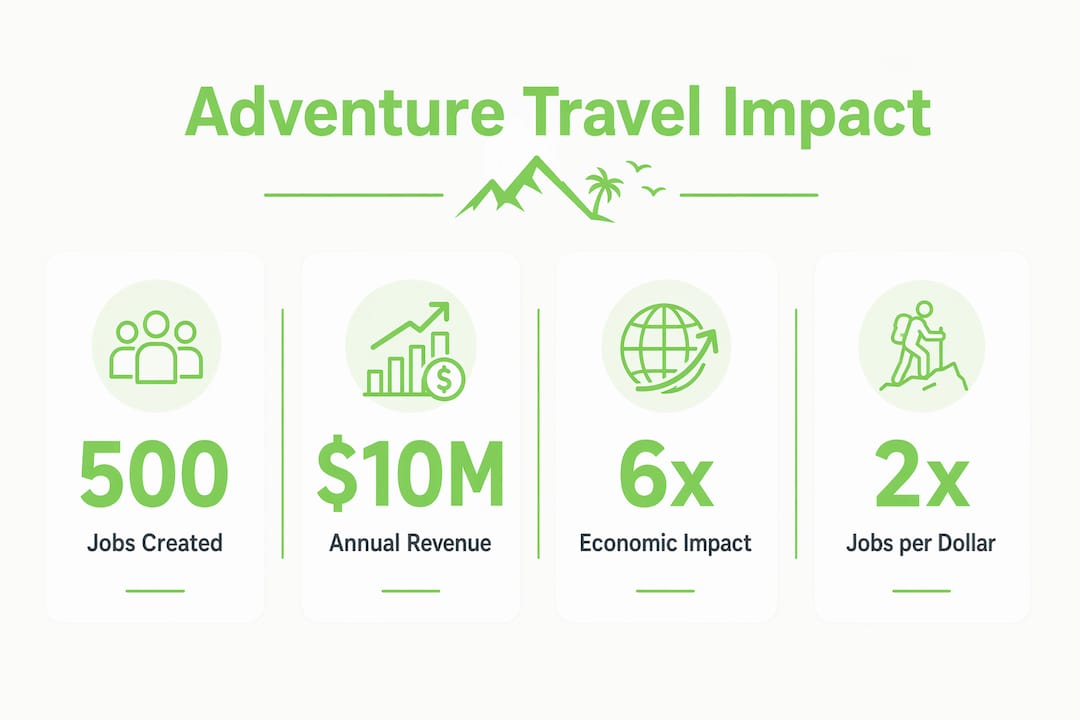
Research in Jordan found that adventure travel could create up to 500 new jobs and $10 million USD annually, delivering six times the local economic impact of conventional mass tourism. That figure alone tells you why destination planners and development agencies are paying close attention.
What are the real economic benefits for local communities?
Adventure tourism is one of the most labour-intensive forms of travel, and that quality is what makes it such a powerful economic tool for rural communities. Because it relies on human expertise, local knowledge, and physical terrain rather than automated systems or centralised infrastructure, it generates employment at a rate that other sectors simply cannot match. The Harvard Center for International Development notes that tourism’s labour intensity means a growing sector directly expands employment for disenfranchised populations, driving more inclusive economic growth.
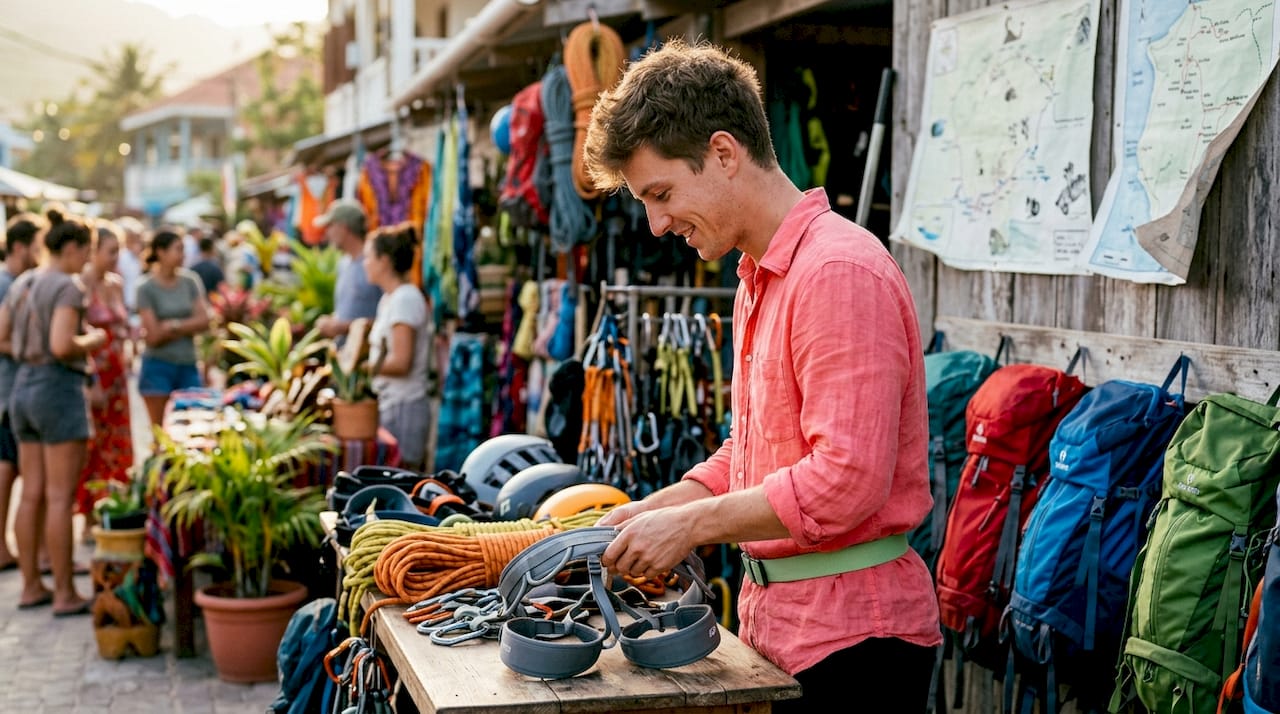
The multiplier effect is where the real power lies. When a traveller pays a local guide, that guide spends their wages at a local market. The market owner pays a local farmer. The farmer invests in equipment from a local supplier. Each transaction amplifies the original tourist spend, circulating money through the community rather than extracting it. Economic input-output models such as IMPLAN allow destination managers to map and predict exactly how these flows work, identifying which investments in adventure tourism activities will generate the greatest return in jobs, wages, and tax revenues. This kind of modelling transforms adventure tourism from a vague aspiration into a measurable development strategy.
The South African example is particularly striking. The country’s adventure tourism sector contributed substantial economic value and supported tens of thousands of jobs, illustrating how extended value chains carry benefits well beyond the immediate tourism businesses into related industries and regional economies.
Key figure: Research comparing adventure and mass tourism found that adventure travel creates nearly twice the jobs in local communities for every dollar generated, and integrates more local businesses into the tourism supply chain.
| Economic indicator | Adventure tourism impact |
|---|---|
| Jobs created per dollar generated | Nearly twice that of mass tourism |
| Jordan case study: annual job creation potential | Up to 500 new jobs |
| Jordan case study: annual revenue potential | $10 million USD |
| South Africa: sector economic contribution | $1.37 billion |
| South Africa: jobs supported | 91,000 |
| Local impact multiplier (Jordan research) | Six times the impact of mass tourism |
Research in Jordan showed that adventure travel can deliver six times the local economic impact of mass tourism by reaching a wider range of local businesses.
Small and medium enterprises benefit disproportionately from adventure tourism growth. Backpackers and adventure travellers tend to spend across a wider range of local businesses, engage in more activities, and stay longer than package tourists. The ATTA report on sustainable experiences confirms that supporting local accommodations, guides, and artisans is central to achieving decent work and poverty reduction targets. These are not abstract goals. They translate into real wages for real people in communities that often have very limited economic alternatives.
How does adventure tourism support cultural heritage and community empowerment?
Adventure travel preserves cultural heritage most effectively when local communities are active participants rather than passive backdrops. The most compelling experiences on the market today involve Indigenous and First Nations guides who bring genuine expertise, personal history, and cultural depth to every trip. Micro-adventures and day trips led by these guides are growing rapidly, and the ATTA’s research confirms that this model benefits both sides: tourists gain authentic, first-hand knowledge of local history and culture, while communities generate income from sharing their heritage. Understanding why local storytelling enhances cultural tours helps explain why these experiences consistently outperform generic sightseeing in visitor satisfaction.
Community empowerment through adventure tourism takes several practical forms:
- Training and apprenticeships that give local residents the skills to work as guides, instructors, and hospitality professionals
- Volunteer and conservation schemes that connect travellers with community projects, generating both income and goodwill
- Artisan and craft markets that give local makers a direct route to tourist spending, sustaining traditional skills and cultural products
- Community-based tour design that ensures experiences are developed with local input, respecting customs and avoiding exploitative commercialisation
- Women-owned businesses receiving direct support, since many local artisan and hospitality enterprises are run by women, contributing to gender equality alongside economic growth
Spending on local artisans and cultural products keeps traditions alive in a way that no museum or heritage grant can fully replicate. When a traveller buys a handmade textile or joins a cooking class led by a local family, they are funding the continuation of a living culture. The challenge, acknowledged honestly in the ATTA’s findings, is that accommodation in community-based tourism is sometimes owned by non-local investors, which can dilute the economic benefit to residents. Conscious choices about where to stay and who to book with make a genuine difference to how much of that spending reaches the community directly.
How does adventure travel promote environmental stewardship?
Adventure tourism and environmental conservation are more closely linked than most travellers realise. The natural landscapes that draw adventure seekers, whether mountain trails, coastal waters, or dense forests, are the very assets that local communities depend on for their livelihoods. Protecting those environments is therefore an economic priority, not just an ethical one.
Sustainable adventure travel practices that protect both ecosystems and local income include:
- Renewable energy use in accommodations and tour operations, reducing carbon footprint and cutting long-term operating costs for local businesses
- Waste reduction and water conservation programmes that prevent environmental degradation at popular sites
- Local sourcing of food and supplies, which reduces transport emissions, supports local farmers, and keeps spending within the destination economy
- Traveller education on respectful engagement with nature and local culture, reducing damage to fragile ecosystems and cultural sites
- Wildlife and habitat conservation integrated into tour experiences, giving communities a financial incentive to protect rather than exploit natural resources
The ATTA’s sustainable experiences framework places ecological stewardship, social integrity, and economic vitality as three equally weighted pillars of responsible adventure travel. When operators source staff and materials locally, offer eco-certified food, and design experiences that immerse travellers in nature without degrading it, they create a product that is both commercially attractive and genuinely sustainable. Travellers who choose these operators are not just having a better experience. They are actively funding the conservation of the places they visit.
Does adventure tourism drive infrastructure improvements in rural areas?
Adventure tourism consistently drives infrastructure investment in places that conventional tourism ignores. When travellers want to reach remote mountain villages, coastal trails, or inland waterways, roads need upgrading, accommodation needs building, and local services need developing. That investment benefits residents year-round, not just during the tourist season.
Key infrastructure and development pathways linked to adventure tourism growth:
- Road and transport improvements that connect rural communities to markets, healthcare, and education, as well as to tourist entry points
- Accommodation development ranging from family-run guesthouses to eco-lodges, creating both construction jobs and long-term hospitality employment
- Digital connectivity investments that allow local businesses to market themselves online and manage bookings, reducing dependence on external operators
- Diversification of economic activity beyond crowded traditional tourism hubs, spreading growth into secondary destinations that would otherwise miss out
- Public-private partnerships between local governments and adventure tourism operators that share the cost and benefit of infrastructure development
The World Economic Forum highlights that destination management organisations expanding their products into diverse regions can address overcrowding while bringing capital to communities that would otherwise lack access to it. That positive impact naturally extends to improved infrastructure and resources. Seasonality remains a real challenge: many rural adventure destinations see visitor numbers drop sharply outside peak months, which can leave infrastructure underused and local workers without income. Strategic destination management, including year-round product development and targeting domestic visitors during off-peak periods, helps smooth those fluctuations and maintain a more stable economic base.
Pro Tip: If you are planning an adventure trip to a rural destination, look for operators who run year-round programmes rather than seasonal-only offerings. Year-round operators tend to employ local staff on longer contracts, which creates more stable livelihoods for the community.
How can you maximise your positive economic impact as a traveller?
The single most effective thing you can do as an adventure traveller is keep your spending local. Every pound or dollar you direct towards a locally owned guesthouse, a community guide, or a family restaurant stays in the destination economy rather than flowing back to a head office in another country. The ATTA confirms that choosing locally guided tours, locally owned accommodations, and local artisans prevents tourism leakage and directly stimulates economic growth in and around destinations.
Here is how to make your adventure travel spending count:
- Book locally owned accommodation such as family guesthouses, community lodges, or independent eco-stays rather than international chain hotels
- Hire local guides who bring genuine knowledge of the terrain, culture, and wildlife, and whose income stays in the community. The role of local guides in sustaining destination economies is often underestimated
- Eat at locally owned restaurants and try regional dishes, which also supports local farmers and food producers through the supply chain
- Buy from local artisans and vendors rather than souvenir shops stocked with imported goods
- Participate in community-based tours and cultural experiences that are designed and led by local residents
- Engage with local conservation or social projects during your trip, contributing time or donations alongside your spending
- Choose local cuisine as part of your experience. Understanding how local food supports tourism economies helps you see every meal as a direct contribution to the community
Pro Tip: Ask your tour operator directly what percentage of your booking fee goes to local staff and suppliers. Operators who can answer that question clearly are the ones genuinely committed to community benefit.
Small and medium enterprises are where your spending has the greatest impact. Backpacker-style adventure travellers who engage with more activities and stay longer actually generate more local economic activity than high-spending package tourists, because their money reaches a wider range of local businesses. Choosing adventure over all-inclusive is, in economic terms, a more generous act than it might appear.
What do authoritative research and industry bodies say?
The evidence base for adventure tourism’s economic impact has strengthened considerably over the past decade, moving from anecdote to rigorous modelling. Three sources stand out for their authority and specificity.
Key finding: The Adventure Travel Trade Association (ATTA) projects the value of international adventure tourism at US$683 billion, with the International Finance Corporation placing it even higher at $745 billion, making it one of the fastest-growing categories in global tourism.
The Adventure Travel Trade Association (ATTA) has produced some of the most practically useful research in this space. Its work on sustainable experiences documents how traveller behaviour, operator practices, and community engagement interact to produce economic outcomes aligned with the UN Sustainable Development Goals. The ATTA’s framework treats economic vitality, social integrity, and ecological stewardship as inseparable, which is why its findings carry weight with both development agencies and private operators.
The Harvard Center for International Development contributes a different kind of authority. Its research on tourism spaces and economic growth demonstrates how tourist expenditure flows through economic systems in ways that are genuinely hard to track, since travellers shop and dine where locals do. The CID’s work on product space theory, developed by Ricardo Hausmann and colleagues, provides a framework for predicting which industries are likely to grow as tourism expands, giving destination planners a tool for proactive investment decisions.
IMPLAN, the economic input-output modelling system, translates these theoretical frameworks into practical numbers. Destination managers using IMPLAN can predict with reasonable precision how many jobs a given investment in adventure tourism infrastructure will create, what the wage impact will be, and how tax revenues will change. This kind of modelling is what separates evidence-based destination development from guesswork.
Key authoritative findings at a glance:
- Adventure tourism creates nearly twice the jobs per dollar compared to mass tourism, and integrates more local businesses into the supply chain
- Tourism is described by Harvard CID researchers as “very labour intensive” and intrinsically social, making automation difficult and employment growth more durable
- The ATTA report identifies supporting local businesses and artisans as the primary mechanism for achieving SDG 8 (decent work) and SDG 1 (poverty reduction) through travel
- IMPLAN modelling enables destination managers to predict jobs, revenues, and growth impacts from specific adventure tourism investments, supporting balanced, sustainable development
- South Africa’s adventure tourism sector supported 91,000 jobs and contributed $1.37 billion, demonstrating the scale of regional impact possible through extended value chains
The Jordan case study is particularly instructive for UK rural destinations. Research there showed that adventure travel could deliver six times the local economic impact of mass tourism, not because adventure travellers spend more per day, but because their spending reaches a far wider range of local businesses. That structural difference is what makes adventure tourism a development tool rather than simply a leisure category.
What are the challenges and risks of adventure travel on local economies?
Adventure tourism is not without its risks, and understanding them honestly is part of planning for sustainable growth. The most common pitfall is that economic benefits concentrate in the hands of a few operators or external investors rather than spreading through the community. When accommodation is owned by non-local investors, a significant share of tourist spending leaves the destination immediately, undermining the very leakage-prevention argument that makes adventure tourism attractive to development planners.
Seasonality creates a second layer of vulnerability. Many adventure destinations in the UK and elsewhere experience sharp peaks in summer and near-empty periods in winter. Local businesses that depend entirely on tourist income during a few months face real financial instability, and workers on seasonal contracts lack the security that comes with year-round employment. Infrastructure built to handle peak visitor numbers sits idle for much of the year, reducing the return on investment for both public and private funders.
Overtourism, even in adventure contexts, carries its own costs. The World Economic Forum notes that stress on local economies from high visitor numbers can push up the cost of living for residents, making their own communities unaffordable. Popular trails and natural sites can degrade under heavy foot traffic, eroding the very assets that attract visitors in the first place. There is also the risk that rapid tourism growth prices out the small businesses that make a destination authentic, replacing them with larger operators better equipped to handle volume.
Cultural commodification is a subtler but equally real risk. When Indigenous or traditional cultural practices are packaged purely for tourist consumption without genuine community control, they can lose their meaning and dignity. The ATTA’s research acknowledges the possibility of irresponsible commercialisation of culture as a genuine challenge in community-based tourism. Responsible operators address this by involving communities in product design from the outset, ensuring that cultural experiences are representative, respectful, and genuinely beneficial to the people sharing them.
Adventure travel success stories from rural UK destinations
The UK offers some of the most compelling examples of adventure tourism transforming rural economies, particularly in Scotland, Wales, and the Lake District.
Scotland’s mountain biking economy is perhaps the clearest UK success story. The Tweed Valley in the Scottish Borders, centred on Glentress and the wider 7stanes trail network, has become one of Europe’s premier mountain biking destinations. What began as a Forestry Commission initiative to bring visitors to economically marginal upland areas has grown into a year-round economy supporting bike shops, specialist accommodation, cafés, skills coaches, and event organisers. The town of Peebles, previously dependent on agriculture and light manufacturing, now draws visitors from across the UK and Europe specifically for trail riding. Local businesses report that mountain biking visitors spend consistently across the year, reducing the seasonal dependency that affects many rural tourism economies.
Snowdonia in North Wales demonstrates how adventure tourism can anchor an entire regional economy. Climbing, hiking, white-water kayaking, and via ferrata have created a dense ecosystem of local guides, outdoor centres, specialist retailers, and independent accommodation providers. The Llanberis Pass and surrounding valleys support communities that would otherwise face serious economic decline as traditional industries have contracted. Welsh Government investment in the Wales Coast Path and other long-distance routes has extended the geographic reach of adventure tourism spending into villages and small towns that previously saw very little visitor traffic.
The Lake District presents a more complex picture. Its popularity creates genuine overtourism pressures in honeypot locations like Windermere and Ambleside, but the National Park Authority’s work to promote adventure activities in quieter valleys and on less-visited fells has begun to redistribute visitor spending more evenly. Guided wild swimming, ghyll scrambling, and off-road cycling routes have opened up economic opportunities for operators in areas that previously received little benefit from the park’s visitor numbers.
The Cairngorms National Park in Scotland has used adventure tourism as a deliberate tool for community economic development, with the park authority actively supporting local operators to develop year-round products. Winter skiing, summer mountain biking, wildlife watching, and guided hillwalking create a layered economy that is less vulnerable to any single season or activity falling out of fashion.
What role do local government and policy play in maximising economic benefits?
Local government and policy are the difference between adventure tourism that genuinely transforms a rural economy and adventure tourism that delivers a short-term visitor spike with little lasting benefit. The most effective policy frameworks share three characteristics: they involve local communities in planning decisions, they invest in infrastructure before visitor numbers outpace capacity, and they actively manage the distribution of economic benefits to prevent concentration in the hands of a few operators.
Destination management organisations (DMOs) play a central coordinating role. The World Economic Forum argues that DMOs expanding their products and experiences to include a range of regions can address sustainability while reinforcing tourism as a tool for socio-economic development, bringing capital to communities that would otherwise lack access to it. In practice, this means promoting lesser-known destinations alongside established ones, using data to manage visitor flows, and ensuring that marketing investment reaches operators across the destination rather than concentrating on the most visible attractions.
Planning policy shapes the physical fabric of adventure tourism destinations. Permissions for new accommodation, trail development, and visitor facilities determine whether growth benefits local residents or external developers. Local authorities that prioritise community land ownership, local employment conditions in planning agreements, and affordable housing alongside tourism development create the conditions for genuinely inclusive growth. Those that do not risk the scenario the ATTA warns against: a destination that becomes unaffordable for the very people whose culture and knowledge make it worth visiting.
Funding mechanisms matter enormously in the UK context. Rural development grants, National Lottery funding, and UK Shared Prosperity Fund allocations have all supported adventure tourism infrastructure in recent years. The most effective programmes combine capital investment in trails, facilities, and digital connectivity with revenue support for training, marketing, and business development. Skills development is particularly important: the labour-intensive nature of adventure tourism means that a well-trained local workforce is the single most valuable asset a destination can develop, and that workforce needs ongoing investment to remain competitive.
Key takeaways
Adventure travel builds local economies most powerfully when tourist spending flows directly to locally owned businesses, guides, and artisans rather than leaking to external operators.
| Point | Details |
|---|---|
| Labour intensity drives inclusion | Adventure tourism creates nearly twice the jobs per dollar compared to mass tourism, benefiting rural and underserved communities most. |
| Local spending prevents leakage | Choosing locally owned accommodation, guides, and restaurants keeps tourist money circulating within the destination economy. |
| IMPLAN models guide investment | Economic input-output tools like IMPLAN allow destination managers to predict jobs and revenues from specific adventure tourism investments. |
| South Africa scale of impact | The South African adventure tourism sector contributed $1.37 billion and supported 91,000 jobs through extended regional value chains. |
| Policy shapes who benefits | Local government planning, funding, and destination management determine whether economic benefits reach communities or concentrate in external hands. |
Experience adventure travel that supports local communities
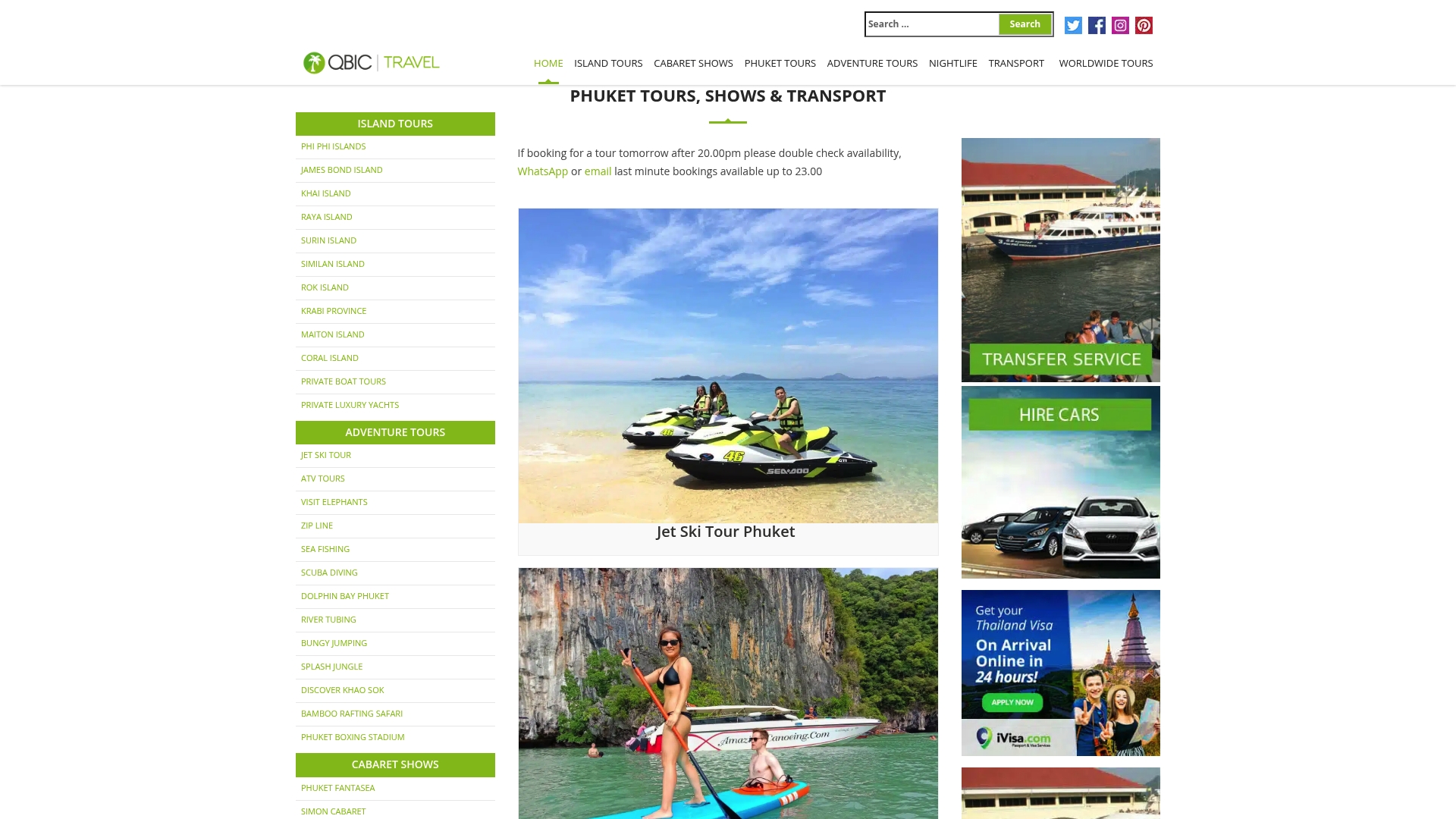
If you want to see how adventure tourism supports local economies in action, Phuket offers one of the most vivid examples in Southeast Asia. Qbictravel connects you directly with local guides, local waters, and local landscapes through experiences designed to put your spending where it genuinely matters. From jet ski tours around Phuket’s islands to ATV adventures through lush terrain, every Qbictravel experience is built around local expertise and community connection. With a 4.5 rating from 237 reviews and 99% issue-free services verified by Trustindex, you can book with confidence that your adventure directly supports the people and places that make it possible.


