
Car Seats for Phuket Transfers: Rules, Seat Types and How to Book
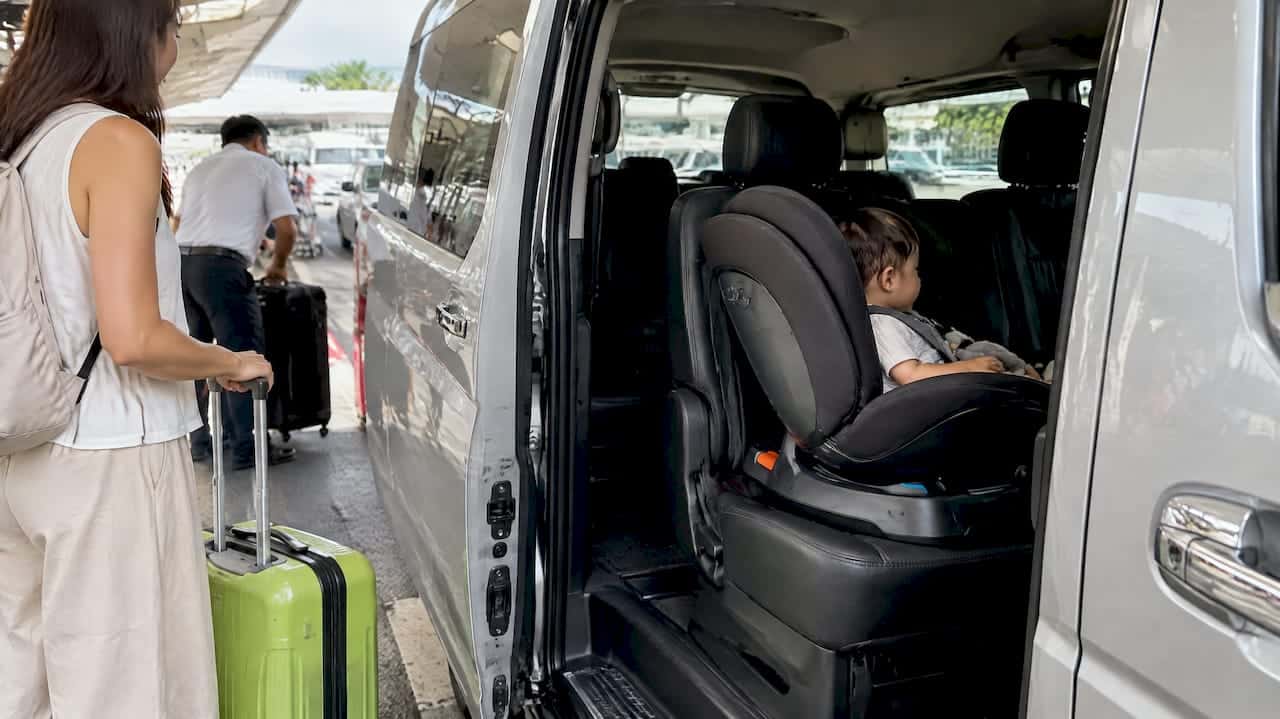
You land at Phuket airport after a long flight, the kids are tired, and the car that pulls up has no child seat in it. That is the most common surprise for families, and it is easy to avoid. Street-hailed taxis and tuk-tuks do not carry seats, so the safest plan is a pre-booked private transfer where the seat is arranged before you fly. Give the age, weight and height of each child when you book, and confirm the seat type in writing. Our Phuket Airport Taxi starts from 800 THB and our Phuket Airport Minibus from 1,200 THB, which is the sensible starting point for a family arrival.
TL;DR
- Since September 2022, Thai law requires children under six to use a child seat in private cars, pickups and minivans. The fine is up to 2,000 baht.
- Children under 135 cm must wear a seat belt or use a specialised seat.
- Pick the seat by your child’s weight and height, not just age: rear-facing for babies, forward-facing for toddlers, boosters for school-age children.
- Pre-book your transfer and confirm the seat type, because hailed taxis and tuk-tuks do not carry seats.
- Send the child’s age, weight and height at booking, and check the seat is clean and fitted before you set off.
Table of Contents
- What Thai law says about child seats
- Which seat does your child need?
- Why a hailed taxi is not the plan
- How to book a Phuket transfer with a child seat
- What to confirm before you fly
- Should you bring your own seat?
- Beyond the airport: tours with children
- Our perspective
- Book your family transfer with Qbic Travel
- FAQ
- Sources
What Thai law says about child seats
The amended Land Traffic Act was published in the Royal Gazette in May 2022 and came into force in September 2022. It requires children under six to use a child car seat or specialised seat in a private vehicle, and passengers under 135 cm to wear a seat belt or use a specialised seat. The official government summary confirms a fine of up to 2,000 baht for violations.
The seat must have a proper harness and meet Thai Industrial Standards Institute (TISI) safety standards. According to the Royal Thai Police announcement reported by Nation Thailand, the rules apply to private cars, pickups and minivans, and the same report sets out what a driver without a seat must do: the child sits in the back, is belted at the waist, and the car stays in the leftmost lane at low speed.
What does this mean for your holiday? Think of the law as the minimum and the seat as the goal. Road crashes killed roughly 2,500 Thai children aged 1 to 14 each year in 2019, most of them unbelted, according to a Chulalongkorn University study. A seat that fits your child is simply the safest way to ride, whatever kind of vehicle you are in.
Which seat does your child need?
Seats are grouped by weight and height. The categories below follow the WHO’s child restraint policy brief for Thailand, and the Thai Consumer Organisation Council (TCC) describes the same four families of seat.
| Seat type | Typical weight or height | Typical age | Direction |
|---|---|---|---|
| Baby seat (Group 0 / 0+) | Up to 10 kg (Group 0) or 13 kg (Group 0+) | Birth to about 12–15 months | Rear-facing |
| i-Size baby seat | Birth to 105 cm | Birth to at least 15 months | Rear-facing |
| Toddler seat (Group 1) | 9–18 kg | About 9 months to 4 years | Forward-facing |
| High-backed booster (Group 2/3) | 15–36 kg | About 4 to 11 years | Forward-facing, uses the car’s belt |
| Booster cushion (Group 3) | 22–36 kg, above 125 cm | About 6 to 11 years | Forward-facing, uses the car’s belt |
Two practical points. First, age ranges are only a guide. Weight and height decide when a child moves up a group, which is why every transfer provider asks for both. Second, the TCC explains that rear-facing suits babies because their necks and spines cannot absorb crash forces the way an older child’s can, so the seat turns the child toward the back of the car and spreads the impact. The TCC also advises a five-point harness for younger children.
If your child is between groups, say so when you book. A toddler at 9 kg or 18 kg sits on the edge of two categories, and a seat chosen in advance is far better than one improvised at the kerb.
Babies and toddlers
For a newborn to roughly 15 months, you need a rear-facing baby seat. Thailand’s Britax distributor lists baby seats for birth to 15 months, 40–83 cm and up to 13 kg, and toddler seats for 9 months to 4 years. Keep a child rear-facing for as long as the seat’s limits allow. Your driver should not have to guess, so give the exact weight.
School-age children
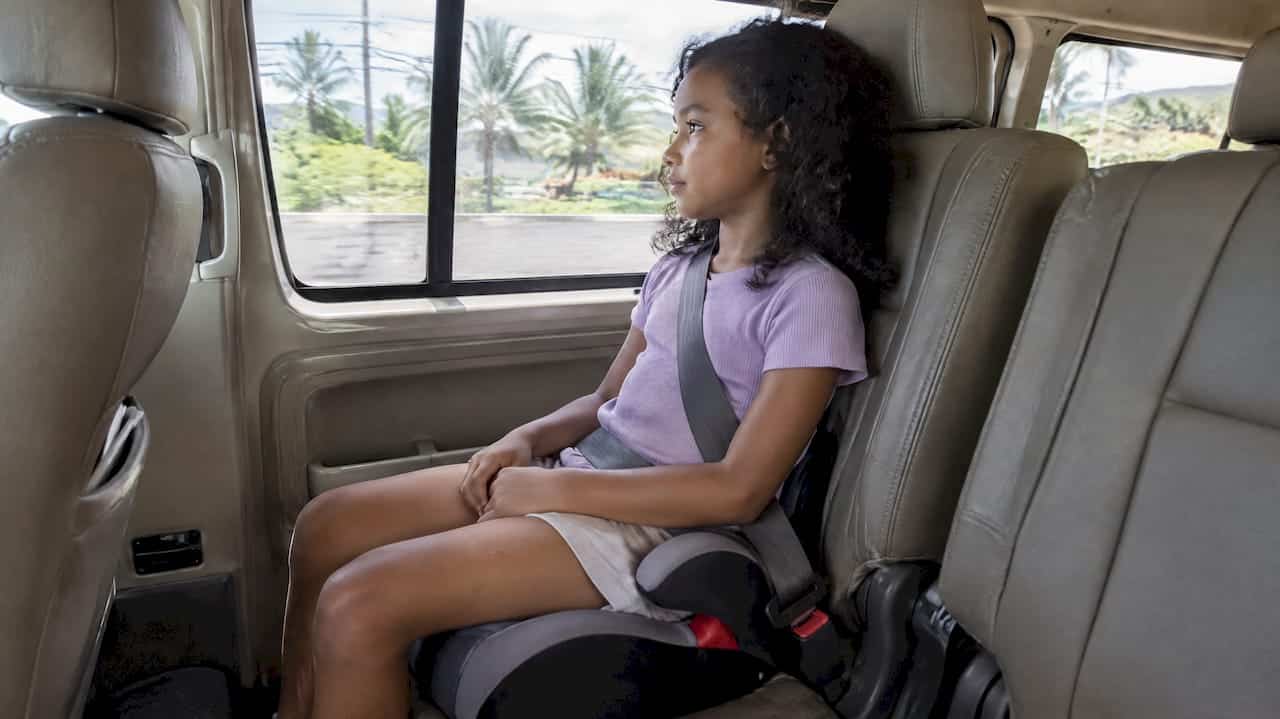
Older children often need only a booster, which lifts them so the car’s own belt sits across the shoulder and hips. The legal threshold for the belt alone is 135 cm. Below that, a booster or specialised seat is the right choice. This is also where vehicles differ: a minivan with proper belts suits a booster far better than a vehicle without them.
Why a hailed taxi is not the plan
Families often assume they can grab a taxi at arrivals and sort a seat later. In practice, street-hailed taxis and tuk-tuks do not offer child seats. Ride-hailing apps are patchy as well: one family travel guide notes that a booster option for children of 100–135 cm exists in some major Thai cities, but infant and toddler seats through apps in Phuket are extremely limited.
The reliable route is a pre-booked private transfer. You choose the vehicle, you state the child’s details, and the seat is confirmed before you leave home. That also helps with the other half of an arrival: luggage, a stroller and a sleeping child do not mix well with a queue.
How to book a Phuket transfer with a child seat
Follow these steps and you will not be improvising at the arrivals hall.
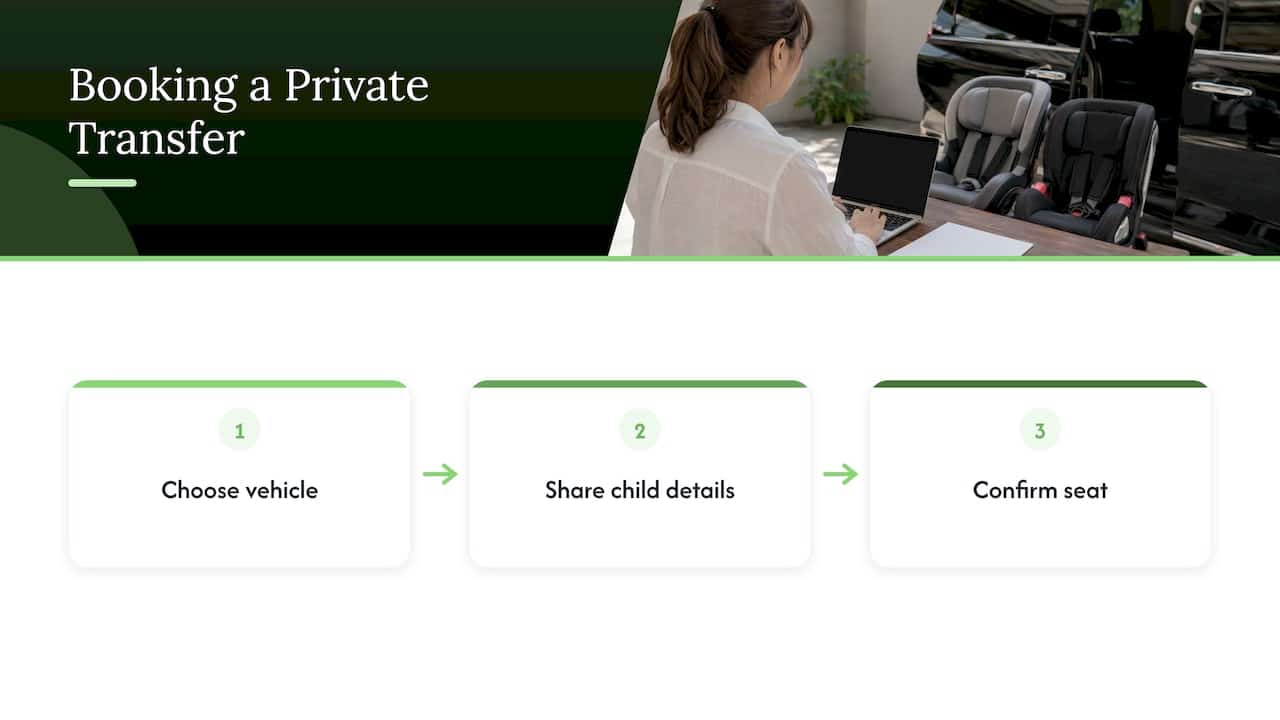
- Decide on the vehicle. A sedan suits two adults and one child with moderate luggage. A minivan gives more room for a stroller, a second child seat and bags. Our airport minibus starts from 1,200 THB and our airport taxi from 800 THB.
- Gather the child’s details. Age, weight and height for each child. If you have a baby and a four-year-old, that is two different seats.
- Ask for the seat type, not just “a child seat”. Say rear-facing, forward-facing or booster, and confirm it back in writing. A family guide to getting around Phuket also advises reserving seats well in advance and specifying the child’s age and weight.
- Share your flight number and hotel. Your pick-up should be tied to the flight, so a delay does not leave you without a ride.
- Check the seat at pick-up. It should be clean, undamaged and fitted before the child goes in. Look for a harness that closes properly and a seat that does not wobble when pushed.
- Plan the return leg too. Book the hotel-to-airport journey at the same time, with the same seat details. Our hotel to airport shuttle covers that direction.
Where we can take something off your plate, it is the pre-booking: sorting your transfer in advance, rather than on arrival, is what keeps a tired family out of a taxi queue. You can browse the full transfer service range online.
What to confirm before you fly
A short message with these questions saves most problems:
- Which seat type will be fitted, and is it suitable for my child’s weight and height?
- Is the seat forward-facing or rear-facing?
- How many children’s seats are needed, and does the vehicle have room for them plus luggage?
- Is the pick-up point set for my flight number, and how long will the driver wait after landing?
- Can the same arrangement be made for the journey back?
Save the confirmation on your phone. When you arrive with a sleepy child, you want the reply on screen, not in your memory.
Should you bring your own seat?
Some families prefer to travel with their own seat because their child is used to it, and that is a fine choice if you can manage the airline rules and the extra bulk. Check that the seat is approved for the standards you expect and that it suits a car belt or ISOFIX fitting. The seat is one more thing to carry through arrivals, and a travelling toddler already comes with plenty of kit. If you are packing for a toddler, this potty training travel checklist covers the rest of the bag.
If you do bring your own seat, tell your transfer provider so they can plan the vehicle space and confirm the belts or fittings suit it.
Beyond the airport: tours with children
Transfers are only the start. Once you are settled, the same questions of age and size come up for tours. Our guide to Phuket tour age limits and booking steps explains how minimum ages work so you are not turned away on the day. If you have a little one in tow, boat tours with a baby are worth reading first, and our guide on choosing a family ATV tour helps with older children who want something more thrilling.
For the days out, plan transport the same way as your arrival: decide who is riding, how old they are and what they weigh, and confirm before you go.
Our perspective
We plan Phuket days around families, and the pattern is clear: the best holidays start with a calm arrival. The transfer is the one part of the trip where your child is strapped in for the longest stretch on unfamiliar roads, so it deserves a few minutes of planning before you fly.
Our airport taxi, from 800 THB, and airport minibus, from 1,200 THB, are built for exactly this: a pre-booked, fixed-price ride that is arranged before you land rather than negotiated at the kerb. Add your hotel-to-airport shuttle for the way home and the whole trip is bookended.
Our advice is simple. Book early, tell us who is travelling and how big they are, and keep your confirmation handy. Then you can spend your energy on the fun part: islands, sea and the occasional muddy trail once the kids are old enough.
Carl
Book your family transfer with Qbic Travel
We offer airport taxis from 800 THB and airport minibuses from 1,200 THB, plus a hotel-to-airport shuttle for the journey home. Our site reports a 4.5 rating from 237 reviews and a 99% issue-free service rate verified by Trustindex. Browse the transfer range and book online or on WhatsApp.

Once you are in Phuket, our island tours include James Bond Island, Phi Phi and the Raya and Coral islands, with hotel pick-up.
FAQ
Can you get taxis with child seats in Phuket?
Street-hailed taxis and tuk-tuks do not provide child seats. The dependable option is a pre-booked private transfer where you confirm the seat type and your child’s age, weight and height in advance. Ride-hailing apps offer only limited booster options for older children.
Is a child seat compulsory in Phuket?
Yes, in private cars, pickups and minivans. Since September 2022, children under six must use a child seat or specialised seat, and passengers under 135 cm must wear a seat belt or use a specialised seat. The fine is up to 2,000 baht. Whichever vehicle you are in, a seat that fits your child is the safest choice.
What information do I give when I request a seat?
Your child’s age, weight and height, the number of children travelling, your flight number and your hotel. Ask for the seat type by name: rear-facing, forward-facing or booster. Ask for a written confirmation you can show the driver.
What seat does a toddler need?
Toddlers from about 9 months to 4 years, weighing roughly 9–18 kg, usually need a forward-facing seat with a harness, or a rear-facing seat if they still fit within its limits. Rear-facing is recommended for as long as the seat allows. Give the exact weight when booking so the right seat is arranged.
Sources
- Children under six must use car seat from September 4 (Nation Thailand)
- Fasten up: Car seats for kids are now mandatory in Thailand (Nation Thailand)
- Land Traffic Act (No. 13) B.E. 2565 government summary
- Challenges of an implementation and enforcement of child car seat law (Chulalongkorn University)
- WHO policy brief on child restraint systems, Thailand
- How to choose a car seat (Thai Consumer Organisation Council)
- Britax Thailand car seat range
- Choosing a car seat for a newborn (Britax Thailand)
- Getting around Phuket with kids
- Pack and go potty training for travel


