
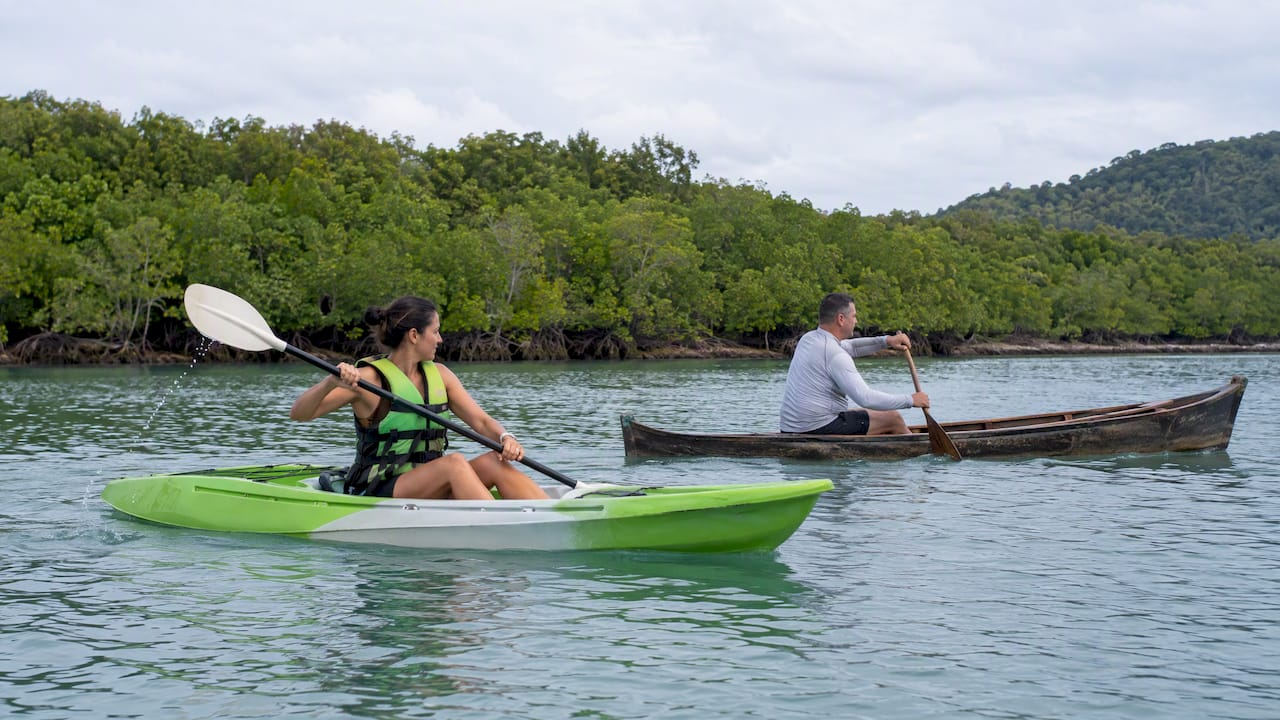
Canoe vs Kayak in Phuket: Which Should You Paddle?
In Phuket the two words mean different things than they do at home. A “sea canoe” trip usually means a guided tour into the limestone caves of Phang Nga Bay, where a local paddler often does the steering. A “kayak” usually means a sit-on-top boat you rent by the hour and paddle yourself on a sheltered bay. Pick the canoe tour for caves and lagoons with no effort. Pick a kayak rental if you want to paddle yourself. Read on for the detail, including how a stand-up paddleboard (SUP) compares.
TL;DR
- Sea canoe tour: a guided Phang Nga Bay trip into caves and hidden lagoons, where you are often a passenger. It is the best choice for first-timers, families and anyone wanting the famous scenery.
- Sit-on-top kayak: you paddle it yourself, it is very stable and easy to climb back onto. It suits calm bays and gives you freedom.
- SUP: more of a balance challenge, but easy to get back on after a fall. Best on flat, sheltered water.
- Season matters: west coast beaches are calmest from November to April. Sheltered east coast bays and Phang Nga Bay work year-round.
- Tides matter: many caves can only be entered around low tide, so ask which ones your tour includes.
Table of Contents
- Canoe and kayak: what the words mean in Phuket
- Sea canoe tours in Phang Nga Bay
- Sit-on-top kayaks: paddle it yourself
- Kayak vs SUP: stability against recovery
- Which is easier, and which flips more?
- When to paddle: season and sea state
- Where to go: matching boat to place
- What it costs
- Our view: pick the experience, not the word
- How to choose in 60 seconds
- What to bring
- Make a day of it with Qbic Travel
- FAQ
- Sources
Canoe and kayak: what the words mean in Phuket
Elsewhere, a canoe is an open boat paddled with a single blade, and a kayak is a closed or sit-on-top boat paddled with a double blade. Phuket’s tour industry blurs this. Operators advertise “sea canoeing” and “sea kayaking” for the same Phang Nga Bay trips, and the boats can be either type. So when you compare the two here, it helps to compare the experience rather than the label on the brochure.
There are really three things you can do:
- A guided sea canoe tour in Phang Nga Bay, usually a boat trip out to the karst islands, then a short paddle through caves.
- A self-paddled kayak rental on a beach or bay.
- A SUP session, standing on a board with a long single-blade paddle.
Each suits a different traveller. The rest of this guide helps you choose.
Sea canoe tours in Phang Nga Bay
This is the version most visitors have in mind. You cruise from Phuket to the bay, then transfer to a canoe to reach spots a bigger boat cannot enter: low cave mouths, tunnels and enclosed lagoons known as hongs.
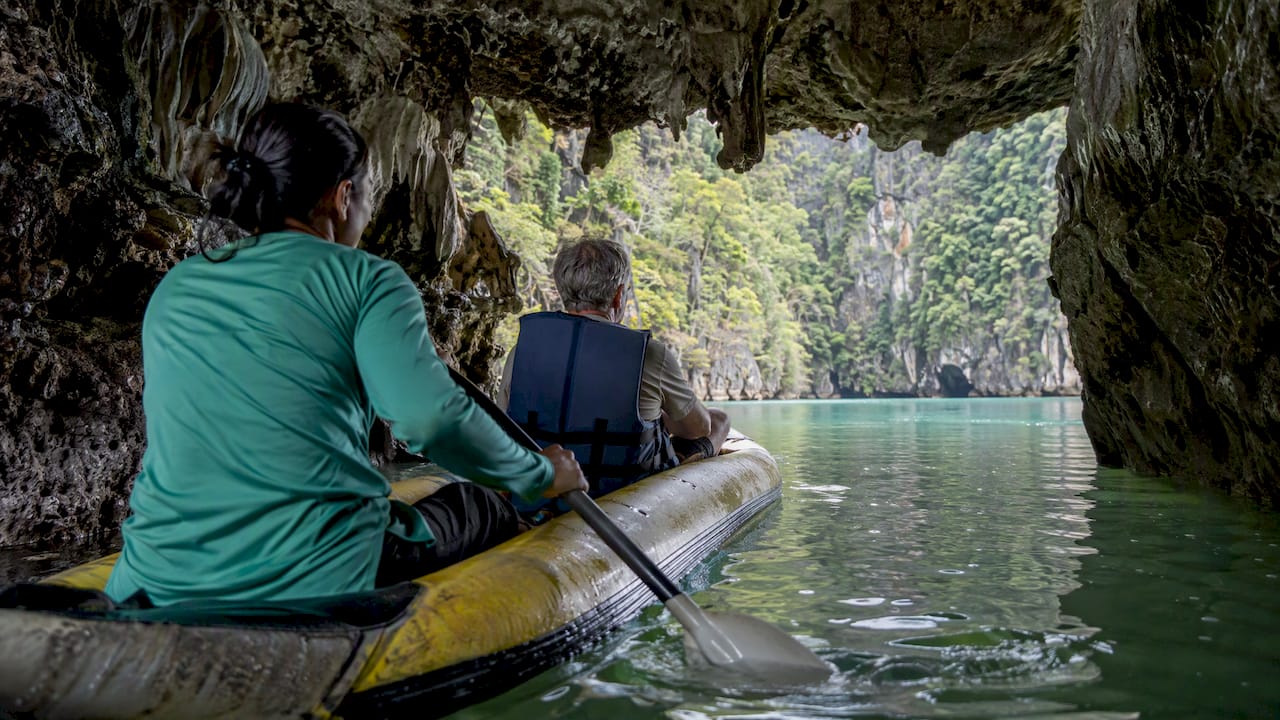
The key thing to know, and the one many people miss, is that you may not paddle much at all. According to a Phuket sea kayaking guide, most Phang Nga Bay kayak tours use a local paddler to steer you into the sea caves while you sit as a passenger. If you want to paddle yourself, that guide points to mangrove kayaking instead.
Why people love it
- The scenery is the main event: sheer limestone walls, bats and hanging stalactites, then a sudden opening into a lagoon.
- There is almost no skill or fitness needed.
- It fits families and mixed-ability groups well.
What to watch
- Tides decide what you see. Some narrow hong entrances are passable for only a one to two hour window around low tide, so good operators build the day around that window. Ask which hongs are included and whether there are access requirements.
- Popular caves get crowded in high season. An earlier start usually means a quieter paddle.
- If you want to be the one holding the paddle, check before you book that the tour is self-paddled.
For a gentler walkthrough of the bay, see our beginner’s guide to Phang Nga Bay kayaking.
Sit-on-top kayaks: paddle it yourself
For beach and bay paddling around Phuket, sit-on-top kayaks are the standard rental. They are highly stable and beginner-friendly, very hard to tip in calm conditions, and easy to climb back onto if you do capsize. Unlike sit-inside touring kayaks, they do not need wet-exit training, so they are the low-stress option for families and first-timers.
A sit-on-top also lets you:
- Stop whenever you like for a swim or a snorkel.
- Take a double kayak with a partner or a child.
- Go at your own pace, which is the real appeal for anyone who dislikes being herded.
The trade-off is that you are on your own. You choose the route, you read the wind, and you are responsible for turning back before you get tired. A beginner should stay close to shore.
Kayak vs SUP: stability against recovery
Many readers also ask whether to try a paddleboard instead. Industry guidance from Paddling.com boils it down to this: kayaks give you more stability from the first minute, while SUPs are much easier to get back onto after a fall, because you simply slide onto the flat board.
| Sit-on-top kayak | SUP | |
|---|---|---|
| First-minute stability | High | Lower, you stand |
| Getting back on after a fall | Easy | Very easy |
| Best for | Families, first-timers, longer outings | Calm water, balance and core work |
| Carrying kids or kit | Easy, especially a double | Limited |
| Handling a little chop | Better | Harder |
| Comfort in strong sun | You sit low, some shade from your body | Fully exposed, bring a hat |
If you are nervous about falling in, a kayak will feel safer to start with. If you are nervous about being in the water, the SUP’s easy re-entry can feel more reassuring. Either way, a wet start is part of the fun in 30-plus degree water.
Which is easier, and which flips more?
For a total beginner, a guided sea canoe trip is the easiest because someone else does the work. Among self-paddled options, a wide sit-on-top kayak is the easiest and the most forgiving. A SUP takes the most practice.
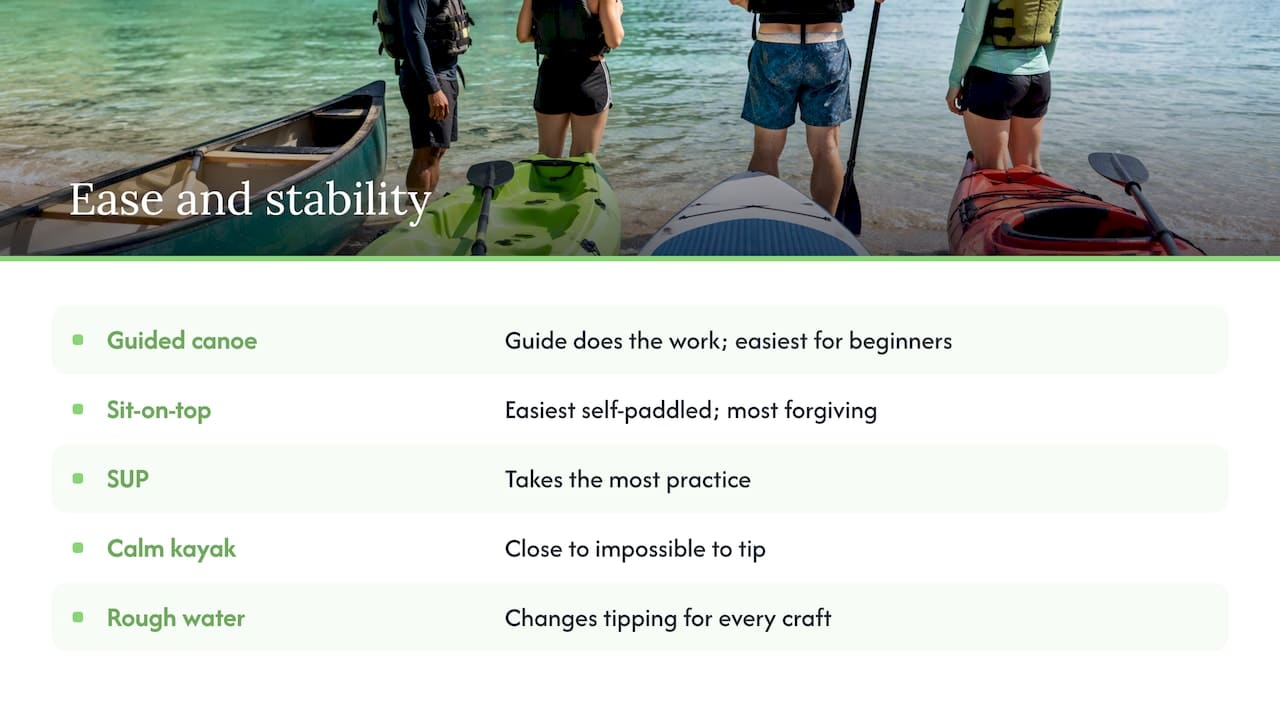
On flipping: in calm water a sit-on-top is close to impossible to tip, and re-boarding is simple. Rough water changes that for every craft, which brings us to the calendar.
When to paddle: season and sea state
The dry season from November through April gives the calmest seas on Phuket’s west coast beaches. In the monsoon, open west coast beaches can be rough and dangerous for beginners.
The good news is that you do not have to skip paddling in the green season. East coast bays such as Ao Yon and Phang Nga Bay offer sheltered, beginner-friendly conditions year-round, according to the same guide. The sea is still the sea, though: if an operator or lifeguard says conditions are poor, believe them and reschedule. Wind, not rain, is usually the deciding factor.
Quick rules for any month
- Paddle in the morning. Winds are usually lighter and the sun is kinder.
- Keep to sheltered water if you are new.
- Wear a life jacket, even if you swim well.
- Check the weather and tide before you leave the shore.
If you are choosing a first activity and a first location, a general guide to picking your first vessel covers the same logic of matching boat, water and experience.
Where to go: matching boat to place
Phang Nga Bay (guided). Best for caves, hongs and lagoons. Go with a tour, not alone, because of tides and navigation. Phang Nga Bay is also the area around James Bond Island, which the expat guide describes as roughly 40 minutes by longtail from Phuket.
Ao Yon (self-paddled). A sheltered east coast bay that local experts recommend for beginners. It is a good place to practise balance and technique before you try open-water routes or more technical cave tours.
West coast beaches (dry season only). Fine for a short paddle or a SUP session between November and April. Be cautious in the monsoon.
Mangroves (self-paddled). If you want to paddle yourself on a tour, mangrove channels are the usual suggestion.
Our page on matching your fitness to Phuket kayak routes, tides and tour types goes deeper on how hard each option is.
What it costs
Prices vary by operator and season, so treat these as a guide. According to the Phuket expat guide:
| Option | Typical price |
|---|---|
| Casual sit-on-top kayak rental | 200 to 400 THB per hour |
| Standalone SUP rental | 300 to 500 THB per hour |
| Guided half-day sea canoe or kayak tour in Phang Nga Bay | 1,500 to 3,500 THB per person |
The tour price generally includes transport, equipment and sometimes lunch. A rental does not, so add the cost of getting to the beach and, if you want one, a dry bag.
The hourly rate looks cheaper, but the tour covers a much bigger trip. If caves are the goal, the tour is the better value. If you simply want an hour on the water, rent a kayak.
Our view: pick the experience, not the word
We run adventure and sightseeing trips around Phuket and the nearby islands every day, and the same question comes up: “Should we do canoe or kayak?” Our honest answer is that the label matters far less than three things.
First, what do you want to see? If the answer is hidden lagoons and sea caves, you want a guided Phang Nga Bay trip, and you should accept that you may be a passenger for the cave section. That is not a downgrade. It is how the tide-dependent, narrow entrances are navigated safely.
Second, who is coming? Families with young children, grandparents and nervous swimmers do best on a guided trip or a double sit-on-top in calm water. Confident, active travellers who want to burn energy usually enjoy a self-paddled kayak or a SUP more.
Third, what is the weather doing? We would rather move your booking than push you out into a rough sea. A flexible plan beats a stubborn one. Pairing a paddle with a boat trip lets you adapt, because the sheltered bay is usually workable when the open coast is not.
If you are choosing between paddling and other ways to cover the water, our guides on longtail versus speedboat trips and speedboat versus catamaran explain how the boat you take changes your day.
— Carl
How to choose in 60 seconds
- You want caves and lagoons and no effort: book a guided sea canoe tour in Phang Nga Bay.
- You want to paddle yourself with kids: rent a double sit-on-top kayak in a sheltered bay such as Ao Yon.
- You want a workout and a challenge: try a SUP on flat water in the dry season.
- You are visiting between June and October: stay on the east coast or in the bay, and keep a spare day.
- You are unsure: start with a guided trip. You can paddle yourself next time.
What to bring
- Reef-safe sunscreen and a long-sleeved rash vest. The UV index is high all year.
- A hat with a strap, and sunglasses with a cord.
- A dry bag for phone, cash and keys.
- Water shoes with grippy soles. Rocky landings and wet boat floors are slippery.
- A towel and a change of clothes.
- Cash for national park or entry fees, if your tour does not include them.
Make a day of it with Qbic Travel
If the bay is on your list, our Phang Nga South Sea tours pair the scenery with hotel pick-up, and our island tours cover favourites such as James Bond Island, Phi Phi and Raya. If paddling is only one item on your wish list, you can add speed with a jet ski or ATV adventure. We hold a 4.5 rating from 237 reviews, and our site reports 99% issue-free service verified by Trustindex. Booking is online or by WhatsApp, and last-minute plans are welcome. Browse everything on our tours page or message us for a plan that fits your group and the tide.
FAQ
Are kayaks or canoes easier?
For most people in Phuket, the easiest option is a guided sea canoe tour, because a local paddler steers and you sit back. If you paddle yourself, a wide sit-on-top kayak is the most forgiving. It is very stable and easy to climb back onto after a capsize.
Are kayaks easy to flip?
A sit-on-top kayak is essentially impossible to tip in calm conditions. Rough water, wind and standing up in the boat are what cause trouble. If you do go over, re-boarding a sit-on-top is simple, and a life jacket keeps it stress-free.
Is kayaking or SUP better for beginners?
Kayaks give you more stability from the start, while a SUP is easier to get back onto after a fall. If you want to feel secure immediately, choose the kayak. If you are happy to wobble and want an easy recovery, try the SUP on flat, sheltered water.
Can I paddle Phang Nga Bay on my own?
We would not recommend it for visitors. Cave access depends on the tide, with some entrances open for only one to two hours around low tide, and many tours use a local paddler for the caves. A guided trip handles timing and navigation for you.
When is the best time to paddle in Phuket?
November to April gives the calmest seas on the west coast. In the monsoon months, choose sheltered east coast bays or Phang Nga Bay, and be ready to reschedule if the wind picks up.
Sources
- Sea Kayaking & Paddleboarding in Phuket 2026 Guide
- Sea Kayaking in Phuket: Hongs, Caves and What’s Actually Paddled
- SUP Versus Kayaking: Which Is Better To Learn First? (Paddling.com)


