
Bioluminescence Photography in Phuket: Settings, Spots and Timing
You can photograph bioluminescence around Phuket, but you have to plan for it. The glow is faint, it only flashes when the water moves, and your camera needs a tripod, a wide aperture and a long exposure to catch it. Choose a dark, calm night, head for sheltered water such as Phang Nga Bay, and give yourself time to try different settings.
We run adventure and boat trips around Phuket every day, and the night-time glow is one of the questions guests ask us most. Here is what causes the light, where and when to look, how to set your camera or phone, and how to avoid the mistakes that leave you with a black frame.
TL;DR
- Phang Nga Bay’s sheltered lagoons and caves are the most consistent places to look. Open beaches can work too, but less reliably.
- The dry season, roughly November to April, is the usual window, though the glow can show at other times.
- Use a sturdy tripod, an open aperture (f/2.8 or wider if your lens allows), a high ISO and exposures from a fraction of a second up to a minute.
- The plankton only flash when disturbed, so shoot as a wave breaks, or splash the water by hand or paddle.
- Keep torches, phone screens and boat lights off while you shoot. Your eyes and your sensor both need darkness.
Table of Contents
- What you are actually photographing
- Where to shoot around Phuket and Phang Nga Bay
- When to go: season, moon and weather
- Camera settings that work
- Mistakes that leave you with a blank frame
- Swimming, safety and respect for the water
- Our perspective
- Make the night easy: our Phuket trips
- Your photo night checklist
- FAQ
- Sources
What you are actually photographing
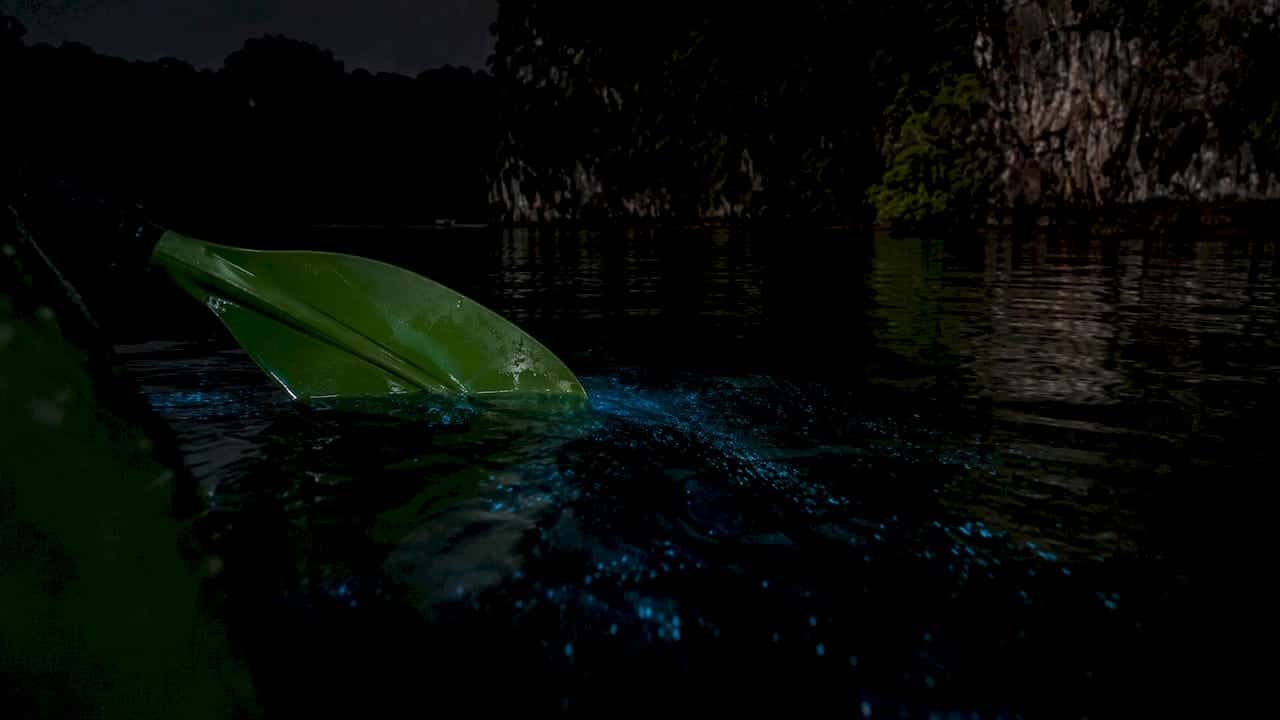
The glow in Phuket’s water comes from single-celled plankton called dinoflagellates. When something disturbs them, such as a wave, a paddle or your hand, they flash blue. Research on the process describes how mechanical stress changes the acidity inside tiny compartments in the cell, which activates the enzyme that makes light. The same paper notes that the chain from physical disturbance to flash takes only about 20 milliseconds.
That tells you two practical things:
- The light is brief. Each spark is over almost instantly, so a long exposure stacks many flashes into one glowing trail.
- No movement, no glow. Calm, flat water with nothing disturbing it will look black. You need waves, a paddle, a hand or a hull.
Where to shoot around Phuket and Phang Nga Bay
Phang Nga Bay is the area photographers and tour guides point to most often. Its enclosed lagoons and caves around Hong Island and Koh Panak are widely described as more reliable than open beaches, because they stay sheltered and dark. We cover the comparison in more detail in our piece on why Phang Nga lagoons beat Krabi beaches, and our guide to where to see bioluminescence near Phuket lists the options by area.
From the shore
Phuket beaches that people commonly mention for glowing plankton include Patong, Kalim, Bang Tao, Nai Harn and Ao Sane. The same guide suggests the best viewing is from late evening to midnight, when the water is calmest. Shore shooting has pros and cons:
- Pros: free, flexible, and you can set up a tripod on firm sand and take your time.
- Cons: beach lights, restaurants and street lamps spill onto the water, and sightings are less predictable.
If you go to a beach, walk to the darkest stretch you can safely reach and face the sea, away from lights behind you.
From the water
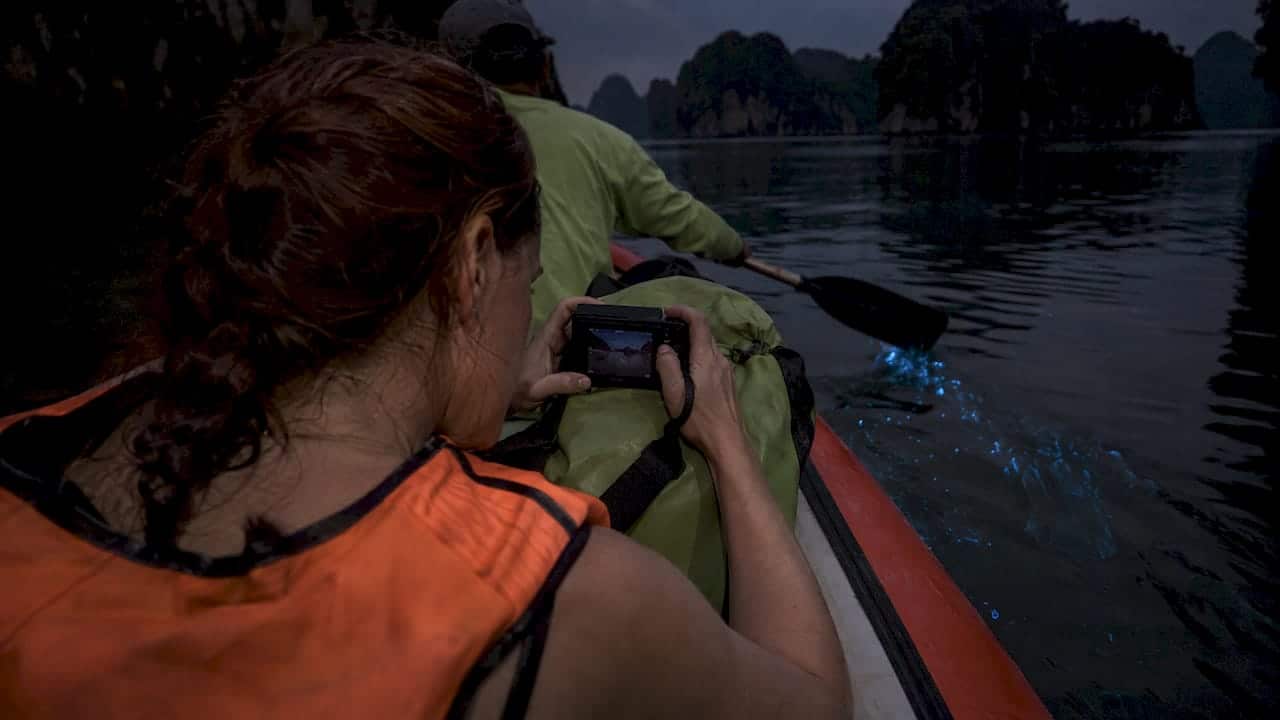
A guided night trip in Phang Nga Bay puts you in the dark, sheltered spots where the glow is easiest to see. You are also sitting a few centimetres above the surface, so every paddle stroke lights up the water around you. That is ideal for photography, but you are in a moving boat or canoe. Bring a small, stable setup and protect your gear from splashes. A tripod rarely works well on a rocking boat, so plan on bracing your camera against a seat or a dry bag, and expect to shoot shorter exposures.
When to go: season, moon and weather
Time of year
One Thailand guide says the best time for bioluminescent plankton in Phuket is the dry season from November to April, although it can be visible at other times. A photography article on sea sparkle adds that warmer months tend to be more successful. It also suggests that clumps of red algae near the shoreline can show plankton is present, and that it may be worth returning the next night.
Treat all of this as a guide to probabilities, not a promise. Plankton blooms vary from night to night, and no operator can guarantee a sighting. Our own take on the seasonal pattern is in why new moon nights favour sheltered bays.
Moon and cloud
The darker the sky, the stronger the glow looks. Moonlight washes out the faint sparks, so aim for the days around the new moon and check the forecast for clear or lightly clouded skies. Heavy rain and strong wind make the sea choppy, which is bad for both comfort and image quality, so build in a spare night if your schedule allows.
Time of night
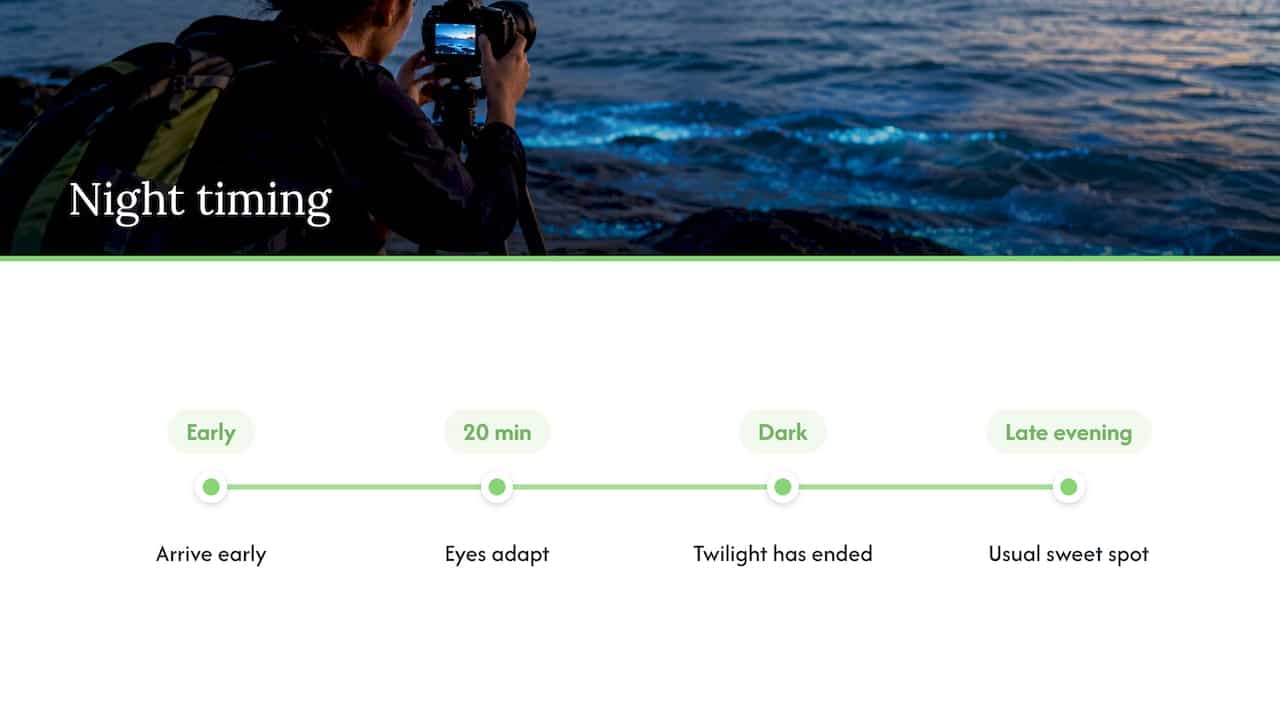
Wait until the sky is fully dark. Twilight skies add a blue cast that muddies the picture. Late evening is usually the sweet spot, and your eyes need about 20 minutes to adapt, so arrive early and resist checking your phone.
Camera settings that work
There is no single perfect recipe, because every beach, wave and boat is different. These starting points come from working photographers, and you adjust from there.
Starting points
| Scene | Shutter | ISO | Aperture | Source |
|---|---|---|---|---|
| Still, low-light scene | 30 to 60 seconds | 400 | f/4 | Nature TTL |
| Breaking waves | 0.3 seconds | 3200 | f/2.8 | Nature TTL |
| General long exposure | 10 seconds to a minute or more | High | f/2.8 or lower | Digital Camera World |
The general advice from the Nature TTL guide is to use a sturdy tripod, open the aperture, raise the ISO and experiment with exposure times to suit the location and the look you want.
Step by step on a beach
- Set up in daylight or at dusk. Pick your spot, check for rocks and tide, and plan your footing.
- Mount the camera on a sturdy tripod with the legs pushed firmly into hard sand.
- Switch to manual focus. Autofocus hunts in the dark. Focus on a distant light or star, or focus in daylight and tape the ring.
- Open the aperture as wide as your lens allows.
- Start at a mid-range exposure such as 10 to 15 seconds with a high ISO, then check the screen.
- Use a timer or remote so you do not shake the camera when you press the shutter.
- Time the shot to the wave. The Digital Camera World guide suggests firing the exposure as the wave comes towards you so the glow appears when it breaks.
- Review and adjust. Too bright and flat? Shorten the exposure or drop the ISO. Too dark? Lengthen it or raise the ISO.
Making the glow happen
Because the light only appears with movement, you can help it along. Photographers create movement with a stick, by kicking the water, or by timing a shot with a breaking wave. On a boat trip, a gentle paddle stroke or trailing a hand just below the surface does the same job. Keep your gear well away from the splash.
Shooting with a phone
Phones can capture a faint glow, though you will get less than a camera on a tripod. The principles are the same: hold the phone as still as possible, ideally on a small tripod or braced on a firm surface, switch on night mode or a long-exposure setting if your phone has one, and keep the screen brightness low. Tap to focus on a distant light before it goes dark, and lock the focus. Do not use flash. It will light the foreground and wipe out the sparks.
Mistakes that leave you with a blank frame
- Using white light. Torches, phone screens and boat lamps all spoil your night vision and flatten the scene. Use a red headlamp if you need light, and ask others in your group to do the same.
- Overexposing. Pushing the exposure too long makes the water a uniform grey-blue and drowns the individual sparks. Shorter exposures often look better.
- Waiting for a glow that never moves. If the water is dead calm, nothing will flash. Create movement or wait for a wave.
- Camera shake. Even a slight wobble turns sparks into smears. Use a timer and avoid touching the tripod during the exposure.
- Rushing. The first few frames are test shots. Plan for at least an hour at one spot.
- Forgetting the foreground. A silhouette of limestone cliffs or a canoe gives the glow scale. Include something solid in the frame.
Swimming, safety and respect for the water
The glow is tempting to jump into, but Phang Nga Bay’s sea caves are often too shallow for swimming. One traveller discussion notes you can dip your arms in rather than swim, and that guides sometimes ask people to get out of the water because of jellyfish. Always follow your guide’s instructions on entering the water.
Some practical safety points for a night trip:
- Wear the life jacket your operator provides, even if you are a confident swimmer.
- Keep cameras and phones in dry bags, with a lanyard or wrist strap on anything you hold over the side.
- Do not use sunscreen or insect repellent heavily just before touching the water, and avoid putting chemicals into the sea.
- Stay seated in canoes and small boats when shooting.
We explain what to look for in our guide on checking life jackets and permits on bioluminescent night tours.
Our perspective
We spend a lot of nights on the water around Phuket, and our advice to photographers is always the same: choose your spot and your night first, then worry about your settings.
The best frames we see come from people who arrive early, keep the lights off and give the water time. A guide who knows the sheltered bays in Phang Nga Bay is worth far more than a better lens, because the right place saves you hours of waiting.
That is why we plan our trips around comfort and good timing, with hotel pick-up, small, well-organised groups and the flexibility to adjust to the weather. Our guests rate us 4.5 from 237 reviews, and our site reports a 99% issue-free service rate verified by Trustindex. When the glow is faint, we would rather you had a calm, well-run night with a few good shots than a rushed one.
Bring patience, a tripod and a sense of fun. The rest we can handle.
Carl
Make the night easy: our Phuket trips
If you want to focus on the picture and not the logistics, we can take care of the boat, the route and the transport. We run island and boat tours across Phuket and the nearby islands, with hotel pick-up and flexible, last-minute booking, and our range includes bioluminescent and sunset trips alongside kayak tours.

Browse our Phuket island tours, look at our private boat tours if you want a quieter group, or message us on WhatsApp to ask about a night that suits your dates. Photographers who want golden-hour pictures first can also read about asking captains to hold five minutes for sunset shots. You can see everything we offer on our homepage.
Your photo night checklist
- Camera or phone, fully charged, plus a spare battery
- Sturdy tripod, or a small one for a phone
- Remote release or self-timer
- Red headlamp
- Dry bag and microfibre cloth
- Light, quick-drying clothes and a warm layer for the breeze on the water
- Insect repellent applied well before you reach the water
- Waterproof phone pouch with a wrist strap
- Patience and a back-up night in your plans
FAQ
Can I see bioluminescence in Phuket?
Yes, you can, and Phang Nga Bay is the area most often recommended. The glow shows when plankton in the water are disturbed, so sightings depend on conditions on the night. Calm, dark, sheltered water gives you the best chance.
What are the best months for bioluminescence photography?
The dry season from November to April is the usual recommendation, though it can appear at other times. Pick nights near the new moon with clear skies, and keep a spare evening in case conditions are poor.
What is the best way to photograph bioluminescence?
Use a tripod, a wide aperture, a high ISO and a long exposure, then adjust to the scene. Start around 10 to 30 seconds for still water and under a second for breaking waves. Create movement in the water so the plankton have a reason to light up.
Can I photograph it with a phone?
Yes, though the results will be fainter than with a camera. Steady the phone, use night mode or a long-exposure setting, turn off the flash and keep the screen dim. A small tripod makes a big difference.
Can I swim with the plankton?
In many Phang Nga Bay caves the water is too shallow to swim, and guides may ask you to stay out for safety reasons. Dipping your hands in is usually the safest way to light up the water. Always follow your guide’s advice.
Sources
- Understanding Bioluminescence in Dinoflagellates
- How to Photograph Bioluminescence in the Ocean, Nature TTL
- How to photograph Sea Sparkle, Digital Camera World
- How to photograph bioluminescence, Biocast
- Where to Find Bioluminescent Plankton in Phuket
- Where can I swim with bioluminescent plankton in Phuket?


