
Sea Cave Claustrophobia: How to Enjoy Phuket’s Bays
Yes, you can have a brilliant day around Phang Nga Bay and the Andaman islands with claustrophobia. Most of the scenery is open water, towering cliffs and wide lagoons, and the tight, dark passages are only a few stops on certain routes. The trick is to know which stops involve a squeeze, pick the route to match your comfort level, and agree a plan before you leave the pier. We run island and boat tours around Phuket, and the best days we hear about are the ones where the traveller chose the itinerary with their fear in mind, not in spite of it.
TL;DR
- Claustrophobia is an intense fear of enclosed spaces, and caves and tunnels are classic triggers. It is common, manageable and no reason to skip the islands.
- Some Thai sea caves are genuinely tight: low entrances near the waterline and, on some kayak routes, lying flat to pass through.
- Many of Phuket’s best boat days, such as beaches, snorkelling, viewpoints and open lagoons, involve no cave at all.
- Decide before you book: which stops are on the route, whether you can stay on the boat, and what the tide and weather will do.
- Practise slow breathing beforehand, bring a head torch and tell your guide about your fear at the start.
Table of Contents
- What claustrophobia feels like, and why caves set it off
- What a Thai sea cave actually looks like
- Which Phuket boat days involve caves and which don’t
- Tides decide how tight it gets
- Prepare before the day: a calm plan in five steps
- Questions to ask before you book
- During the cave: how to handle a rising panic
- Boat, kayak or cave diving: not the same thing
- Where you can still go: the best cave-free days
- Our view: plan around the fear, not around the cave
- Plan a day that suits you
- FAQ
- Sources
What claustrophobia feels like, and why caves set it off
Claustrophobia is the intense fear of enclosed or confined spaces. The Cleveland Clinic lists caves and tunnels among the usual triggers, alongside lifts, MRI scanners and crowded rooms. Symptoms it describes include a racing heartbeat, trouble breathing, dizziness, confusion, a sense of dread and a strong urge to get out.
Sea caves are a particularly tricky combination for some people. They are dark, the ceiling can be close, there is water around you, and you cannot simply walk out. Add a group moving in single file and the feeling of being committed grows. If you recognise that picture, you are not being dramatic. You are planning sensibly by reading this first.
Two points help from the start:
- Fear is about the space, not the sea. Plenty of people who dread a narrow tunnel are perfectly happy on open water, on a jet ski or on a beach.
- Your fear is about control. The more you know about how long a passage is, how you will move through it and how you can leave, the smaller the fear usually becomes.
If your fear is strong enough that it already stops you taking lifts, flying or having medical scans, speak to your doctor or a therapist before the trip. The Cleveland Clinic names behaviour training as the main treatment and lists relaxation and deep-breathing exercises as coping methods, and a professional can guide you through both far better than an article can.
What a Thai sea cave actually looks like
“Sea cave” covers very different experiences. Knowing the types removes much of the unknown.
Hongs: lagoons hidden behind rock
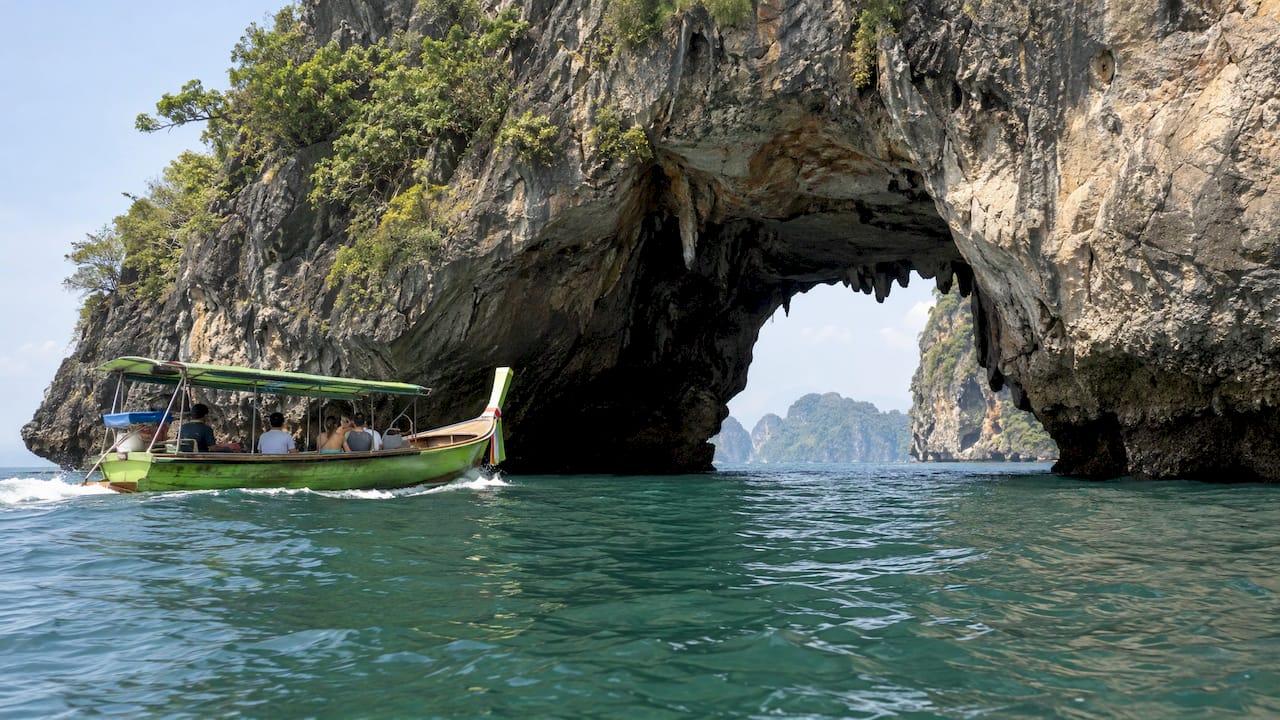
Phang Nga Bay is famous for hongs, from the Thai word for “room”. An academic paper on the area describes hongs as sea-invaded karst depressions ringed by steep limestone walls and reached through sea-level caves in the tidal zone. In other words, the cave is the doorway and the hong is the open-air reward on the other side.
The same paper notes that some entrances are low and close to the water, and that on some kayak routes visitors have to lie flat to get through. A Los Angeles Times travel report paints the same picture: a paddler leans back under the cave ceiling, then emerges into a sunlit hong enclosed by rock.
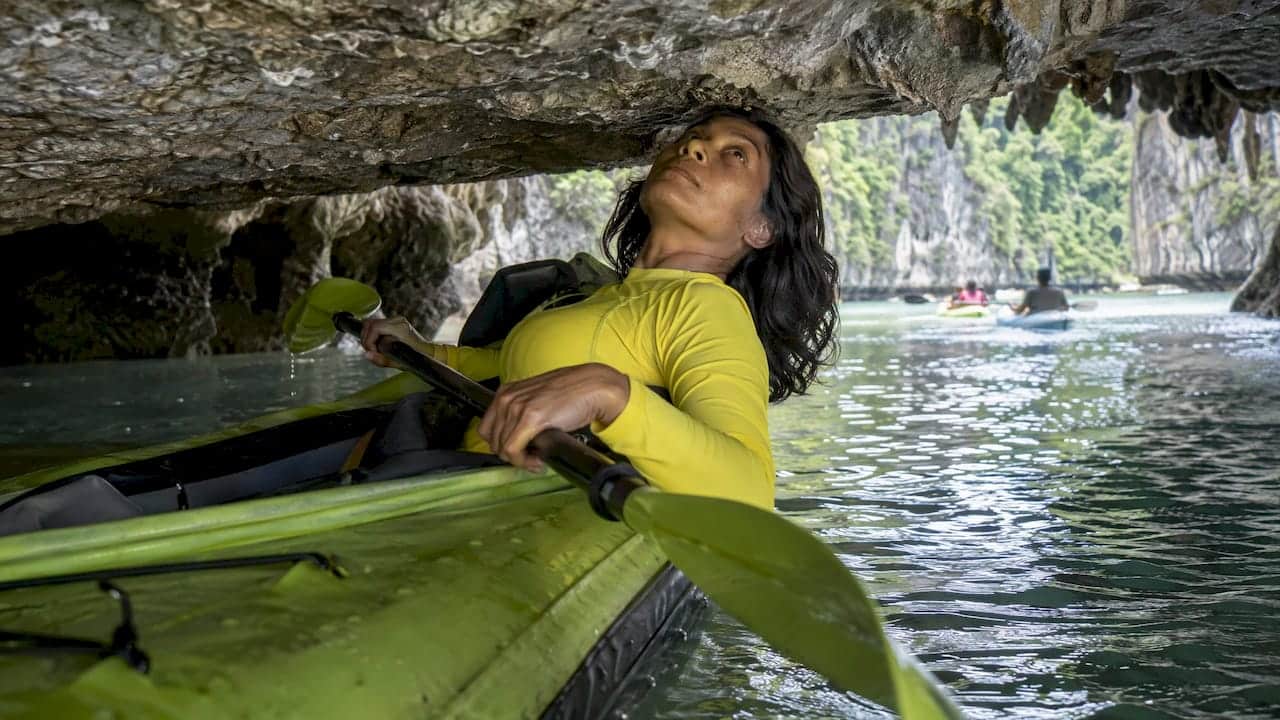
That is useful for you. The tight part is usually short, and what follows is open sky. But “short” is relative when you are anxious, so it is worth knowing that these are the stops to think about carefully.
Walk-in and swim-in caves
Some caves are on the mainland coast or on islands and involve a walk, a wade or a swim. The Tourism Authority of Thailand (TAT) warns visitors to Tham Le Khao Kop in Trang that they must pass through a very narrow cave passage before reaching the exit, and advises people with claustrophobia not to visit. That is the kind of plain official guidance you can trust: some caves are simply not for you, and that is fine.
Caves you only see from the boat
Many limestone cliffs around Phuket and the islands have caves and overhangs you can admire from the water without going in. You still get the dramatic rock, the echo and the photos, with a wide-open view behind you.
Which Phuket boat days involve caves and which don’t
Here is a practical way to sort the options. This is a general guide to activity types, so always confirm the specific route.
| Type of day | Cave or tight space likely? | Comfort level for claustrophobia |
|---|---|---|
| Island hopping with beach and snorkelling stops | Usually none | Very comfortable |
| Speed boat tour to Phi Phi, Raya or the Coral Islands | Open-water stops, viewpoints and beaches | Very comfortable |
| Jet ski and ATV days | None, you are in open air | Very comfortable |
| Sunset boat trip | None | Very comfortable |
| Phang Nga Bay by boat | Hongs and cave entrances may be on the route | Check the route, and agree your plan |
| Phang Nga Bay by sea kayak | Low entrances, possibly lying flat | The most demanding for claustrophobia |
| Dark sea-tunnel swims | Enclosed, dark, in the water | The hardest, usually best skipped |
If you want James Bond Island, Phi Phi or the Coral Islands without the cave question, our island tours around Phuket cover those destinations, and our Phi Phi early morning tour is an example of a day built around open water and beaches. For Phang Nga Bay specifically, read the Phang Nga South Sea tour page and our beginner’s guide to kayaking in Phang Nga Bay first, so you know what the paddling involves.
Tides decide how tight it gets
With sea caves, the same entrance can feel completely different at different times. Because hong entrances sit in the tidal zone, the water level changes how much headroom you have. A route that is a gentle glide at one tide can be a flat-on-your-back squeeze at another, and some passages are closed altogether when the water is high.
That is why timing matters as much as the place. Our guide to Phang Nga Bay kayaking and the tides explains when the caves open and why. If you are anxious, a more generous tide means a bit more space above you, but never guess: confirm with the people running your trip.
Thailand’s official tourism guidance for caves adds a second layer. The Thailand.go.th Cavern Travel Guide says visitors should check the cave type, water levels and rain conditions to avoid being trapped, and should use a guide or supervising staff on arranged cave tours. Heavy rain and rising water are exactly the conditions where you want a flexible operator who will change the plan, not push on with it.
Prepare before the day: a calm plan in five steps
This is the routine we would give a friend who dreads tight spaces but refuses to miss the bay.
1. Choose the route for the fear you have
Be honest about which situation bothers you. Is it the dark, the low ceiling, the group in single file or the water? A passage that is lit by daylight and open at both ends is a very different test from a dark tunnel.
2. Train your breathing a week early
Slow, deep breathing is one of the coping methods the Cleveland Clinic lists. Practise it for a few minutes each day: breathe in through the nose for four counts, out through the mouth for six. When panic starts, your body then already knows the pattern. If your fear is severe, work on it with a therapist, who can set up gradual exposure.
3. Pack for light and calm
TAT notes that boat operators provide torches for the Tham Le Khao Kop trip but recommends bringing your own waterproof head torch. Thailand.go.th suggests cave visitors carry a flashlight or head torch, drinking water, spare batteries and a first-aid kit. A head torch keeps your hands free and gives you your own light source, which is more comforting than it sounds.
Add a dry bag for your phone, reef-safe sun protection and shoes that grip when wet.
4. Tell your guide at the start
Do not wait until you are at the cave mouth. Say at the pier or on the boat: “I get claustrophobic in tight spaces.” Guides hear this regularly and can reorder the day, seat you near the front or back, or point out which stops to enjoy from the deck.
5. Agree your exit plan
The most important question is not “how narrow is it?” but “what happens if I want to stop?” Before entering any cave, know whether you can stay on the boat, how long the passage is and who goes first and last. Do not simply assume you can turn back once a group is inside a one-way passage: in a narrow channel with people behind you, turning around may be impossible.
Questions to ask before you book
Use this list for any operator, anywhere in Thailand:
- Which stops on the itinerary involve entering a cave or tunnel, and how long is each one?
- Is the cave entered by walking, swimming, paddling or lying back in a kayak?
- Can I stay on the boat during that stop, and is there shade and someone looking after me?
- Will the tide or rain change the route on the day?
- Are life jackets provided and do I wear one throughout?
- Is there a guide or crew member with the group at all times?
Thailand.go.th recommends following the designated cave route and staying on the marked path, which is also a good reason to go with a guide who knows it, not to wander in alone.
During the cave: how to handle a rising panic
If you do decide to try a short, daylight-lit passage, these habits help:
- Look at the exit, not the walls. In a hong entrance you can often see sky or light ahead. Fix your eyes on it.
- Slow the exhale. Longer out-breaths calm the body faster than big gulps of air.
- Count or name things. Counting paddle strokes or naming five things you can see pulls attention away from the sensation of being enclosed.
- Stay with the group, and speak up early. Tell the guide at the first sign, not the tenth.
- Accept that stopping is a success. Deciding to wait on the boat is a good decision, not a failure.
If you feel dizzy, confused or struggle to breathe, treat it seriously, signal your guide at once and get to open air. For anything that worries you medically, see your doctor after the trip.
Boat, kayak or cave diving: not the same thing
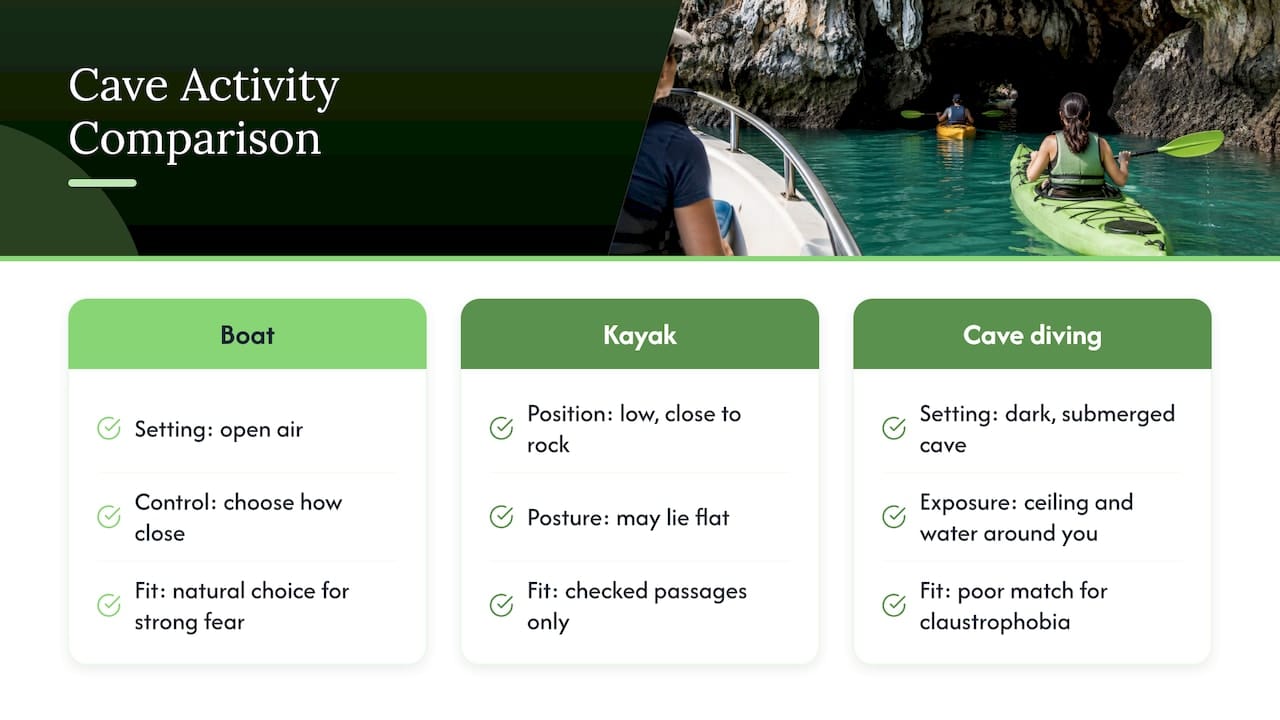
A boat day that passes cave entrances, a kayak trip through a hong and cave diving are three very different activities. On a boat you stay in open air and decide how close to go. In a kayak you are lower and closer to the rock, and some entrances need you to lean back or lie flat. Diving or swimming inside a dark cave is the most enclosed of all, with a ceiling above you and water around you.
If your fear is strong, the first option is the natural fit, and the second is only for passages you have checked. Anything involving dark, submerged or technical passages is a poor match for claustrophobia, and nothing on a family-friendly Phuket island day needs it.
Where you can still go: the best cave-free days
The good news is how much Phuket offers that is wide open:
- Island hopping: beaches, clear water and snorkelling around the islands.
- Jet ski tours: full speed, sea spray and open horizon. See our jet ski checklist for Phuket before you go.
- ATV adventures: muddy trails, viewpoints and fresh air.
- Sunset and evening trips: golden light on the water, including bioluminescent night trips. Read our guide on life jackets and permits for night tours.
- Private boat charters: you set the pace, and the route is yours to choose.
Families with younger children benefit most from this approach. A child who is nervous about the dark does not need to be pushed through a tunnel to have a memorable day.
Our view: plan around the fear, not around the cave
We would rather you enjoy every hour of a Phuket day than tick off a cave you dread.
Our tours cover James Bond Island, Phi Phi, Raya and Coral Islands, plus kayak tours, sunset trips and bioluminescent tours, so you have real choice about what a day contains. That choice is the point. When a traveller tells us up front what they are comfortable with, the itinerary can be built around it, with hotel pick-up and last-minute booking to keep things easy.
Our guests rate us 4.5 from 237 reviews, and our service is 99% issue-free according to Trustindex. Those numbers come from travellers who got what they expected. If tight spaces worry you, say so when you book, and we will help you pick the stops that suit you.
Carl
Plan a day that suits you
If you would like an island day without the cave question, start with our Phuket island tours, which cover Phi Phi, James Bond Island, Raya and the Coral Islands, with hotel pick-up and flexible last-minute booking. Prefer to go with your own group? Our boat charters let you shape the day.

You can book online or by WhatsApp. Tell us about your comfort level when you message, and we will point you to the right tour on our tours page.
FAQ
What is the fear of getting stuck in a cave called?
The established term is claustrophobia, an intense fear of enclosed spaces. Caves and tunnels are among its typical triggers, according to the Cleveland Clinic. The fear of being trapped underground is a common form of it, and it responds well to behaviour training and breathing techniques.
Can I visit Phang Nga Bay if I’m claustrophobic?
Yes. The bay is mostly open water, cliffs and lagoons. Only some routes enter tight cave passages, and on some kayak routes you may need to lie flat to get through. Choose a boat itinerary, check which stops involve caves and agree in advance that you can stay on deck.
Can I stay on the boat while others go into a cave?
On many group trips this is a sensible plan, but never assume it. Ask before you book and confirm again at the start of the day. Tides and weather can also change which stops are used, so ask what happens if the route changes.
Does claustrophobia affect snorkelling or scuba diving?
It can, because masks, tight wetsuits and being underwater can feel confining to some people. Open-water snorkelling in a wide bay is usually very different from swimming through a dark tunnel. If you are unsure, talk to your doctor and keep your first try short, with a guide close by.
What should I bring if I want to try a short cave passage?
A waterproof head torch, water, spare batteries and a small first-aid kit are the basics, as Thailand.go.th advises. Wear a life jacket where provided, stay on the marked route and keep your guide within sight at all times.
Sources
- Claustrophobia: What Is It, Symptoms, Causes & Treatment, Cleveland Clinic
- Tourism Authority of Thailand, destination page
- Hongs of Phang Nga Bay, Thailand
- Paddling through the caves of Phang Nga Bay, Los Angeles Times
- Cavern Travel Guide, Thailand.go.th


