
Sea Snakes and Snorkelling in Phuket: What You Need to Know
Yes, there are sea snakes in the Andaman Sea off Phuket, and yes, you can still have a brilliant snorkelling day. Most visitors never see one. If you do, the sensible response is to stay calm, keep your distance and let it go about its business. Bites to snorkellers are very rare, and nearly all of the recorded cases involve people handling the animal or tangled fishing nets. Pick a calm-season day, head to a proper reef such as Racha or Coral Island, and the sea snake question becomes a small footnote to a great trip. If you would rather have the planning taken care of, our island tours from Phuket include hotel pick-up and snorkelling stops at the places most visitors want to see.
TL;DR
- Sea snakes live in the Andaman Sea around Phuket, but most snorkellers never meet one.
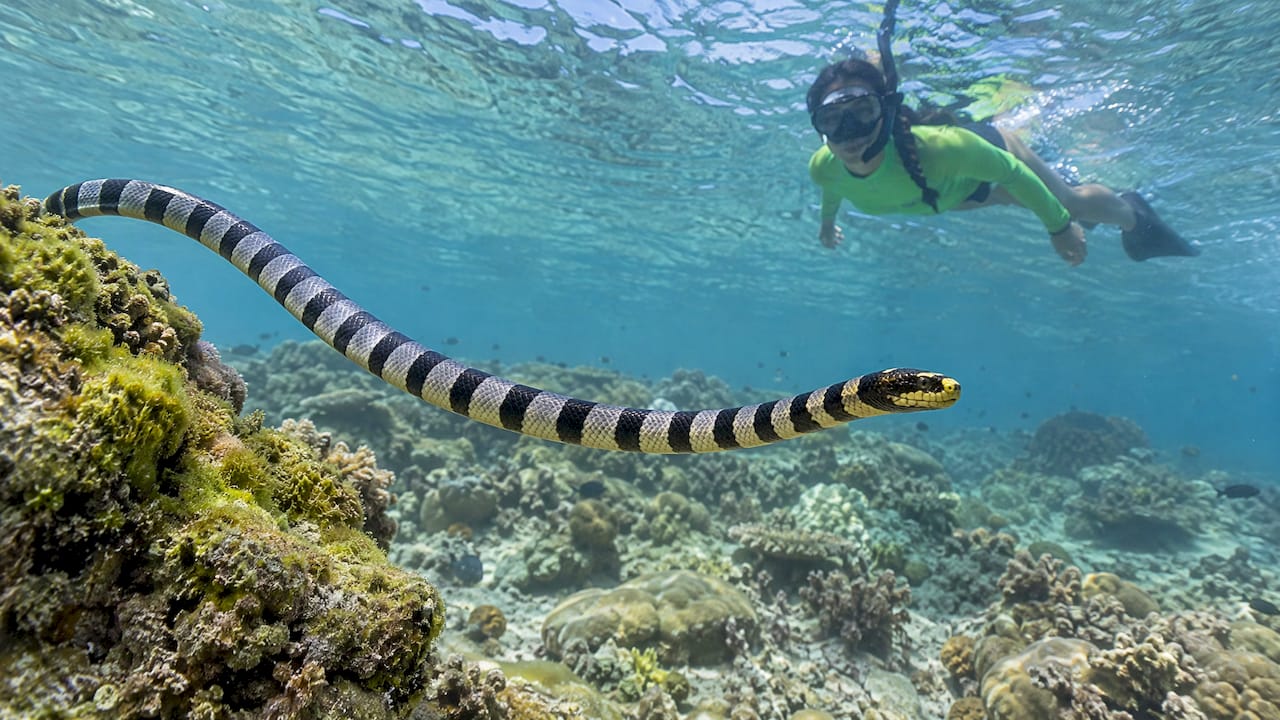
- The one you are most likely to see is the banded sea krait: blue-grey with black bands, a yellow snout and a paddle-shaped tail.
- Bites on swimmers are very rare. The risk comes from touching, grabbing or cornering the animal, so look and move away.
- If a bite ever happens, get out of the water, keep the person still and calm, and get them to hospital fast. Never use a tight tourniquet or cut the wound.
- Calm season (November to April) gives the best visibility and the safest sea, which matters far more for your day than any snake.
Table of Contents
- Are there sea snakes in Phuket?
- Which sea snake might you actually see?
- How dangerous are they to snorkellers?
- What to do if you see one while snorkelling
- If someone is bitten: what to do
- The bigger safety picture for snorkellers
- When and where to snorkel around Phuket
- Book a Phuket snorkelling day that is easy to enjoy
- Our view: a sea snake is a good story, not a problem
- FAQ
- Sources
Are there sea snakes in Phuket?
There are. A 2026 study of sea snake bites in Thailand reports that around 30 species of marine elapids (the venomous snake family that includes cobras and sea snakes) have been recorded in Thai waters. Along the Andaman coast, which is Phuket’s side, the species documented include Hydrophis cyanocinctus, Hydrophis spiralis and the yellow-lipped sea krait, Laticauda colubrina.
That sounds like a lot, so here is the context. Phuket’s own sea-safety guidance says that although sea snakes, lionfish and stonefish are present, jellyfish are the only creature that is a real concern for swimmers on the Andaman coast. Sea snakes are shy animals that spend their time hunting small fish and eels around rocks and reefs, and they mostly want nothing to do with you.
Sightings do happen. Beach and shallow-water photos of banded sea kraits turn up regularly in Phuket travel groups, and one traveller wrote up a snorkelling trip off Phuket where a banded sea krait swam about three metres below him. A sighting like that is a story to tell at dinner, not a reason to cancel.
Which sea snake might you actually see?
For a snorkeller around Phuket, the most likely animal is the yellow-lipped sea krait, also called the banded sea krait. It is the one that comes close to shore, rests among rocks and sometimes crawls onto beaches. A krait is a sea snake with a body that still works on land, which is why you can see one out of the water.
How to recognise a banded sea krait
According to ThailandSnakes.com’s species profile, adults are usually 1.0 to 1.4 metres long, occasionally 1.5 metres, and look like this:
- a blue-grey to silvery-blue body
- roughly 30 to 55 full black bands that wrap all the way round
- a bright yellow snout and upper lip with a black stripe through the eye
- a flattened, paddle-shaped tail
True sea snakes of the Hydrophis group tend to be more uniform in colour and lack that strong yellow head pattern.
The tail test
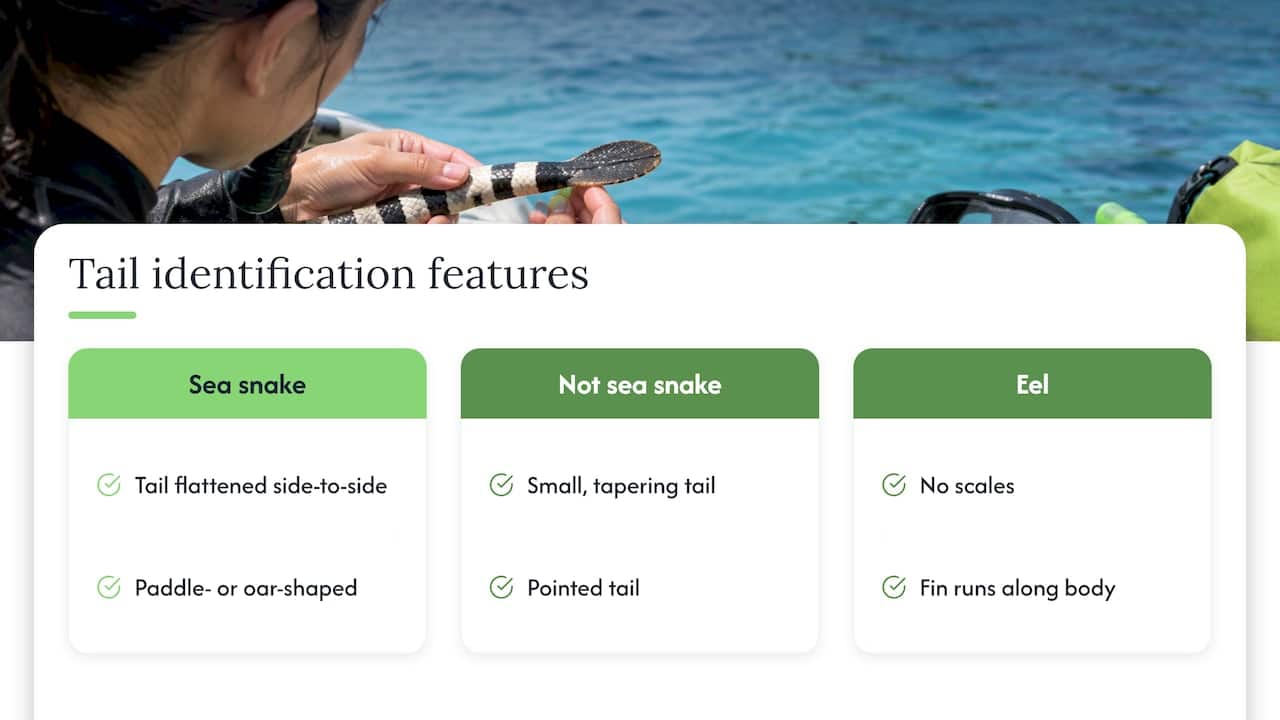
If you only get a glimpse, look at the tail. A Siam Society field key to sea snakes advises that the first check is the tail: a true sea snake has a tail flattened from side to side like a paddle or oar. A small, tapering, pointed tail means the animal is not a true sea snake. Eels, by contrast, have no scales and a fin running along the body, which is why people often confuse the two.
You do not need to identify the species in the water. The practical rule is simple: anything snake-shaped and swimming gets the same polite distance.
Why they surface, and why that is normal
Sea snakes breathe air. They hold large lungs that run most of the length of the body, and they can stay under for several hours, but they do rise to the surface to breathe. Seeing one come up for air near you is not aggression, it is just a snake doing what snakes do.
How dangerous are they to snorkellers?
The venom of sea snakes is potent. That is the part that makes headlines. The part that gets left out is how reluctant they are to use it.
The Thaiger’s Phuket diving feature notes that despite their strong venom, sea snakes are not considered dangerous to humans, and that only about a quarter of bites actually inject venom. Researchers who ran standardised snorkel surveys in New Caledonia, where encounters are very common, found that recreational swimmers are rarely bitten. One explanation the authors give is that the snakes do not seem to treat brief human contact as an attack.
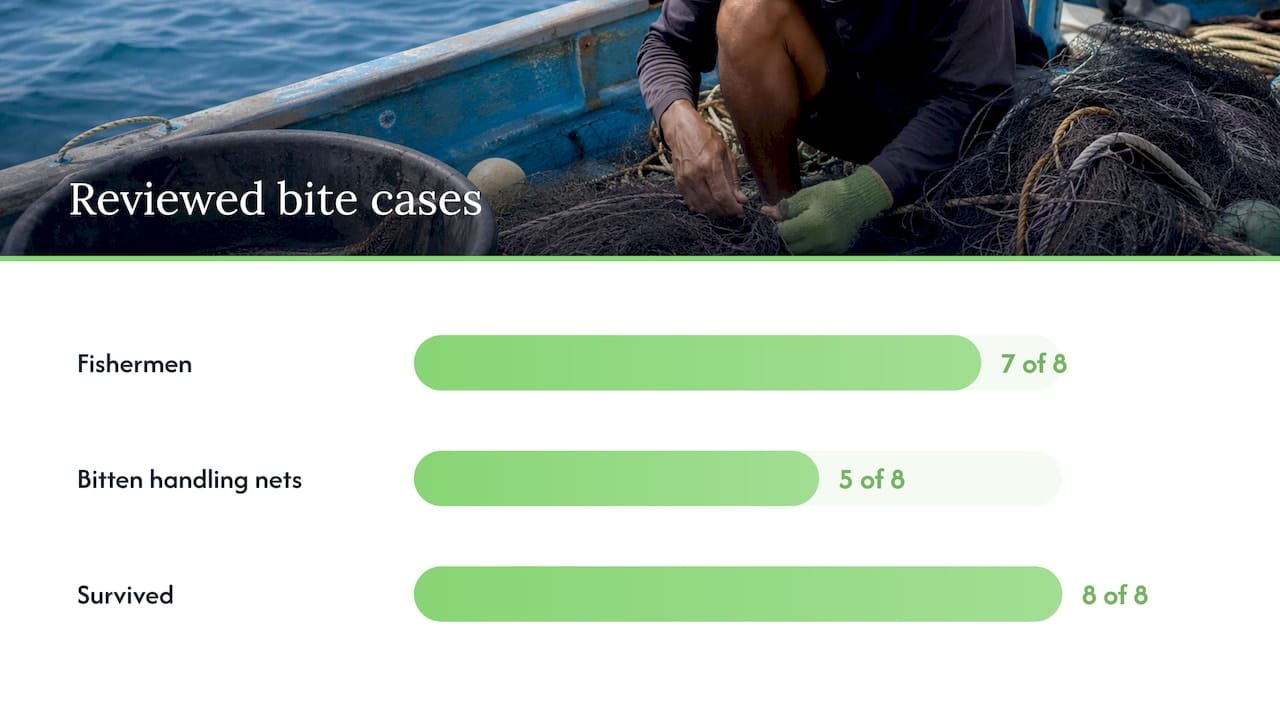
The Thai picture is similar. A 2026 review of suspected sea snake bites handled by the Ramathibodi Poison Center in Bangkok covered cases from January 2011 to June 2026. Of the eight patients whose records could be analysed, seven were fishermen and five were bitten while handling nets. All eight survived. That is the profile of the risk: people pulling snakes out of nets, not people floating over a reef with a mask.
So the rule that matters is about behaviour, not luck. Do not touch, chase, grab or corner a sea snake, and the odds are overwhelmingly in your favour.
What to do if you see one while snorkelling
Keep it boring. A calm reaction keeps you safe and keeps the animal relaxed.
- Stop and stay level. Do not splash, kick hard or dive down towards it.
- Keep a respectful distance. ThailandSnakes.com advises not to poke or grab a sea krait and to keep a respectful distance underwater. A few metres is plenty.
- Do not block its way to the surface. It needs to breathe, so leave it a clear path up.
- Swim away slowly. Turn and move off in a relaxed way. No need to rush.
- Tell your group. Let the others know so nobody swims straight into it, especially children.
- Skip the selfie. Underwater photos are fine from distance. Never reach out for a closer shot.
If you find one on the beach
Banded sea kraits do come ashore to rest and digest. On a beach, the same advice applies: do not pick it up, keep children and pets back, and photograph from about a metre away. If it is sitting in a busy walkway, tell local marine park or beach staff rather than moving it yourself.
Murky water deserves extra care
WHO South-East Asia guidance notes that bathers can be at risk of bites in the muddy water of estuaries and river mouths, where you cannot see what is beside you. Clear reef water, the kind you want for snorkelling anyway, puts you in a much better position to spot and avoid any animal.
If someone is bitten: what to do
This is rare, but it is worth knowing, because the first minutes count. Any suspected sea snake bite is a medical emergency, even if the person feels fine. Call emergency medical services (1669 in Thailand) or have someone arrange transport to hospital straight away.
The WHO’s snakebite first-aid guidance is specific for sea snakes:
- Get the person out of the water. Victims of sea snake bites need to be moved to dry land to avoid drowning.
- Keep them still. Immobilise the whole person and splint the bitten limb, so the venom is not pumped around by movement.
- Reassure them. Staying calm helps.
- Remove rings and tight objects from the bitten limb before swelling starts.
- Never use a tight tourniquet. The same guidance says a tight arterial tourniquet must never be used, and a BMJ clinical review explains it can cause severe local damage and gangrene.
- Do not cut, suck or use traditional remedies such as black stones.
- Pain relief: paracetamol is acceptable for pain.
- If they vomit, place them in the recovery position and keep checking their breathing while you arrange rapid transport.
What happens at hospital
The Thai poison-centre review explains that Thailand’s national snakebite guidelines recognise sea snake envenoming as a cause of muscle damage, and that treatment is primarily supportive care with close monitoring of muscle enzymes, kidney function, electrolytes, urine output and breathing. Hospital teams in Phuket deal with the full range of marine injuries, so the key thing is to arrive quickly and tell staff you were in the sea.
Tell the doctors exactly what you saw and when. A photo of the animal, taken safely from a distance, can help, but never go back for one.
The bigger safety picture for snorkellers
If you want to rank the real risks of a Phuket snorkelling day, sea snakes sit near the bottom. The things that deserve your attention first:
- Sea state. Phuket’s sea-safety guidance warns of rough seas with waves of 4 feet or more and rip currents on the west coast in the rainy season, May to October, and notes there are no lifeguards on Phuket beaches except Kata and Karon.
- Jellyfish. These are the marine animals most likely to bother swimmers. Our guides to jellyfish stings while snorkelling in Phuket and jellyfish season and vinegar first aid cover what to do.
- Sun and fatigue. Wear a rash vest and take breaks. Our snorkelling attire guide lists what to pack.
- Water conditions. Algae blooms, runoff and murky water can change a day on the sea. This guide to red tide safety checks shows the habit worth borrowing wherever you swim: check local conditions on the day, not the week before.
For a fuller routine, see our 10 safety checks for snorkelling in Phuket.
When and where to snorkel around Phuket
The season matters more than any animal. Phuket101’s 2026 guide says the best snorkelling window is November to April, when the sea is calm and visibility is often 10 metres or more. During the monsoon, May to October, most west coast snorkelling becomes unsafe, with Paradise Beach as the year-round exception because it faces northeast. The same guide points to the Similan Islands (visibility up to 30 metres, open from mid-October to mid-May) and to Racha Island, about 30 minutes by speedboat from Chalong, where the coral stays healthy year-round.
Clear water in calm season helps you in two ways: you see more of the reef, and you see anything else in the water from a comfortable distance.
| Place | Why snorkellers go | Best time |
|---|---|---|
| Racha Islands | Healthy coral, clear water | Coral healthy year-round; calm season November to April is easiest |
| Coral Island | Close to Phuket, shallow bays | Calm season, November to April |
| Phi Phi Islands | Classic scenery and reef stops | Calm season, November to April |
| Paradise Beach | Faces northeast, so sheltered | Works year-round |
If you are planning around Phi Phi, read our Phi Phi snorkelling rules and the guide to the best snorkelling spots in the Phi Phi Islands. For the months when the weather is most reliable, our page on Phuket snorkelling conditions from December to March helps you pick days.
Tips for families
- Give every child a snorkel vest and keep them within arm’s reach.
- Teach one rule before getting in: if we see an animal we do not know, we look and do not touch.
- Keep young children in shallow, clear water near the boat or the shore.
- Choose a boat day over a random beach on windy days.
Book a Phuket snorkelling day that is easy to enjoy
Our island tours cover the places in this guide, including Phi Phi, Racha and Coral Island, with hotel pick-up and flexible last-minute booking, so you can choose a calm day once you have checked the forecast. Families, couples and groups can browse the full range on our Phuket island tours page, and if you want a private option, the private speed boat tours give you your own schedule.

Guests rate us 4.5 from 237 reviews, and our website shows a 99% issue-free service rate verified by Trustindex. Message us on WhatsApp or book online and we will help you match a trip to the season and your group.
Our view: a sea snake is a good story, not a problem
We spend our days on the water around Phuket and the nearby islands, and the question about sea snakes comes up from time to time. Our answer is the same as the science: they are shy, they are rarely a concern for snorkellers, and a few simple habits take care of nearly everything.
The habits are the ones that make any day on the sea better. Choose the calm season. Pick a reef with clear water. Keep your distance from anything you do not know. Never touch wildlife. That is how we plan every island trip, and it is why we suggest guests look at the conditions before they pick a day rather than worrying about one animal.
What we want is for you to enjoy Racha, Coral Island or Phi Phi without a second thought. A well-planned trip with hotel pick-up, a clear route and flexible booking takes the stress out of the day, and that is what our guests tell us they value in the reviews. If you see a banded sea krait gliding past, enjoy it from a distance. You will remember it.
Carl
FAQ
Are there sea snakes in Phuket?
Yes. Sea snakes live in the warm coastal waters of the Andaman Sea, including around Phuket, and the banded sea krait is the one you are most likely to see. Most snorkellers never meet one, and those who do usually see a snake that moves away calmly.
Is it safe to swim and snorkel in Phuket?
It is, when you choose the right season and conditions. November to April brings the calmest sea, while the monsoon from May to October brings rough west coast water and rip currents. Check the sea state on the day, stay near your boat or guide, and watch for jellyfish, which are the most common nuisance.
What should I do if I get bitten by a sea snake?
Get out of the water, keep the person still and calm, remove rings and tight items from the limb, and call emergency services (1669) so they can reach hospital quickly. Do not use a tight tourniquet, cut the wound or try to suck out venom. Treatment in Thailand focuses on supportive care and close monitoring.
Are sea snakes aggressive?
No. Sea snakes tend to avoid people, and researchers have found that swimmers are rarely bitten even where encounters are common. Bites mostly follow handling, such as removing a snake from a fishing net. Keep your hands to yourself and the animal will usually just swim off.
Is Phuket good for snorkelling?
Yes. Racha Island and the Similan Islands are known for clear water and healthy reef, and Coral Island is the closest option to Phuket. The calm season from November to April gives the best visibility.
Sources
- Clinical Characteristics and Outcomes of Sea Snake Bites in Thailand (MDPI, 2026)
- Phuket Water and Sea Safety Tips and Advice (Phuket.Net)
- Best Snorkelling Beaches in Phuket 2026 (Phuket101)
- Yellow-Lipped Sea Krait profile (ThailandSnakes.com)
- A Key to the Sea Snakes (Siam Society, Murphy)
- Phuket Diving: sea snakes edition (The Thaiger)
- Peaceful coexistence between people and deadly wildlife (British Ecological Society, 2021)
- Guidelines for the Management of Snake-Bites (WHO SEARO)
- Snakebite envenoming treatment (WHO)
- Managing snakebite (BMJ clinical review)
- The Closest I’ve Been to Death: an encounter with a sea snake off Phuket (Frank in Asia)


