
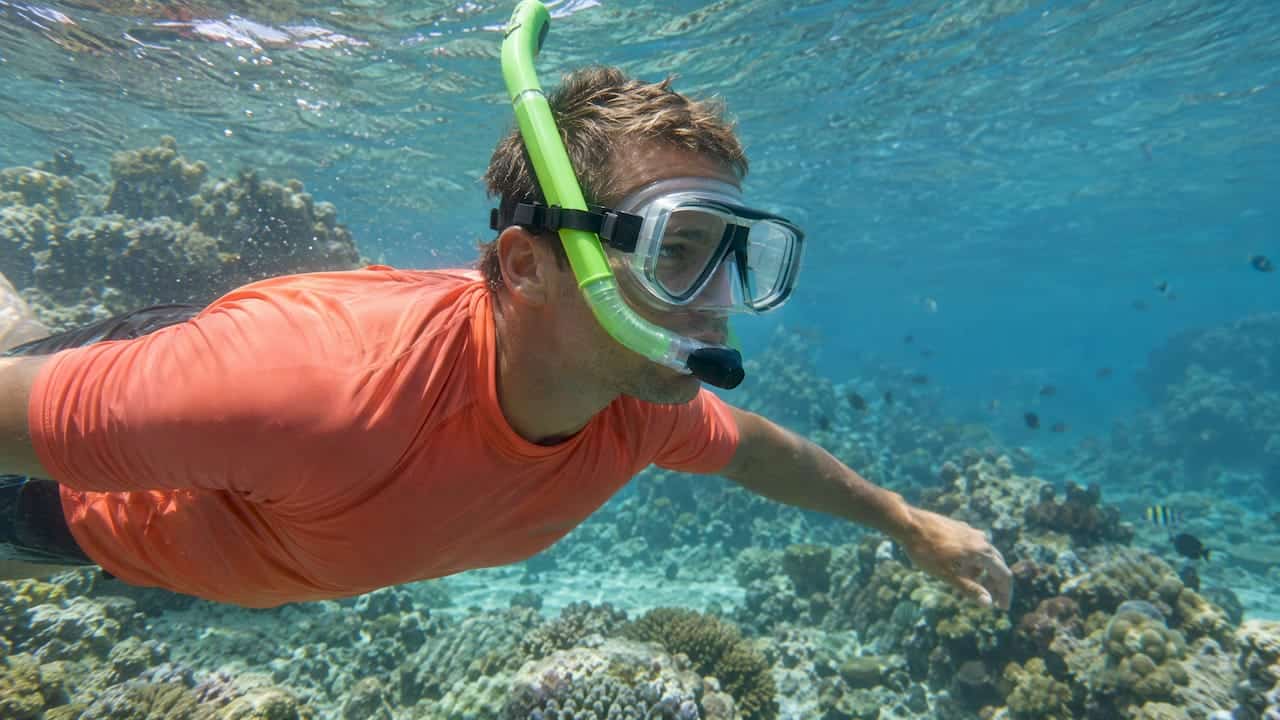
Snorkelling with Glasses in Phuket: Your Best Options
Yes, you can snorkel in Phuket if you wear glasses, but not with the glasses on your face. Their arms break the mask seal, so you need a different route: a prescription mask, stick-in corrective lenses, or (with care) contact lenses. Pick one before you board and the reef will look sharp instead of blurry.
This guide walks you through each option, what it costs, how to check the fit, and how to handle a day on the water around Phuket’s islands when you can’t see well without correction.
TL;DR
- Never wear regular glasses under a snorkel mask. The arms interfere with the silicone seal and let water in.
- Easiest fix: a mask with prescription lenses built in, or a mask that accepts corrective inserts.
- Mild prescription? You may see well enough in a normal mask, because things look bigger and closer underwater.
- Contacts carry an eye-infection risk when exposed to water. Talk to your optician before using them.
- Sort your mask before the trip. Fit matters more than anything else, and a good mask in your size makes the day.
Table of Contents
- Why glasses and snorkel masks don’t mix
- Your options at a glance
- Option 1: a prescription snorkel mask
- Option 2: stick-in corrective lenses
- Option 3: contact lenses
- Option 4: go without correction (if your prescription is mild)
- How to check the fit before you buy
- Choosing where to snorkel when you wear a mask with lenses
- What to pack for a day on the water
- Book your island day with us
- FAQ
- Sources
Why glasses and snorkel masks don’t mix
A snorkel mask works because its soft skirt presses against your face and forms a seal. Ordinary glasses put a pair of arms right through that seal. The arms interfere with the silicone and can let water leak in, which means a flooded mask and a salty eye-sting at the worst moment.
There is also comfort to think about. Seaview 180 notes that the arms create painful pressure points on the temples and the bridge of the nose, on top of breaking the seal. After an hour floating over a reef, that adds up.
So the question is never “how do I keep my glasses on?” It is “how do I get my prescription inside the mask?”
What about a full-face mask?
It is tempting to think a big full-face mask solves the problem. It doesn’t automatically. Whether glasses fit depends on the particular design and frame size, and some designs are specifically not recommended for wearing over glasses because of discomfort, a poor seal or leaks. Treat a full-face mask as one more thing to test, not as the answer.
Your options at a glance
| Option | How it works | Best for | Watch out for |
|---|---|---|---|
| Prescription mask (lenses built in) | Corrective lenses are part of the mask | Regular snorkellers, stronger prescriptions | Higher cost, needs your exact prescription |
| Mask with stick-in or insert lenses | Lenses attach inside a compatible mask | Occasional snorkellers, families sharing kit | Must match the mask model and your strength |
| Contact lenses under a normal mask | Wear your usual contacts with a well-fitted mask | Short swims, people comfortable with the risks | Eye-infection risk from water exposure |
| Normal mask, no correction | Rely on underwater magnification | Mild prescriptions only | Distant details may stay soft |
Option 1: a prescription snorkel mask
A prescription mask has corrective lenses built into the mask itself. It is one of the simplest ways to see clearly, and the mask holds its seal the way any good mask does.
There are two main designs. In one, the entire lens area is a prescription lens; in the other, prescription lenses are inserted separately between the face shield and your eyes. The same guide suggests asking your eyewear provider to help adapt your glasses prescription for a mask.
Strengths and prices
Most designs cover a decent range. Most prescription snorkel masks support about -10.0 to +5.0 diopters, with premade lenses in fixed steps up to around -8.0, while stronger or more precise prescriptions need custom lenses. The same testing guide puts typical prices at $50 to $400, so the spread is wide.
Some examples of what is out there:
- One optical mask accepts lenses from -1.0 to -10.0 and +1.0 to +4.5 in half-diopter steps, plus bifocal reader lenses, and was listed at $145.
- Another popular model takes prescription lenses from -1.0 to -7.0 and +1.5 to +3.0 diopters, sold separately at around $60 to $70 a pair.
Prices and ranges change, so check the maker’s page when you buy.
Premade or custom lenses?
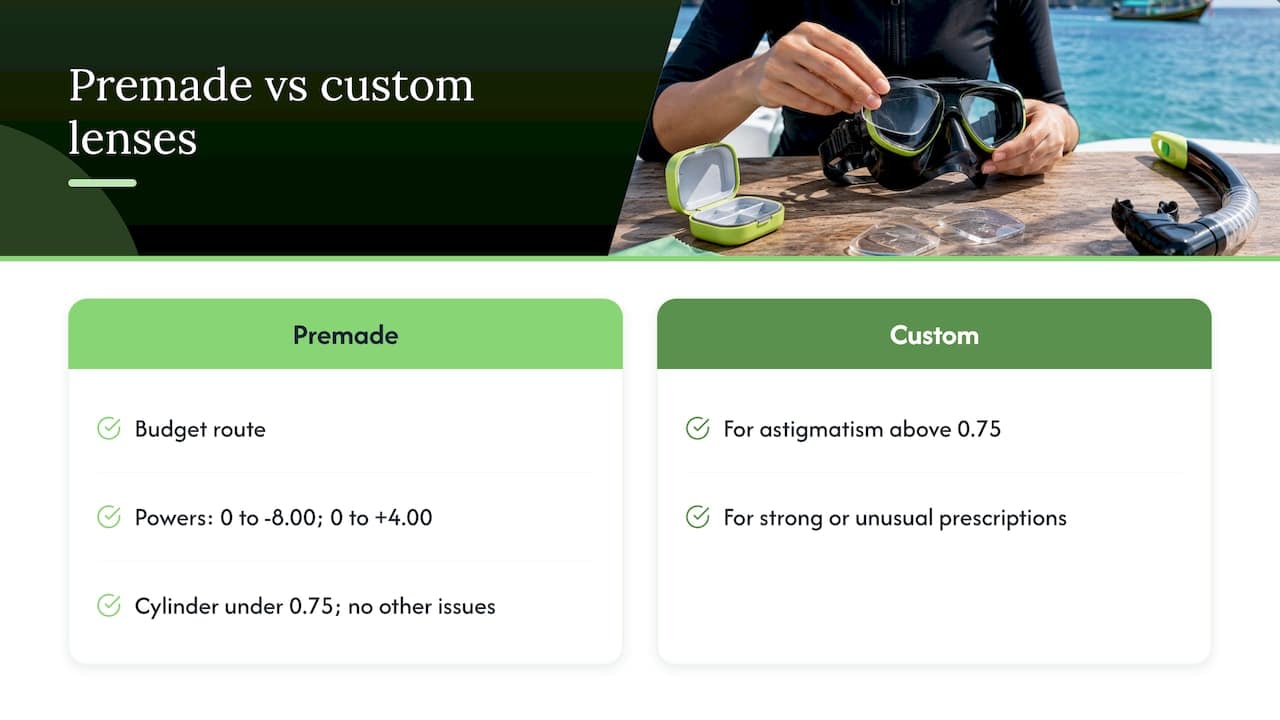
Premade stock lenses are the budget route. They are available in powers 0 to -8.00 and 0 to +4.00, and suit divers with cylinder correction under 0.75 and no other vision issues. If you have astigmatism above that, or a strong or unusual prescription, go custom.
Two more practical points. If your exact strength isn’t in stock, the usual advice is to choose the next weakest strength. And for bonded lenses, your pupil distance and glasses prescription must be measured or known, so bring your latest prescription.
Option 2: stick-in corrective lenses
If you only snorkel on holiday, a full prescription mask can feel like a lot. Stick-in lenses are the middle path. For example, suction-cup optical lenses for one snorkel mask run from -8.0 to +8.0 diopters and attach inside without tools or adhesive.
This suits families where several people need different strengths, because you can swap lenses for each wearer. The catch: the lenses are made for specific masks, so buy the matching pair together and try the setup at home before you fly.
Travel guides for Thailand agree it is worth planning ahead. One Thailand snorkelling guide lists optical inserts for glasses wearers as extra equipment, next to a snorkel vest for beginners and a UV shirt.
Option 3: contact lenses
Many snorkellers use contacts under a regular mask, and one eyewear retailer says this works and suggests daily disposables to limit contamination after water exposure. It also advises talking to an eye-care professional first.
That last part matters. Eye-health bodies take a more cautious line on water and contacts:
- The American Optometric Association recommends removing contact lenses before swimming, using watertight goggles if they must stay in, and throwing them away immediately if they get wet.
- A US CDC survey found that nearly 85% of Acanthamoeba keratitis cases occur in contact lens wearers, and exposing lenses to water is a primary risk factor.
- Prevent Blindness says a correctly fitted snorkelling mask reduces, but does not eliminate, the risk, and that lenses should be discarded straight afterwards.
If you do wear contacts in the sea, make them daily disposables, keep a fresh pair and your glasses in your day bag, and take the lenses out and bin them as soon as you are back on the boat or beach. Because this depends on your eyes, ask your optometrist or ophthalmologist at home which option suits you. If you get redness, pain or blurred vision afterwards, see an eye doctor promptly.
Option 4: go without correction (if your prescription is mild)
This surprises people. Underwater, a mask makes things look bigger and closer. DIVEIN says everything looks 25 percent bigger because of refraction, so if your glasses only correct a small amount, you may not need a prescription mask at all.
A rough rule from divers: people who can legally drive without glasses may not need correction to dive. Snorkelling is easier on the eyes than most things, because fish and coral are usually close and you are looking down.
If you are unsure, try it in a pool before the trip, or on your first beach swim in Phuket, then decide whether to upgrade.
How to check the fit before you buy
A prescription lens in a leaking mask is worthless, so fit comes first. Here is the quick test:
- Place the mask on your face without the strap.
- Breathe in gently through your nose.
- If a seal forms, the mask should stay on without you holding it.
- Repeat with the snorkel in your mouth, because your lip contour changes the fit.
Few more checks:
- Tempered glass lenses. The same guide advises tempered glass, as plastic scratches and can be dangerous.
- Silicone skirt. Softer silicone tends to fit better than stiff plastic skirts, which may also cause skin rashes.
- Facial hair and hairstyle. Beards and stray hair under the skirt cause leaks, whatever the lens.
- Anti-fog. Rinse the lenses and follow the maker’s instructions before you get in the water.
Masks vary widely in real-world performance. DIVEIN’s testers found that lens quality, diopter precision and mask design can significantly affect vision, seal and comfort, especially on long sessions. For a full day hopping between islands, comfort is the thing to prioritise.
Our take: sort your eyes out before the boat
We run island days around Phuket every week, and the guests who enjoy snorkelling most are the ones who solved their vision problem in advance. The reef is the star, whether that is the shallow coral near Coral Island or the clear water around Racha and Phi Phi, and it is a shame to spend it squinting at a blur.
Our advice is simple. Choose a mask that fits your face first, then add your prescription. If your correction is mild, try a normal mask. If it is strong, get a prescription mask or insert lenses at home, where you can take your time. Pack your glasses in a dry bag so you can see clearly on the boat, at lunch and on the way back to the pier.
We plan our itineraries so you are not rushed in the water, which gives you time to adjust your mask, rinse it and get comfortable. If you have questions about your day, message us on WhatsApp before you book and we will help you plan it.
Carl
Choosing where to snorkel when you wear a mask with lenses
With corrective lenses you will want calm, clear water and gentle entry points, since you do not want to fiddle with your mask in a chop. Our own island guides can help you choose:
- Comparing the two most popular day-trip islands? Read Coral Island vs Racha for how the reef, crowds and boat ride differ. The section on what the snorkelling is really like is a good place to start.
- Torn between the two big names? Our Racha vs Phi Phi guide covers snorkelling, diving and views.
- Want specifics for the Phi Phi area? See the best snorkelling spots in Phi Phi.
- Curious about the deeper side? Our Phuket scuba diving page shows what we offer below the surface.
Choose quieter times when you can. Our Coral Island and Racha guide also explains when the islands are busiest, and fewer people means less crowding while you adjust your mask.
Sea safety still applies
Your mask will not help you in rough water. Local safety advice for Phuket says to obey swimming signs and flags, watch the ocean for at least 15 minutes before entering, and swim in the lifeguard-protected area. On a boat trip, listen to your crew’s briefing, and stay close to the boat if your eyesight without correction is poor, since landmarks are harder to judge.
What to pack for a day on the water
Glasses wearers need a slightly longer list than everyone else:
- Your prescription mask or insert lenses, already tested for fit
- Your normal glasses in a hard case, kept dry
- Spare daily-disposable contacts if you use them, plus your lens solution
- A snorkel vest if you are a beginner or a nervous swimmer
- A UV shirt and reef-safe sun protection. Thailand’s waters stay between 28 and 32°C year-round, so you will not need a wetsuit
- A small microfibre cloth for your glasses once you are out of the water
For clothing and sun-care detail, see our full guide on what to wear snorkelling in Phuket.
Book your island day with us
Once your mask is sorted, the rest is easy. We run island tours around Phuket with hotel pick-up, covering places like James Bond Island, Phi Phi, Raya and Racha and Coral Island, with private and group boat options and last-minute booking when plans change. Our reviews carry a 4.5 rating from 237 reviews, and our site cites a 99% issue-free rate verified by Trustindex.
Browse the full range on our Phuket island tours page, or see our boat and service options if you want a private day on the water. You can book online or through WhatsApp.

Want a more active day? Our jet ski and ATV adventures pair well with a relaxed snorkelling morning.
FAQ
Can I snorkel if I wear glasses?
Yes, you can, but not with your glasses under the mask. The arms break the seal and let water in. Use a prescription mask, a mask with insert lenses, contacts used with care, or a standard mask if your prescription is mild.
Is there a snorkel mask you can wear with glasses?
Not regular glasses, no. Prescription masks have the corrective lenses built in, and some masks take stick-in lenses instead. Full-face masks are not a guaranteed answer, because whether glasses fit depends on the design and your frame size.
How can I snorkel if I have bad eyesight?
You have three practical routes: a prescription mask, insert lenses that match your mask, or contact lenses. If your correction is mild, a normal mask may be enough because everything looks about 25 percent larger underwater. For a strong or complex prescription, ask your optician about custom lenses.
Is it safe to wear contact lenses snorkelling?
Eye-health bodies advise removing contacts before swimming because water exposure raises the risk of a serious infection called Acanthamoeba keratitis. If you do wear them, use daily disposables under a well-fitted mask and throw them away straight afterwards. Check with your optometrist first, and see an eye doctor if your eyes become red or painful.
Can I buy or rent a prescription mask in Phuket?
It is safest to arrange it before you travel, because the right strength and a good fit are hard to guess on arrival. Premade lenses cover many prescriptions, but custom lenses take time. Bring your up-to-date prescription and your pupil distance if you plan to shop locally.
Sources
- Can You Snorkel With Glasses? 5 Ways to See Clearly
- Can I Snorkel If I Wear Glasses or Contacts?
- Can I wear glasses under a full face snorkel mask?
- A Buyer’s Guide to Swim Goggles and Dive Masks
- 7 Best Prescription Snorkel Masks in 2026
- Tusa Liberator Plus Prescription Mask
- Mares X-Vision Ultra LS Mask
- Prescription Dive Masks, DAN World
- Choosing a snorkel mask
- Corrective Dive Masks, DIVER magazine
- Seaview Pro Snorkel Mask
- Snorkeling in Thailand: Coral Reefs, Reef Sharks and the Best Spots
- Diving and Snorkeling with Contact Lenses
- Pool of knowledge: swimming and eye safety, AOA
- Water Exposure is a Common Risk Behavior among Soft and Gas Permeable Contact Lens Wearers, CDC
- Acanthamoeba Keratitis and Contact Lenses, Prevent Blindness
- Phuket Travel Safety Guide


