
Drone Rules for Phuket and Its Islands: What Tourists Must Know
Yes, you can fly a drone in Phuket, but only after your drone and you are registered, and never in the places where flying is banned outright: within 9 km of an airport, and over national park waters and beaches such as Maya Bay, the Similan Islands and Phang Nga Bay. Bringing a drone into Thailand is easy. Flying it legally takes preparation, so start before you pack.
This guide walks through what tourists need to check, from registration to battery rules at the airport, and what it means once you are out on a boat or a jet ski around the islands.
TL;DR
- Every drone must be registered with NBTC. Drones with a camera, or over 2 kg, also need CAAT registration, and the pilot is registered too.
- Fly in daylight, in clear weather, in sight of the drone, and no higher than 90 metres.
- Stay at least 9 km from airports. Much of north Phuket, including the Mai Khao and Nai Yang area, sits in or near this zone.
- National park areas, including Maya Bay, the Similan Islands and Phang Nga Bay (James Bond Island), are no-drone places.
- Breaking the rules can mean up to one year in prison, a fine of up to 40,000 baht, or both.
Table of Contents
- Are drones legal in Thailand for tourists?
- Registration: NBTC, CAAT and who needs what
- Do you need a separate permit to fly?
- The flying rules in plain English
- Where you cannot fly around Phuket
- Flying from a boat or a jet ski
- Taking a drone on the plane
- Pre-trip checklist
- Our view on drones and island days
- Make the island day easy
- FAQ
- Sources
Are drones legal in Thailand for tourists?
Drone flights are allowed across Thailand under strict conditions, with exceptions for the prohibited areas set out in the national notice. That is the position in the official Thai government guide for tourists, effective 6 February 2026.
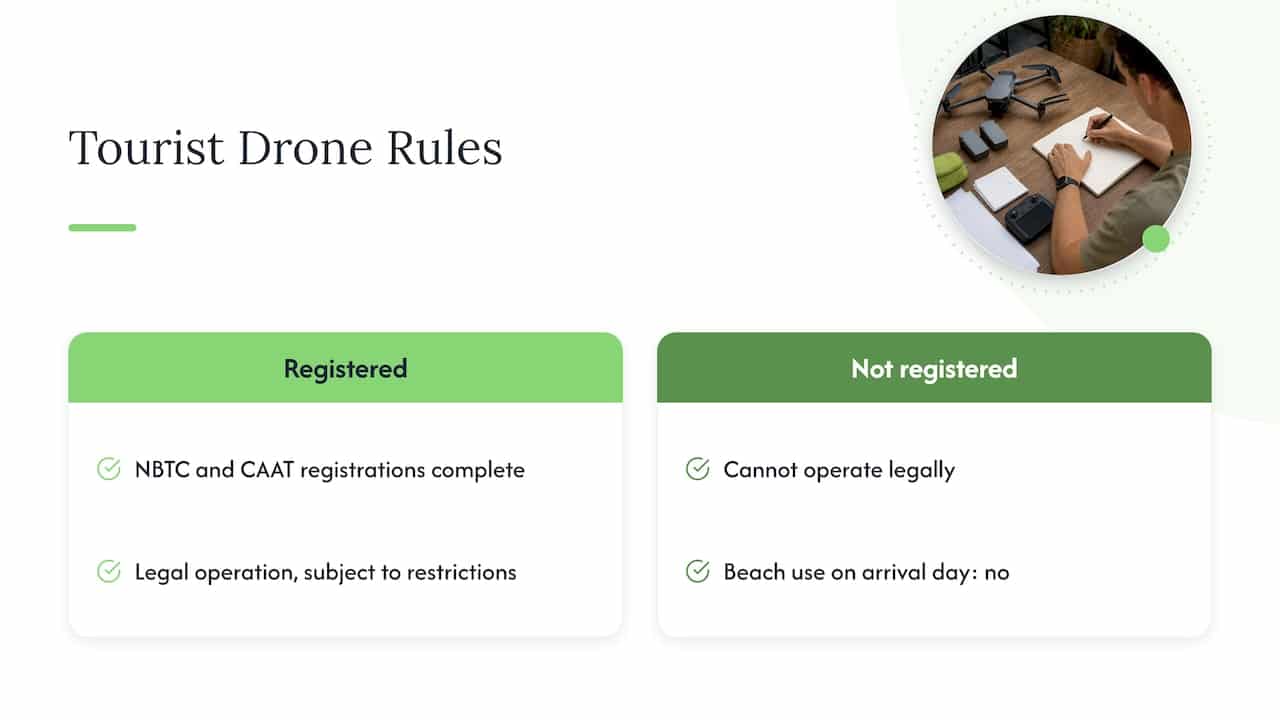
The key point for visitors: bringing a drone into the country is not the same as being allowed to fly it. Thailand’s tourist guidance says you may bring a drone in, but you cannot operate it legally until the NBTC and CAAT registrations are complete.
So the honest answer to “can I use my drone in Phuket?” is: yes, if you have done the paperwork, and no if you plan to take it out of the bag at the beach on arrival day.
Registration: NBTC, CAAT and who needs what
Thailand uses two regulators, and it helps to keep them apart.
| Body | What it covers | Who must register |
|---|---|---|
| NBTC (telecoms regulator) | The drone’s radio equipment | All drones, whatever the weight, use or camera |
| CAAT (civil aviation authority) | The aircraft and the pilot | Drones with a camera, and drones over 2 kg |
| Minister of Transport | Written approval | Drones over 25 kg |
This split comes from the NBTC registration FAQ. Because almost every consumer drone has a camera, assume you need both.
CAAT registration step by step
CAAT directs applicants to register the drone and the pilot through the UAS Portal. In practice:
- Create your account on the UAS Portal and register yourself as the pilot.
- Register each drone you plan to fly.
- Sort out your insurance (see below).
- Display the approved registration number on the drone.
Foreign visitors should know that you need a Thai SIM card after arrival to receive the one-time password for the portal, according to a guide on registering as a foreigner. That means you cannot always finish everything from your home country, so plan a day or two of admin before your first flight.
Insurance and labelling
Operators need third-party liability insurance with minimum cover of 1 million baht. The official tourist guidance says this can be arranged in Thailand or abroad.
The approved registration number must also be visible on the drone. CAAT’s pre-flight information sheet sets a minimum character size of 3 mm for drones under 25 kg. A small printed label or engraved tag does the job.
Do you need a separate permit to fly?
Registration is one thing, and telling CAAT about the flight is another. The official guide says operators must submit the flight details (area, date, time and purpose) through the UAS Portal at least three days before the flight, as set out in the February 2026 tourist guide.
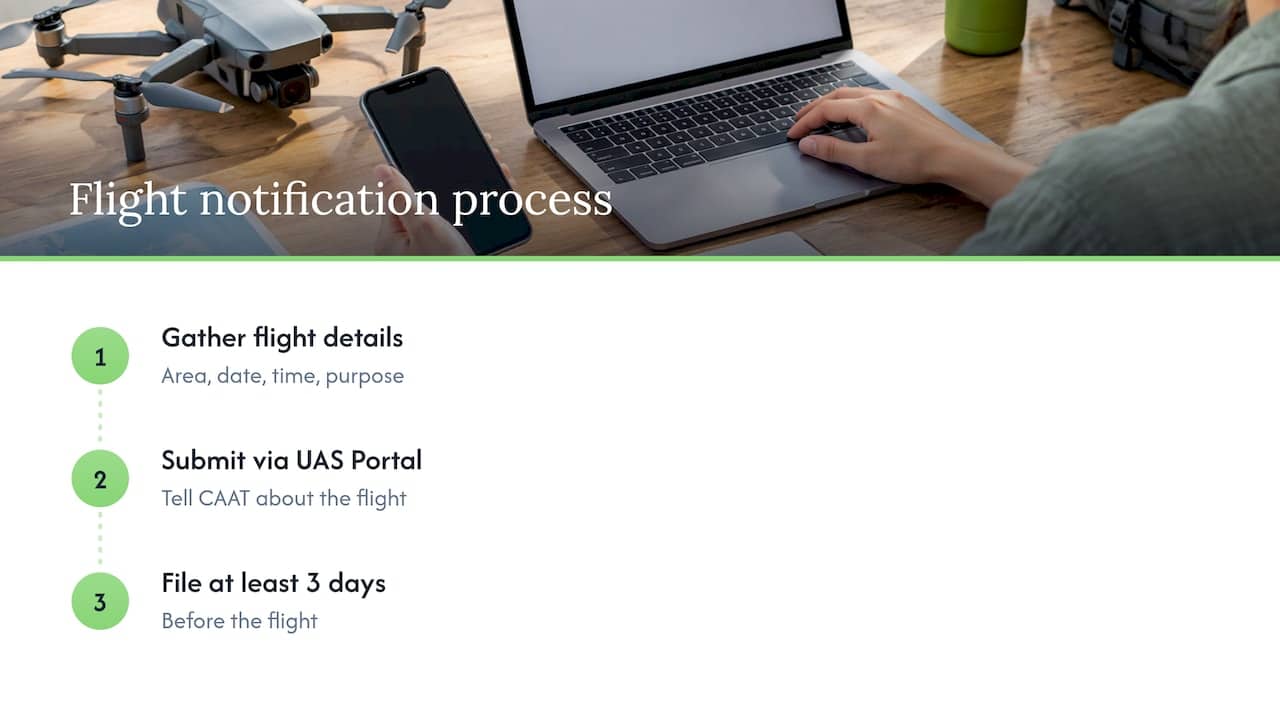
That three-day lead time matters for holidaymakers. If you want a sunrise clip on day two of a week-long trip, you have already missed it unless you filed before you left. Build the filing into your plan, and check the portal for the current process, because CAAT adjusts its notices over time.
The flying rules in plain English
Hours and height
The official guide sets these windows:
- 06.00 to 18.00: allowed, up to a maximum of 90 metres (about 300 feet).
- 04.01 to 05.59 and 18.01 to 24.00: only with prior approval.
- 00.01 to 04.00: prohibited.
In practice that means golden-hour sunset flights in Phuket are often a grey area. Sunset in Phuket falls close to 18.00, so a flight that runs past it needs approval. Flights above 90 metres also need prior written approval.
Sight and weather
Flights must be in daylight and clear weather, and you must keep the drone within your own line of sight. Using FPV goggles or the onboard camera alone to navigate is not allowed, per the tourist guidance. During the monsoon months, when squalls roll in fast over the Andaman Sea, that clear-weather rule is a sensible safety margin as well as a legal one.
People, buildings and sensitive sites
The same guidance restricts flights over urban areas, gatherings, government buildings, hospitals and military zones unless authorised. For a beach holiday, the practical version is simple: do not fly over crowded beaches, hotel pools or people who have not agreed to be filmed. Privacy complaints are the quickest way for a harmless flight to turn into a problem.
Penalties
The official guide states that violations can lead to imprisonment of up to one year, a fine of up to 40,000 baht, or both. A few minutes of footage is not worth that.
Where you cannot fly around Phuket
Airports
Flights are prohibited within nine kilometres (five nautical miles) of designated airports and airstrips, with 14 designated in total, according to the official tourist guide. Phuket International Airport sits in the north of the island, so a wide arc of the north is affected. Check your exact spot on a map with a 9 km radius drawn from the airport before you launch. Do not rely on your drone’s built-in geofence alone.
National parks and famous islands
Much of what visitors come to Phuket for is in national park territory. According to a local Phuket drone guide, Maya Bay, the Similan Islands, Phang Nga Bay (including James Bond Island) and the Sirinat National Park beaches (Mai Khao, Nai Yang, Nai Thon) are areas where drones are banned. Park rules are separate from aviation law, so having your CAAT and NBTC papers does not give you permission to fly there.
If you are planning island days, the table below shows how it plays out.
| Place | Drone outlook |
|---|---|
| Maya Bay, Phi Phi | National park: leave the drone in the bag |
| James Bond Island, Phang Nga Bay | National park: no launching from boats |
| Similan Islands | National park: no drones on day trips or liveaboards |
| Mai Khao, Nai Yang, Nai Thon | Park rules and airport zone overlap |
| Quiet coast outside parks and 9 km zone | Possible, with registration and the standard rules |
Also remember the seasonal closures on top of the drone rules. Our guide to the Maya Bay closure and where to go instead explains how park dates affect your island plans.
Temporary restrictions
CAAT notices are dynamic and are adjusted as national security assessments change, as shown in CAAT’s own regulatory notice. That is why you should recheck the official pages in the week you travel rather than rely on a blog post from last year, including this one.
Flying from a boat or a jet ski
Tour days are where most visitors get tempted, and where most mistakes happen. A few practical points:
- Boats usually sail through park waters. If your route takes in Phang Nga Bay, Phi Phi or the Similans, the drone stays packed from departure to return.
- Launching from a moving vessel breaks the basics. Keeping the drone in sight while a boat moves, rocks and turns is hard, and you also need a safe, legal take-off area.
- Jet skis are no place for a drone. You need both hands and full attention on the water. Our guide to Phuket jet ski distance limits covers the rules that apply on the water.
- Ask before the trip. Tell your tour operator or skipper what you are carrying so you can agree where it travels and whether any stop is suitable.
If you want aerial-style footage with no paperwork, an action camera on a pole, or a photo stop planned with your guide, gets great results without the legal risk.
Taking a drone on the plane
People also ask whether a drone can go in carry-on. For Thailand’s airlines and airports, CAAT’s dangerous goods guidance points the same way as most aviation rules:
- Lithium-ion batteries up to 100 Wh are permitted. Batteries above 100 Wh and up to 160 Wh need operator approval, per CAAT’s dangerous goods manual.
- Portable electronics with lithium batteries should travel as cabin baggage where possible. If they are checked, they must be protected from damage and completely switched off (same manual).
- Spare, loose batteries belong in carry-on, with the terminals protected against short circuits, according to CAAT’s safety bulletin. It advises keeping original packaging, taping exposed terminals, or putting each battery in its own pouch or bag.
Check your airline’s own policy too, since carriers can be stricter than the regulator, and read your departure airport’s rules as well.
Pre-trip checklist
This condenses the official checklist:
- Drone registered with NBTC and CAAT, pilot registered, registration number displayed.
- Third-party insurance of at least 1 million baht in place.
- Flight details filed on the UAS Portal at least three days ahead.
- Site outside the 9 km airport zone and every national park or restricted area.
- Daylight, clear weather, drone in sight, under 90 metres.
- Batteries packed in cabin baggage with terminals protected.
- Official pages rechecked in the week you fly.
Our view on drones and island days
We spend our days on the water around Phuket, and we see what visitors want: the big view of the islands, the turquoise colours and the limestone cliffs. We understand why a drone is on the packing list.
Our honest advice is to treat the drone as a separate project from your tour day. Do the registration at home, fly on a quiet stretch outside the parks and the airport zone, and let your island trip be about being there. Our itineraries are planned so that you spend your time on the experience: snorkelling, swimming, a jet ski ride or a cultural stop, with a crew that handles the logistics.
If you want memories from the water, our guides know the best photo stops on each route and can tell you how to get great shots on your phone or action camera. That is the kind of local help we are proud of.
Carl
Make the island day easy
If you would rather leave the flying rules behind and simply enjoy the islands, we run guided trips with hotel pick-up, from island tours in Phuket to jet ski and ATV adventures. Our customers rate us 4.5 from 237 reviews, and our site cites a 99% issue-free rate verified by Trustindex.

Browse the full range of tours in Phuket, or message us on WhatsApp for last-minute availability.
FAQ
Can I use my drone in Phuket?
Yes, once the drone and you are registered with the right authorities and the flight meets the daylight, height and sight rules. You cannot fly it inside the 9 km airport zone or in national park areas. Check the official pages shortly before you travel.
Do I need a permit to fly a drone in Thailand?
Beyond NBTC and CAAT registration, operators are asked to submit flight details (area, date, time and purpose) on the UAS Portal at least three days before flying. Night flights and flights above 90 metres need prior written approval.
Can I take my drone as carry-on luggage?
Yes, and carry-on is the right place for it. CAAT guidance says spare lithium batteries must travel in the cabin with their terminals protected. Batteries over 100 Wh and up to 160 Wh need operator approval, so confirm with your airline.
Can I fly a drone at James Bond Island or Maya Bay?
No. These are national park areas where drones are banned, according to local drone guidance. Keep the drone packed on island tours and use a phone or action camera instead.
What happens if I break the rules?
The official penalty is up to one year in prison, a fine of up to 40,000 baht, or both. Park rangers can also act on park rules, so it pays to get the details right first.
Sources
- Flying a Drone in Thailand: Updated Guide for Tourists from 6 Feb 2026
- Updated Guide for Tourists Regarding Flying a Drone in Thailand
- NBTC drone registration FAQ
- CAAT: Important things to know before using drones
- CAAT: Remotely Piloted Aircraft (RPA) Regulation
- How to register your drone in Thailand as a foreigner
- CAAT regulatory notice
- CAAT dangerous goods manual
- CAAT safety bulletin on lithium batteries
- Flying a drone in Phuket: spots, rules and no-fly zones


