
Kayak Weight Limits in Phuket: How to Check Before You Paddle
There is no single weight limit for kayaks in Phuket. The limit belongs to the kayak: a child’s single can be rated for 40 kg, while a two-seat touring kayak sold in Thailand is rated for 300 kg. What matters is the total load, meaning everyone aboard plus bags, water and camera gear, against the rating of the specific boat you will sit in. Below we show typical ranges, a simple way to do the sums, and the questions to ask any Phuket operator before you pay.
TL;DR
- Capacity is per model, not per island. Rated loads run from about 40 kg for a children’s kayak to 300 kg for a two-seater, and tandem and fishing models go higher.
- The rating covers people and gear together. Add every paddler, passenger, dry bag and bottle of water.
- Leave a margin. Most guidance suggests staying at roughly 70 to 80% of the maximum, which keeps the boat steadier and faster.
- Ask before you book. On a guided trip, tell the operator the weights of everyone in your group and ask which kayak each person will be in.
- Wear a life jacket that fits your weight, and check the sea and weather on the day.
Table of Contents
- What “weight limit” means on a kayak
- Typical kayak weight limits by type
- How to work out whether you are within the limit
- What to expect when you kayak in Phuket
- Safety checks if you are close to the limit
- Can beginners kayak in Phuket?
- Our perspective: ask about weight early
- Book a Phuket trip that fits your group
- Quick checklist before you paddle
- FAQ
- Sources
What “weight limit” means on a kayak
A kayak’s weight limit, also called maximum load or capacity, is the most the manufacturer says the boat can carry safely. It is not the weight of the kayak itself. One guide to kayak limits says the figure covers the paddler and gear, including accessories such as seats and motors, and excludes the kayak (Kayak Scout).
For two or three people in one boat, the rating is shared. Gumotex’s official specification for its three-person Thaya inflatable lists a 230 kg maximum load, with room for two adults and one child (Gumotex). That 230 kg includes the people and everything they bring, so three adults with bags would not fit inside it.
Two more points trip people up:
- The maximum is not the target. A boat loaded to its rated limit sits low, turns slowly and takes on water more easily in chop.
- Weight is not the only limit. A kayak also has a seat count. A 300 kg two-seater is still a two-seater, however light the passengers are.
Typical kayak weight limits by type
Manufacturers publish very different numbers, so treat any table as a guide for what to expect and not as a replacement for the plate or the spec sheet on the boat you will use.
A comparison from a kayak-equipment brand gives these ranges: 250 to 350 lb for recreational kayaks, 350 to 500 lb for touring, 200 to 300 lb for whitewater, 350 to 600 lb for fishing, 200 to 300 lb for inflatables and 500 to 700 lb for tandems (Hiseadock). In kilograms, that is roughly 113 to 159 kg for recreational boats and 227 to 318 kg for touring boats.
| Kayak type | Typical stated capacity | Rough kilogram equivalent |
|---|---|---|
| Recreational sit-on-top | 250 to 350 lb | about 113 to 159 kg |
| Touring / sea kayak | 350 to 500 lb | about 159 to 227 kg |
| Inflatable | 200 to 300 lb | about 91 to 136 kg |
| Fishing | 350 to 600 lb | about 159 to 272 kg |
| Tandem | 500 to 700 lb | about 227 to 318 kg |
Real models show how wide the spread is:
- Children’s kayak: the Blue Runner Kid Kayak 180, sold by a Thai retailer, is rated for one seat and 40 kg (Rigger Thailand).
- Two-seat recreational kayak: the Blue Runner Couple Seat 380 lists a 300 kg maximum load (Blue Runner).
- Sea kayaks: P&H’s model list shows stated paddler limits from 70 kg for the Volan 156 and 80 kg for the Virgo LV up to 140 kg for the Volan 162 and Cetus HV (P&H Sea Kayaks). Small-volume boats are built for smaller paddlers, so a lighter limit is not a flaw.
- Inflatables: Aqua Marina lists 110 kg for its one-person Memba ME-330 and 180 kg for the two-person ME-390 (Aqua Marina).
The takeaway: a heavier paddler should look for a wider, higher-volume or tandem boat, and a child should never be placed in an adult single just because there is a free seat.
How to work out whether you are within the limit
You only need a calculator and honest weights.
- Add up the people. Every adult and child who will be in the boat.
- Add the gear. Dry bag, water, camera, snacks, a spare change of clothes, fishing kit if you have it. A litre of water weighs about a kilo, so it adds up.
- Compare with the rating. Find the manufacturer’s maximum for that model.
- Apply a margin. One calculator suggests dividing your total load by 0.7 to find the minimum rated capacity you should look for (PaddleSizer). Another guide recommends staying below about 80% of capacity (Kayak Help). These are rules of thumb, not regulations, and they agree on the idea: do not load to the maximum.
A worked example
Two adults weighing 82 kg and 68 kg, with 8 kg of bags and water, make a 158 kg load. Divide by 0.7 and you get about 226 kg. That pair would be comfortable in a tandem rated for 300 kg. The same pair would be too close to the edge in a recreational boat rated for 180 kg, even though 158 kg is technically under the limit.
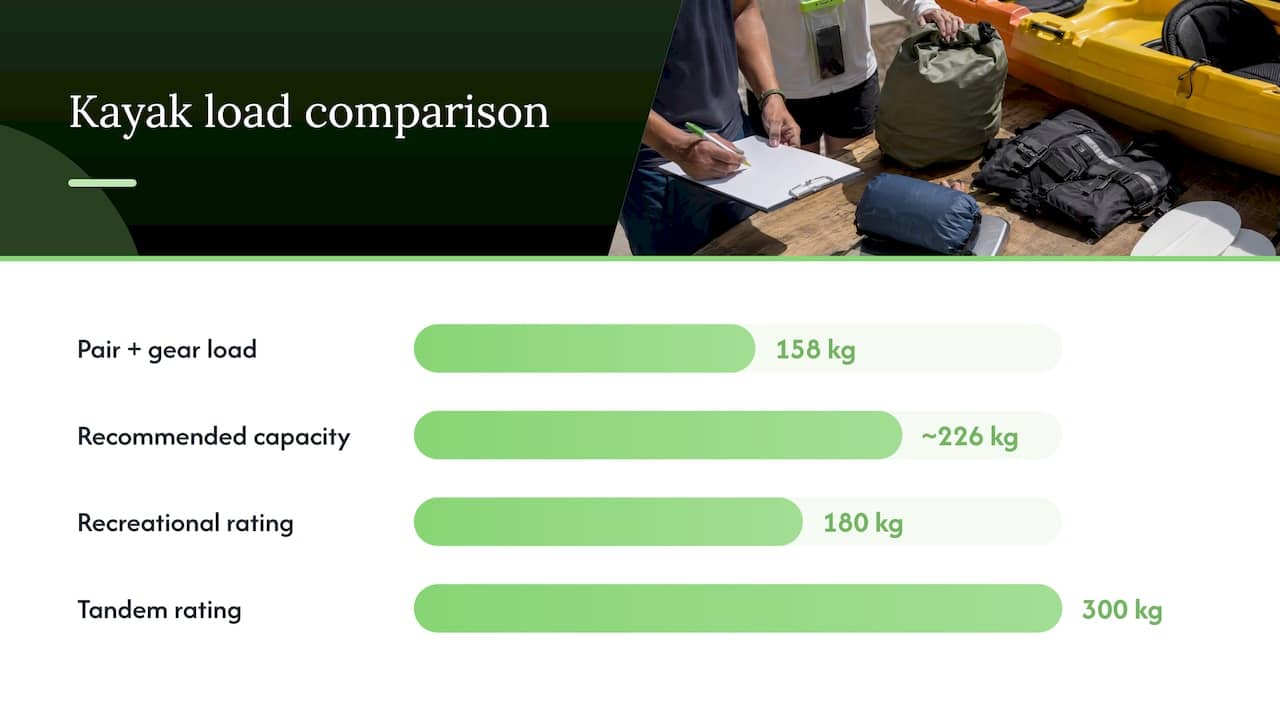
The same calculator describes the effect: at 70 to 85% of rated capacity a kayak is slower with less freeboard, and above 85% it is unsafe in wind or waves (PaddleSizer). Freeboard is the height of the boat’s side above the water, and in Phuket’s warm but sometimes choppy sea it is what keeps splashes out of your lap.
Where to find the number
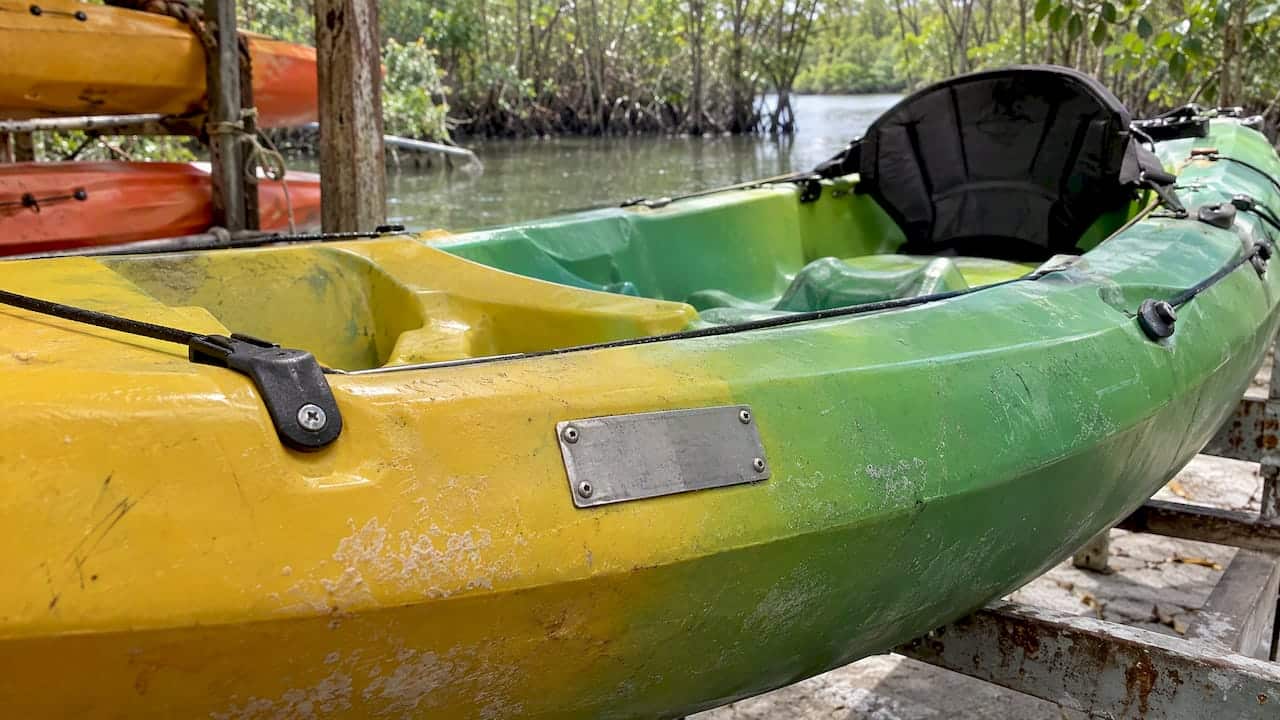
Look for a capacity plate or sticker on the boat, then the manual or product page. If neither is there, one paddlesports guide says to check with the dealer, manufacturer catalogues or website, or call the manufacturer (Boat-Ed). Ohio’s paddling safety guidance gives the same advice: follow the manufacturer’s people-and-gear recommendation, and do not overload or unevenly load the kayak (Ohio DNR).
What to expect when you kayak in Phuket
You can kayak in Phuket in two broad ways, and the weight question looks different for each.
Hiring a kayak by the hour at a beach or mangrove. These are usually basic sit-on-top or recreational boats, often rented with a lifejacket and little paperwork. Few will show a capacity plate, so you need to ask. If a staff member looks surprised that you asked, that is a sign to pick a larger boat or go elsewhere.
Joining a guided kayak tour. Many Phang Nga Bay and sea-cave trips use tandem or inflatable canoes where a guide does much of the paddling. The load rating still applies, because the guide’s weight, yours, your partner’s and your bags all sit in one boat. This is where groups mixing adults and children should speak up early.
If you are choosing between boat styles, our guide to canoe vs kayak in Phuket explains which suits couples, families and first-timers. For route difficulty, tides and fitness, see matching your fitness to Phuket kayak routes.
Questions to ask any operator
- What is the rated capacity of the exact kayak my group will use?
- Who sits in which boat, and does that include the guide?
- Is there a weight or age rule for children and for the heaviest paddler?
- Will we carry bags in the kayak, and is there a dry storage option on the support boat?
- What happens if the sea is rough or it rains?
A good operator answers these quickly. If you are trying to find a paddling experience that fits your group size and boat capacity, a curated tour guide for planning paddling trips shows the sort of details worth comparing, such as group size and pace, even though it covers a different country.
Safety checks if you are close to the limit
If the numbers say you are near the rated capacity, change something before you launch.
- Pick a bigger boat. Moving from a single to a tandem, or from one tandem to two kayaks, is the simplest fix.
- Spread the weight. A government boating guide advises distributing passengers and load evenly and stowing heavy items as low as possible (NSW Government).
- Lighten the load. Leave the extra camera bag and the big cooler on shore.
- Wear the right life jacket. Thailand’s official safety guidance says to always wear a life jacket appropriate for your weight when travelling by water (Thailand.go.th). A child’s jacket on an adult, or the other way round, does not do the job. Our life jackets and safety guide covers fit in more detail.
- Read the flags. The same guidance says a red flag means the beach is closed and swimming is strictly prohibited, while black-and-white chequered flags mark zones for watercraft such as kayaks and surfboards, not swimmers (Thailand.go.th).
- Skip the rain. The guidance also says not to play in the water while it is raining (Thailand.go.th). In monsoon season, a heavily loaded kayak is the first boat to feel a squall, so read our notes on Phuket boat trip weather before you go.
What about the “50/90 rule”?
You may see this in searches next to kayak weight. It is a cold-water safety guideline about hypothermia risk, not about how much a boat can carry, so it will not tell you a capacity. In Phuket’s warm water it is rarely the concern. Use the load sums above instead.
Can beginners kayak in Phuket?
Yes. Most guided kayak trips and short beach or mangrove hires suit beginners, because the water is typically calm in sheltered bays and a guide does the hard work. What a beginner should check:
- Fit: can you sit comfortably, reach the paddle and get in and out unaided? A boat that is too small or too tight is harder to handle.
- Capacity: use the sums above, especially when paddling with a child.
- Conditions: tides and wind change the day. Ask about them when you book.
- Swimming: you do not need to be a strong swimmer on a guided trip, but you should be comfortable in a life jacket and tell the guide if you are nervous.
Our perspective: ask about weight early
We run adventure and sightseeing trips around Phuket every day, including jet skis, ATVs and boat excursions, and the same pattern shows up on all of them: the best trips are the ones where weight and group makeup were mentioned at the start. Guests are sometimes shy about it. Please don’t be. Operators ask because the answer decides which boat, which vehicle or which seat is right for you, not to judge anyone.
That is why we publish limits where they matter. Our page on ATV weight limits in Phuket explains exactly what to check before booking, and the same logic applies to kayaks: find the rating, add everyone’s weight and gear, and leave a margin. If a group is near the line, the answer is almost always a second boat or a bigger one, not squeezing in. We would rather rearrange a trip on WhatsApp the day before than discover the problem at the pier.
We also keep an eye on the sea. Thrill is great, but safety margins come first, and weather can change what is sensible on a given morning. Our guests rate us 4.5 from 237 reviews, and Trustindex verifies a 99% issue-free rate, which comes from this kind of planning more than anything else.
— Carl
Book a Phuket trip that fits your group
If you want a day on the water with the details handled, we offer adventure and cultural tours in Phuket and nearby islands with hotel pick-up, flexible last-minute booking, and online or WhatsApp checkout. Kayak tours, sunset trips and bioluminescent tours sit alongside island hopping to places such as James Bond Island, Phi Phi and the Racha and Coral Islands. Browse our Phuket island tours, look at private boat tours if your group includes children or mixed weights and you want your own space, or see our full range of tours. Message us your group’s details and we will help match the right boat and trip. If you are also packing for the day, our boat trip packing list covers what to bring and what to leave behind, and our guide to private boat capacity in Phuket explains how many guests a boat can legally carry.
Quick checklist before you paddle
- Find the kayak’s rated capacity and the seat count.
- Add every person and every bag, then stay around 70 to 80% of the maximum.
- Check that children are in boats and life jackets sized for them.
- Spread the load evenly and keep heavy items low.
- Check the flags, the sky and the tide, and postpone if it is raining or rough.
- Tell the guide about any health condition, fear of water or weight concern.
FAQ
Can we do kayaking in Phuket?
Yes. Phuket and nearby Phang Nga Bay have kayaking in sheltered mangroves, sea caves and lagoons, either on guided trips or with short hire at some beaches. Choose a guided trip if you are new to the sea. Always ask for the capacity of the boat you will use.
What is the average weight limit for a kayak?
It depends on type. Recreational kayaks are commonly rated at about 250 to 350 lb (113 to 159 kg), touring kayaks at 350 to 500 lb and tandems at 500 to 700 lb, according to one equipment maker’s comparison. Children’s boats can be as low as 40 kg. Always use the figure for the exact model.
Does the weight limit include gear?
Yes. The rating covers people and equipment together, not the kayak’s own weight. Add bags, water and cameras to your body weight, then leave a margin of roughly 20 to 30% below the maximum.
What should I do if I am near the limit?
Switch to a larger or tandem kayak, split the group across two boats, or carry less. Spread the weight evenly and keep heavy items low. Wear a life jacket suited to your weight.
Sources
- Kayak Scout: Kayak weight limit
- Gumotex: Thaya
- Hiseadock: How much do kayaks weigh
- Rigger Thailand: Blue Runner kayaks
- Blue Runner: 2-seat kayak
- P&H Custom Sea Kayaks
- Aqua Marina: Memba
- PaddleSizer: kayak weight capacity calculator
- Kayak Help: weight limit for kayaking
- Boat-Ed: knowing your paddlecraft’s capacity
- Ohio DNR: paddling safety
- NSW Government: loading your vessel
- Thailand.go.th: safety measures on waterways and beaches


