
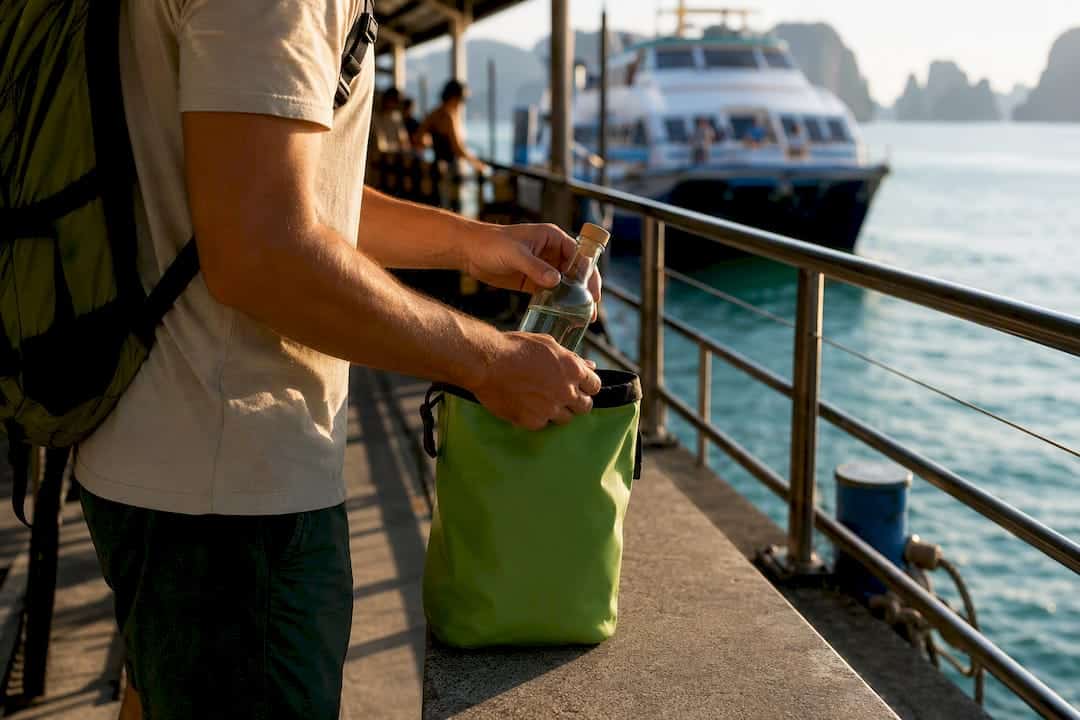
From May 12, 2026: Thailand boat alcohol rules for Phuket travelers
No, you cannot drink or buy alcohol on public passenger boats or at public piers in Thailand: national rules that took effect on 12 May 2026 list both as prohibited places. Crew face an even stricter, effectively zero-tolerance standard while on duty. Private, pre-booked charters can set their own house rules, but everyone aboard still answers to national and port law.
TL;DR:
- Alcohol sales and consumption are now prohibited at all public piers and passenger boats nationwide since May 12, 2026, with some local variations like Phuket.
- Crew members face near-zero tolerance for alcohol on duty, risking suspension or removal from service regardless of criminal penalties.
- Enforcement primarily targets open containers, disorderly conduct, and illegal sales, especially during busy departure times or holidays.
- Travelers should treat public piers and passenger vessels as dry zones and only consume alcohol on private charters where policies are agreed upon beforehand.
- Private boat operators can set their own alcohol rules, but passengers must confirm policies before booking and follow crew instructions to avoid penalties.
Table of Contents
- What the law says about alcohol on boats and piers
- Rules for crew and vessel operators under Marine Department guidance
- How enforcement and penalties actually play out
- Practical advice for travellers heading out on the water
- How Phuket operators and Qbic Travel handle alcohol rules locally
- Want alcohol allowed under clear house rules? Here’s what Qbic Travel offers
- Sources
- FAQ
What the law says about alcohol on boats and piers
The legal backbone here is the Alcoholic Beverage Control Act, B.E. 2551, Thailand’s 2008 law that gives a national control committee the power to designate where and when alcohol can be sold or consumed. It doesn’t ban drinking everywhere: it lets the committee draw up specific lists of prohibited places, prohibited times and prohibited sales conditions, then attaches penalties to breaking those lists.
For years, boats and piers weren’t consistently on that list. That changed in May 2026, when new notifications added public piers and public passenger boats to the roll of prohibited places, alongside seven other categories. The rules took effect on 12 May 2026, and government health pages continue to list fresh notifications, so it’s worth treating this as a living framework rather than a fixed one.
One detail matters a lot for travellers: the Act often separates the ban on selling from the ban on consuming. A vendor caught selling alcohol at a pier faces one set of consequences; a passenger drinking a beer they brought themselves faces another, though both fall under the same prohibited-place designation once a location is listed.
In practice, that means:
- Public piers used for ferry or passenger boat departures are now listed prohibited places for both sale and consumption.
- Public passenger boats, including scheduled ferries, fall under the same designation while underway or docked.
- The distinction between “sale” and “consumption” affects who gets penalised, a vendor, a passenger, or both, but doesn’t change the basic fact that alcohol shouldn’t be sold or drunk in these spaces.
Government notification listings show the pattern is accelerating. Health ministry pages list a string of amendments from 2015 through 2026 that keep adding new categories of prohibited places and sale-time restrictions, several marked as new for the current legal year. The Government Gazette holds the definitive text, and it’s the first place to check if a rule seems to have shifted again.
Rules for crew and vessel operators under Marine Department guidance
Passengers face one layer of rules. Crew face another, tighter one. The Marine Department’s Rule on Seafarer’s conducts B.E. 2564, issued in 2021, sets conduct standards for anyone working on a Thai-registered vessel, and alcohol sits near the top of that list.
The rule points towards breath and blood-alcohol guidance for seafarers, with an effectively zero-tolerance standard while on duty. That’s noticeably stricter than the rules for road drivers, where the legal limit is commonly cited as 0.05% BAC, or 50 mg%. Marine environments carry different risks: currents, sudden weather changes and passenger safety all depend on a sober crew, so the stricter line makes sense even without a single unifying statute spelling out an exact number for every vessel type.
What this means for crew and operators in practice:
- Breach of the seafarer conduct rule can lead to suspension of a Certificate of Competency, the document that lets someone legally work as crew.
- Administrative sanctions, including removal from active service, sit alongside or instead of suspension, depending on the severity.
- Enforcement here runs through the Marine Department and port authorities, a separate track from the criminal penalties under the Alcoholic Beverage Control Act, so a crew member can face departmental discipline even where no criminal charge follows.
The upshot: your captain and crew have far less room to drink on the job than you do as a passenger, and that’s by design.
How enforcement and penalties actually play out
Two systems run in parallel, and it helps to know which one applies to you. Under the Alcoholic Beverage Control Act, selling alcohol or allowing consumption in a prohibited place carries criminal penalties, with fines and, in some cases, imprisonment set out in the Act’s penalty provisions for breaches of prohibited-place and prohibited-time rules. These are the same criminal provisions that apply to any other designated prohibited place in Thailand, not a boat-specific carve-out.
Crew and operators face a different, administrative track under Marine Department rules: licence suspension, removal from service, or other sanctions tied to the seafarer conduct standard rather than a criminal court.
In practice, enforcement tends to follow visible triggers rather than random checks. Open containers on a busy pier, disorderly behaviour, or a vendor openly selling drinks near a ferry queue are the situations most likely to draw attention from port staff or police.
- Open alcohol containers at a public pier or on a passenger boat are an obvious enforcement trigger.
- Disorderly or unsafe behaviour onboard tends to prompt a much faster response than quiet, sealed-bottle possession.
- Vendors selling alcohol within a prohibited zone face the most direct criminal exposure under the Act.
- Spot-checks at busy departure points, particularly around holidays, are where most enforcement activity concentrates.
None of this means a sealed bottle in your bag is risk-free everywhere, but the pattern of enforcement gives you a reasonable sense of what actually draws official attention.
Practical advice for travellers heading out on the water
The safest approach is simple: treat public piers and public passenger boats as dry zones, and save any drinking for a private, pre-booked charter that has agreed its own alcohol policy with you in advance.
If you’re carrying alcohol at all, keep it sealed and packed away rather than open in your hand. A bottle in checked luggage or a dry bag draws none of the attention that an open can does at a ferry queue. Once you’re on a public passenger boat, treat it the same way you’d treat a plane: no drinking, sealed items only, and save the celebration for later.
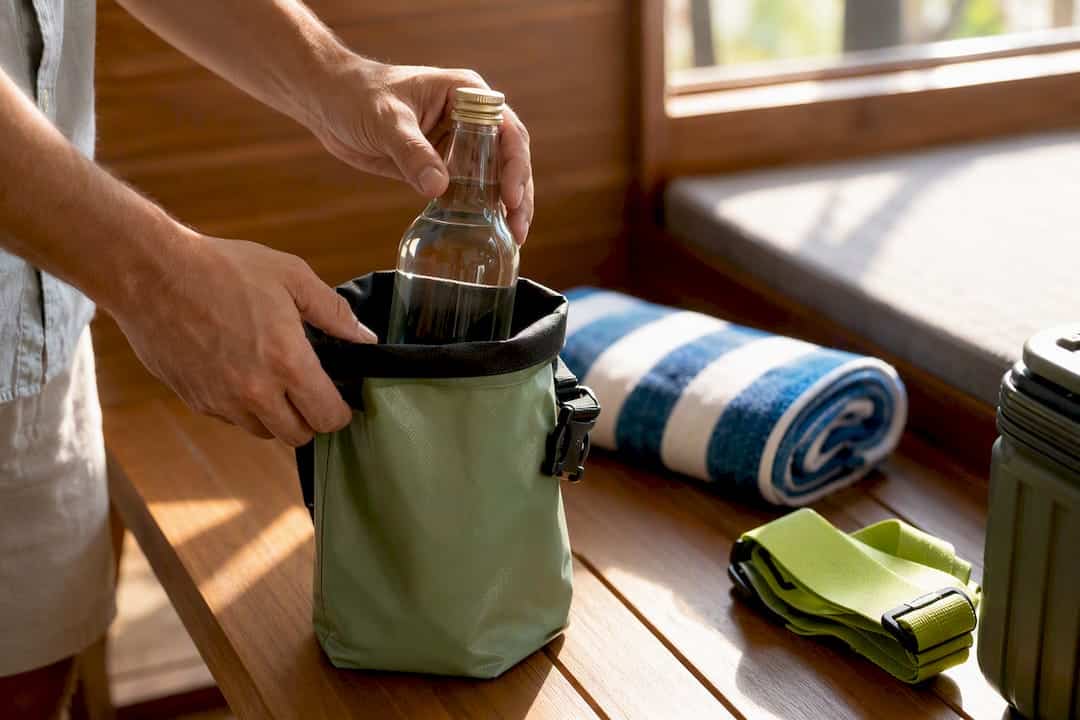
Private charters and tour boats work differently. Because they’re not public passenger services, operators can set their own house rules on alcohol, and many do, particularly on longer day trips or sunset cruises. That flexibility is exactly why it’s worth confirming policy before you pay a deposit rather than assuming.
A short checklist before you board:
- Ask the operator directly whether alcohol is permitted onboard and under what conditions.
- Pack any alcohol sealed, and leave open containers off the pier and off the boat entirely.
- Confirm the policy again with crew as you board, since written terms and on-the-day practice don’t always match.
- Follow crew instructions without argument if you’re asked to stop drinking or put a bottle away.
- Keep the mood calm if a member of staff or an official raises the issue: a polite response ends things faster than a debate.
Pro Tip: Screenshot your charter operator’s written alcohol policy when you book, so you’ve got it to hand if anyone onboard questions what was agreed.
How Phuket operators and Qbic Travel handle alcohol rules locally
Phuket has its own history with this issue. Local reporting once noted that Phuket authorities left alcohol policy on private tour boats largely to individual operators, rather than imposing a blanket local ban. The May 2026 national designation of public piers and public passenger boats changes the baseline everywhere, Phuket included, even where local practice had previously been looser.
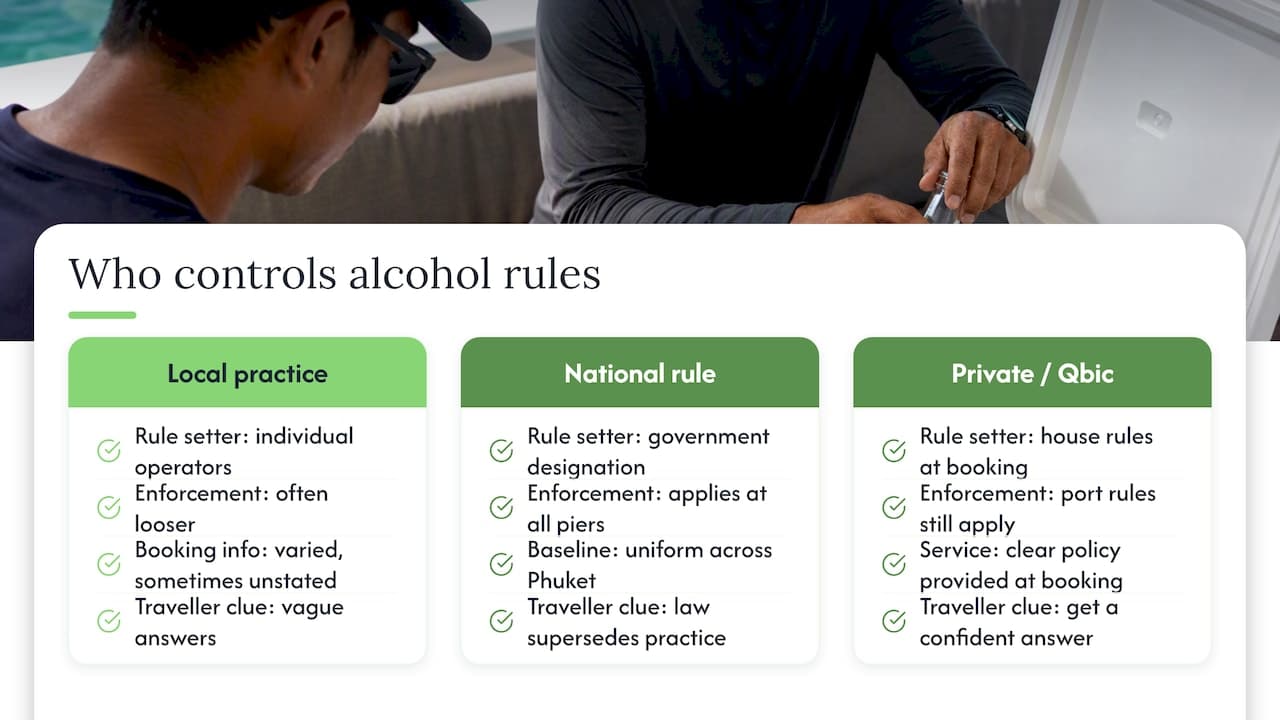
Private-boat options are often built around agreed house rules set at the time of booking, so travellers know what’s allowed before stepping onboard, rather than finding out halfway through the day. That’s a service standard we apply consistently, not a way around national law: port and alcohol-control rules still apply to every vessel, private or public.
Before you commit to a trip anywhere on the island, ask directly: is alcohol permitted, are there time or quantity limits, and what happens if the crew asks you to stop. A confident, specific answer is usually a good sign.
— Carl
Want alcohol allowed under clear house rules? Here’s what Qbic Travel offers
If a dry ferry ride isn’t what you had in mind for your island day, a private charter gets you a boat where the alcohol policy is agreed upfront rather than left to chance. Qbic Travel’s private boat charters let you set the plan with your crew before you leave the dock, from a relaxed sunset run to a full day around the islands.

Our Phuket private boat tours work the same way: you agree the itinerary and the onboard policy with your operator before departure, which is a very different experience from queuing at a public pier under the new restrictions. For something livelier, the Ibiza party boat is built specifically around a managed onboard atmosphere, though national and port rules still apply to that vessel just as they do to any other.
A few things worth knowing before you book:
- Private charters can set house rules on alcohol, but crew and vessel still operate under Marine Department conduct standards.
- Booking ahead lets you confirm the policy in writing, rather than discovering the rules once you’re already at sea.
- It is possible to contact providers to learn what is included and what is expected onboard before paying a deposit.
Browse the full range of boat trips and island tours on our tours page, or get in touch to check availability for your dates.
This article is general information, not a substitute for advice from a qualified lawyer. Consult a qualified legal professional about your own circumstances before acting on anything here.
Sources
- Thailand introduces new alcohol restrictions in 8 places
- Alcoholic Beverage Control Act, B.E. 2551 (Unofficial translation)
FAQ
Can I drink alcohol while on a boat in Thailand?
It depends on the type of boat. On public passenger boats and at public piers, drinking and selling alcohol has been prohibited since new rules took effect on 12 May 2026; on a private, pre-booked charter, the operator can set its own house rules, agreed with you at booking.
What is the new alcohol rule in Thailand for 2026?
From 12 May 2026, national notifications add public piers and public passenger boats to the list of prohibited places for alcohol sale and consumption under the Alcoholic Beverage Control Act. The change sits alongside seven other newly listed categories and applies nationwide, Phuket included.
What is the 2-2-2 rule for alcohol consumption?
There’s no official “2-2-2 rule” in Thai alcohol law: definitions circulating online vary and don’t tie back to the Alcoholic Beverage Control Act or Marine Department rules covered here. If you’ve seen the term used for boating in Thailand, treat it as informal shorthand rather than a legal standard.
Is it allowed to drink alcohol in public in Thailand?
Drinking in public isn’t banned everywhere, but the Alcoholic Beverage Control Act lets the control committee designate specific prohibited places and times, which now include public piers and public passenger boats. Outside those designated zones, local practice and specific venue rules still apply, so it’s worth checking before you assume a spot is fair game.
Do crew face stricter alcohol rules than passengers on Thai boats?
Yes. The Marine Department’s Rule on Seafarer’s conducts sets an effectively zero-tolerance standard for crew on duty, well beyond the everyday rules that apply to passengers, with breaches risking suspension of a crew member’s Certificate of Competency.


