

Temperatures in Thailand: what UK travellers need to know
Thailand’s temperatures stay warm year-round, ranging from around 18°C to 38°C depending on the region and season. The country runs on three main seasons, and knowing which one you’re travelling in changes everything from what you pack to which coast you head for.
Here’s the quick picture:
-
Cool/dry season (mid-October to mid-February): The best all-round window for most travellers. Daytime highs generally warm and comfortable, with lower humidity and mostly blue skies.
-
Hot season (mid-February to mid-May): The most intense heat of the year, with inland areas experiencing high temperatures, along with increasing UV and humidity towards May.
-
Rainy season (mid-May to mid-October): Generally warm and punctuated by heavy downpours, especially June–September. Not as off-putting as it sounds, but sea conditions can disrupt coastal tours.
Typical daytime highs by destination:
-
Bangkok: Warm with higher temperatures in March–May, cooler December–January.
-
Chiang Mai: Variable temperatures with cooler nights in December.
-
Phuket: Moderate temperatures year-round, influenced by the sea; the Met Office currently shows around 30°C.
-
Koh Samui: Warm year-round, with wetter peaks in October–November when Phuket is drying out.
Table of Contents
-
What are Thailand’s three seasons and what does each feel like?
-
Where can you check live temperatures and forecasts for Thailand?
-
The weather shapes the experience more than most travellers expect
What are Thailand’s three seasons and what does each feel like?
Understanding Thailand’s seasonal structure is the single most useful thing you can do before booking flights. The three seasons don’t follow a neat calendar split, and the south behaves differently from the north.
Cool/dry season: mid-October to mid-February
This is peak travel season for good reason. Temperatures are warm but manageable, humidity drops noticeably, and rainfall is minimal across most of the country. Mornings in Chiang Mai can feel genuinely fresh. Phuket and the Andaman coast are at their calmest, with flat seas ideal for island trips and snorkelling. Bangkok is pleasant for sightseeing without the punishing midday heat of spring.
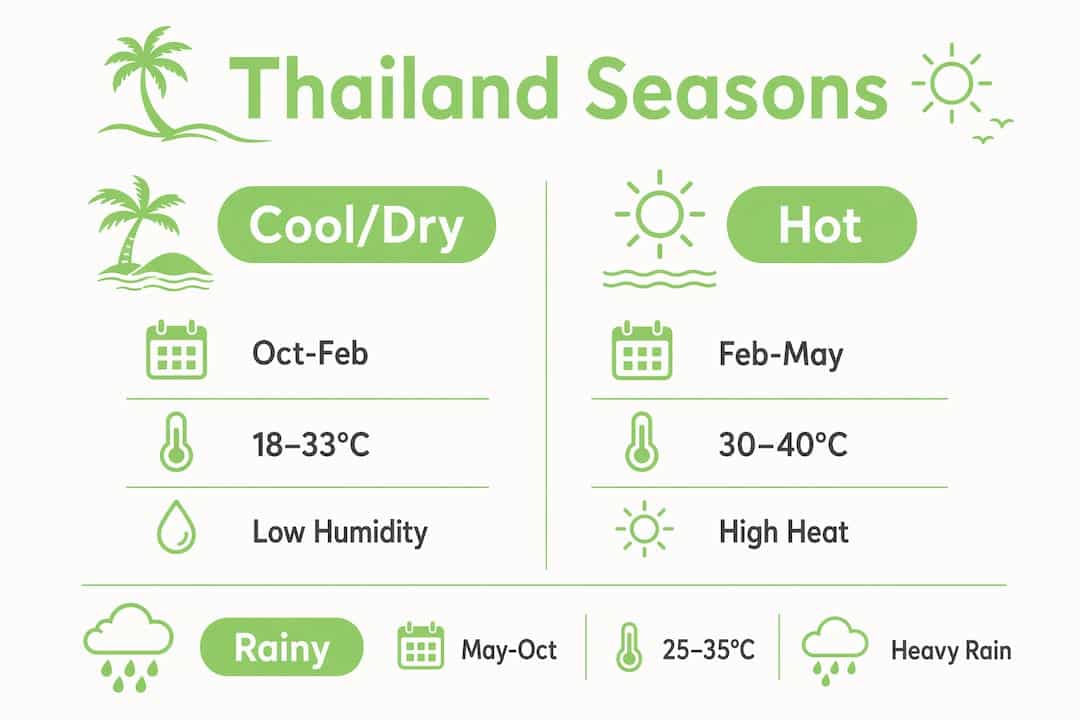
Hot season: mid-February to mid-May
Pre-monsoon heat builds steadily from February, peaking in April. This is when Thailand’s famous Songkran water festival falls (mid-April), which makes perfect sense given the temperatures. Inland cities like Bangkok and Chiang Mai bear the brunt, regularly hitting 36–38°C. Coastal areas stay slightly cooler thanks to sea breezes, but the UV index is extreme across the whole country.

Rainy season: mid-May to mid-October
The southwest monsoon sweeps in from the Andaman Sea, bringing heavy afternoon showers and occasional multi-day downpours. Air temperatures stay warm (27–32°C), but humidity makes it feel hotter. The Andaman coast (Phuket, Krabi) takes the heaviest rain, while the Gulf coast (Koh Samui, Koh Phangan) stays drier until October–November when the northeast monsoon reverses the pattern.
| Season | Typical dates | Temp range | Humidity | Best for |
|---|---|---|---|---|
| Cool/dry | Mid-Oct to mid-Feb | 18–33°C | Low–moderate | Beaches, trekking, sightseeing |
| Hot | Mid-Feb to mid-May | 18–38°C | Moderate–high | Festivals, budget travel |
| Rainy | Mid-May to mid-Oct | 18–38°C | High | Lush scenery, fewer crowds |
How do temperatures vary by region across Thailand?
Thailand stretches over 1,600 km from north to south, so regional differences in temperature are significant. The World Bank Climate Knowledge Portal identifies distinct climatic zones across the country, from tropical savanna in the north to tropical rainforest along the southern coasts.

Monthly average temperature ranges (°C) by region
| Month | Bangkok (high/low) | Chiang Mai (high/low) | Phuket (high/low) | Koh Samui (high/low) |
|---|---|---|---|---|
| January | Warm with cooler nights | Mild with cooler nights | Warm with moderate nights | Warm with mild nights |
| February | Warm day and night | Warmer day and night | Warm day and night | Warm day and night |
| March | Warm day and night | Warm day and night | Warm day and night | Warm day and night |
| April | Hot day and warm night | Hot day and warm night | Warm day and night | Warm day and night |
| May | Warm with increasing humidity | Warm day and night | Warm day and night | Warm day and night |
| June | Warm and humid | Warm and humid | Warm and humid | Warm and humid |
| July | Warm and humid | Warm and humid | Warm and humid | Warm and humid |
| August | Warm and humid | Warm and humid | Warm and humid | Warm and humid |
| September | Warm with some cooling | Warm with some cooling | Warm with some cooling | Warm and humid |
| October | Warm with transition to drier | Warm with transition | Warm and humid | Warm with transition |
| November | Warm and drier | Mild and drier | Warm and drier | Warm and humid |
| December | Warm and drier | Mild and cooler nights | Warm and drier | Warm and mild nights |
Key regional differences to know:
-
Chiang Mai and the north show the widest temperature swings. December and January nights can drop to 12–15°C in the highlands, so pack a light layer for evening treks even if daytime feels warm.
-
Bangkok sits inland on the central plain and absorbs the full force of the hot season. April is brutal, often hitting 35–36°C with high humidity.
-
Phuket benefits from sea breezes that keep temperatures moderate year-round. The Andaman coast rarely drops below 22°C at night, even in December.
-
Koh Samui follows the Gulf coast pattern: its wettest months are October–December, when the northeast monsoon arrives, while the Andaman side is drying out.
Record context: Thailand’s all-time temperature record is held in the northern regions. Coastal resorts rarely approach extreme temperatures, but inland April heat can be intense.
The Asian Development Bank’s climate risk profile for Thailand confirms that the Andaman and Gulf coasts follow different rainfall calendars, which is why the two coasts can have opposite weather in the same week.
What’s the weather like month by month in Thailand?
Use this as a quick planning reference. Temperatures are daytime highs unless stated.
-
January: Cool and dry across most of Thailand. Bangkok sits around 32°C; Chiang Mai mornings are crisp at 13°C. The Andaman coast is at its best. Koh Samui can still see lingering northeast monsoon showers.
-
February: Warming up, still low humidity. One of the most comfortable months for Bangkok sightseeing. Phuket seas are calm and clear. Pack light layers for Chiang Mai evenings.
-
March: Heat building fast. Bangkok hits 34°C+. Excellent for the Andaman coast before the rains arrive. Chiang Mai can reach 35°C by afternoon.
-
April: The hottest month almost everywhere. Songkran (Thai New Year water festival, 13–15 April) falls here, which is both a highlight and a reason to expect crowds and heat. Stay hydrated and limit midday outdoor activity.
-
May: The southwest monsoon begins. Phuket and Krabi start seeing afternoon showers. Still warm (33–34°C) but humidity climbs. The Gulf coast (Koh Samui) remains relatively dry.
-
June: Monsoon in full swing on the Andaman side. Lush green scenery, fewer tourists, lower prices. Sea conditions can be rough. Koh Samui is a smart alternative.
-
July–August: Peak rainy season for Phuket. Heavy downpours, typically in the afternoon. Temperatures hold at 31–32°C. Monsoon conditions can produce waves of 1–3 metres off exposed coasts, affecting boat tours.
-
September: Often the wettest month on the Andaman coast. Not ideal for Phuket island trips. Bangkok can flood. Northern Thailand starts to cool slightly.
-
October: Transition month. Andaman coast begins drying out; Gulf coast picks up rain from the northeast monsoon. Chiang Mai cools to pleasant 32°C days.
-
November: A favourite month for many travellers. The Andaman coast is coming back to life with sunny days and calming seas. Koh Samui can still be wet. Bangkok is lovely at 31°C.
-
December: Peak season. Cool, dry, and sunny almost everywhere except the Gulf coast. Chiang Mai nights dip to 13°C. Phuket is at its most reliable for boat trips and water sports.
Packing essentials by season:
-
Cool/dry season: Light cotton clothing, a thin layer for Chiang Mai evenings, reef-safe sunscreen (SPF 50+), sunglasses.
-
Hot season: Breathable fabrics, electrolyte sachets, a hat, high-SPF sun protection, and a reusable water bottle.
-
Rainy season: A compact rain jacket or poncho, quick-dry clothing, grippy sandals for wet surfaces, and waterproof bags for electronics.
Which activities suit which season and temperature?
Matching your activity to the season makes a real difference to how much fun you have.
Beaches and water sports
The Andaman coast (Phuket, Krabi, Phi Phi) is at its best from November to April. Seas are calm, visibility underwater is excellent for snorkelling and diving, and air temperatures hover at a comfortable 30–33°C. May to October brings rougher conditions on this coast. The Gulf coast (Koh Samui, Koh Tao) flips the calendar: it’s drier and calmer from February to September, making it a solid wet-season alternative when Phuket is soggy.
For Phuket island day trips, the sweet spot is November through April. Jet ski tours, boat excursions to James Bond Island, and snorkelling at Raya and Coral Islands all run most reliably in these months.
Hiking and northern treks
Chiang Mai and the northern highlands are most comfortable for trekking from November to February. Temperatures are warm in the day (28–30°C) but evenings are genuinely cool, which makes multi-day treks far more enjoyable. March and April bring intense heat that makes long uphill walks genuinely taxing. The best time for ATV tours in Phuket follows a similar logic: early morning slots in the hot season, and dry-season months for the most comfortable trail conditions.
Festivals and cultural events
-
Songkran (April): Expect extreme heat alongside the celebrations. Hydration is non-negotiable.
-
Loy Krathong (November): Coincides with the cool season’s arrival. Chiang Mai’s lantern festival (Yi Peng) is one of the most spectacular events in Southeast Asia, and the weather is ideal.
-
Vegetarian Festival, Phuket (October): Transition weather, warm and occasionally wet, but manageable.
Health and acclimatisation tips:
-
Drink at least 2–3 litres of water daily in the hot season; more if you’re active outdoors.
-
The UV index in Thailand regularly hits 11–12 (extreme) from February to October. Reapply sunscreen every two hours.
-
Acclimatise for the first 24–48 hours before attempting strenuous activities, especially if arriving from the UK in winter.
-
Watch for signs of heat exhaustion: dizziness, nausea, and stopping sweating are signals to get into shade and cool down immediately.
Pro Tip: Schedule outdoor activities before 10am or after 4pm during the hot season. Midday heat between April and June is genuinely dangerous for extended outdoor exertion.
Where can you check live temperatures and forecasts for Thailand?
Getting accurate, up-to-date information before and during your trip is straightforward if you use the right sources.
-
Thai Meteorological Department: The primary official source for Thailand. Provides daily forecasts, marine bulletins, and storm warnings by province. Essential for checking sea and wind conditions before a boat trip.
-
Met Office Thailand page: The UK’s own Met Office carries a Thailand country page with current temperatures for major cities including Bangkok, Chiang Mai, and Phuket. Useful for a quick pre-departure check and general travel alerts.
-
Tourism Authority of Thailand: Province-level weather summaries and seasonal overviews. Good for planning at the destination level rather than day-by-day forecasting.
-
World Bank Climate Knowledge Portal: Best for understanding long-term climate patterns and regional differences rather than short-term forecasts.
-
International weather apps (Windy, AccuWeather, Weather.com): Cross-reference these with the Thai Meteorological Department for sea and wind data. Apps sometimes lag behind local marine bulletins on rapidly changing coastal conditions.
What to look for beyond air temperature:
-
Wave height: Anything above 2 metres off exposed coasts typically affects boat tour operations.
-
Wind speed: Strong offshore winds can make jet ski and speedboat trips uncomfortable or unsafe even when the sky looks clear.
-
Thunderstorm probability: Afternoon thunderstorms are common in the rainy season and can develop quickly. Check the afternoon forecast, not just the morning one.
UK travellers should cross-check Thai official forecasts with the Met Office for general travel alerts, but rely on local Thai sources for fine-grained sea and port warnings.
What local Phuket operators know about weather and bookings
Running tours on the water every day gives you a different perspective on Thailand’s weather than any forecast app can offer.
Busiest and most reliable months for Phuket boat trips:
-
November to April is the prime window. Seas are calm, visibility is high, and cancellations are rare. December and January are the most booked months, so advance reservations are strongly recommended.
-
May and October are transition months. Weather can swing either way, and flexibility matters more than a fixed itinerary.
-
June to September is the low season on the Andaman coast. Tours still run on good days, but last-minute flexibility is essential. Sheltered bays can remain viable when open-water routes are rough.
What actually causes cancellations:
Air temperature almost never cancels a tour. What does is wave height and wind speed. Operators monitor Thai Meteorological Department marine bulletins daily, and trips are rescheduled when offshore waves exceed 2 metres or winds push beyond safe comfort thresholds. This is a safety-first decision, not a commercial one.
Booking advice:
-
Book in advance for November–February, particularly over Christmas and New Year.
-
In the shoulder months (May, October), opt for operators who offer flexible rescheduling rather than rigid departure times.
-
Last-minute bookings work well in June–September if you’re comfortable adapting your plans to daily conditions.
Key takeaways
Thailand’s cool/dry season (mid-October to mid-February) offers the best combination of comfortable temperatures, calm seas, and reliable tour conditions for most UK travellers visiting Phuket and the Andaman coast.
| Point | Details |
|---|---|
| Best travel window | Mid-October to mid-February brings 18–33°C days, low humidity, and calm Andaman seas. |
| Hottest months | April peaks at 36–38°C inland; coastal areas stay slightly cooler but UV is extreme. |
| Regional differences | Chiang Mai nights drop to 12–15°C in December–January; Phuket stays above 22°C year-round. |
| Gulf vs Andaman coasts | The two coasts follow opposite rainfall calendars; when Phuket is wet, Koh Samui is often dry. |
| Qbictravel tours | Qbictravel’s Phuket jet ski and island boat tours run most reliably November–April; flexible booking available for shoulder months. |
The weather shapes the experience more than most travellers expect
Most guides treat Thailand’s seasons as a simple traffic-light system: green for cool/dry, amber for hot, red for rainy. The reality is more interesting than that.
The rainy season on the Andaman coast is genuinely dramatic. Afternoon storms roll in fast, the jungle turns an almost unreal shade of green, and the tourist numbers drop enough that you can actually enjoy Phuket’s quieter side. Some of the best diving visibility of the year comes in the weeks just before the monsoon peaks, when the water is warm and the plankton blooms haven’t yet reduced clarity. The hot season in April is brutal, but Songkran is one of the most joyful events in Southeast Asia, and the heat is part of what makes it feel so earned when someone douses you with cold water.
What I’d push back on is the idea that there’s one universally “best” month. The smarter question is: best for what, and where? A family wanting calm seas and easy island trips should target November–February on the Andaman coast. A solo traveller who wants to trek in the north without sweating through every shirt should aim for December–January in Chiang Mai. Someone chasing a bargain and happy to adapt daily plans around the weather can find real value in June or September.
The one thing that genuinely catches people out is the gap between air temperature and sea conditions. A warm, partly cloudy day in July can still mean 2-metre swells that make a boat trip inadvisable. Always check the marine forecast, not just the temperature.
Book a weather-smart tour in Phuket with Qbictravel
Knowing when to go is only half the picture. Booking with an operator who monitors conditions daily and adjusts accordingly is what turns a good trip into a great one.

Qbictravel’s jet ski tours in Phuket and island boat excursions are designed around the Andaman coast’s seasonal rhythms. The prime window runs November through April, when seas are calm and visibility is at its best for routes to James Bond Island, Phi Phi, and Raya Island. In the shoulder months, flexible rescheduling means you’re not locked into a date that the weather decides to ruin. Qbictravel holds a 4.5-star rating from 237 verified reviews, with 99% issue-free services confirmed by Trustindex. Check availability for your travel dates and get in touch via WhatsApp for weather-aware booking advice tailored to when you’re arriving.
Useful sources and live trackers
Keep these bookmarked before and during your trip:
-
Thai Meteorological Department: Daily forecasts, marine bulletins, and storm warnings by province. The most granular source for sea and wind conditions.
-
Met Office Thailand: Current temperatures for major Thai cities and general travel weather alerts, useful for UK travellers pre-departure.
-
Tourism Authority of Thailand: Province-level seasonal summaries and average temperature ranges for trip planning.
-
World Bank Climate Knowledge Portal: Long-term climate data, regional zone maps, and projected trends for Thailand.
-
Asian Development Bank Climate Risk Profile: Detailed analysis of regional climate differences, including Andaman vs Gulf coast rainfall patterns.
-
UK Foreign Travel Advice: Official UK government travel alerts and safety guidance for Thailand, including weather-related advisories.
-
Qbictravel tour booking: For weather-aware tour options in Phuket matched to your travel dates.
This article provides general travel information about Thailand’s climate. Always confirm current conditions with official sources and consult the Thai Meteorological Department or your tour operator for up-to-date sea and weather warnings before activities.
